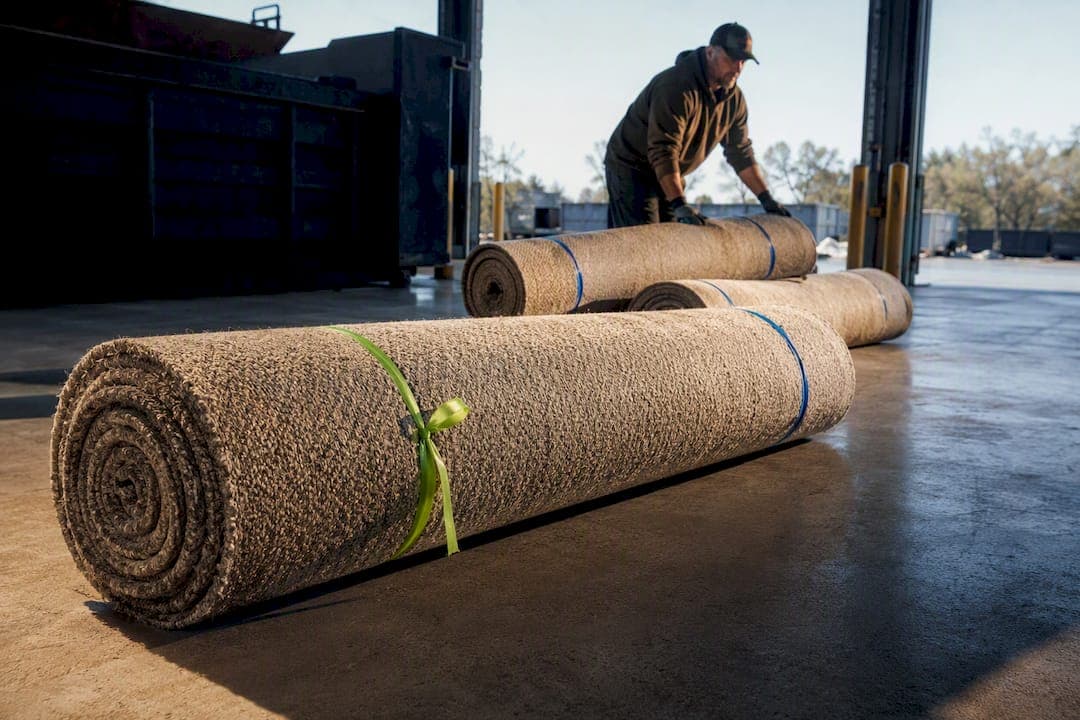
If your carpet is clean and dry, donate or rehome it first. If it's stained, wet, or pet damaged, check the Carpet America Recovery Effort collector map for a nearby recycler, then fall back on municipal bulk pickup or a transfer station. When those routes are full, unavailable, or the load is too big to move yourself, hiring a licensed hauler is the fastest, least frustrating option left.
TL;DR:
- Carpet must be clean, dry, and free of stains, odor, or mold to be accepted for recycling or donation, otherwise it is likely to be rejected.
- Recycling options depend heavily on regional availability, with most residential carpet still ending up in landfills due to limited processing capacity.
- Municipal bulk pickup and transfer stations often restrict carpet based on weight and contamination, requiring callers to confirm rules beforehand.
- Hiring a licensed hauler or junk removal service is often the fastest and most reliable way to dispose of stained, pet-damaged, or heavy carpets that cannot be recycled.
- Repairing or donating clean, recent carpet remnants to Habitat for Humanity ReStore, animal shelters, or local swap networks offers environmentally friendly alternatives to landfill disposal.
Table of Contents
- How Do You Assess Old Carpet Before Choosing a Disposal Method?
- Where Can You Recycle Old Carpet, and Does It Actually Get Recycled?
- What Are the Rules for Municipal Bulk Pickup and Transfer Stations?
- Will Your Flooring Installer or Retailer Take the Old Carpet?
- Can You Donate or Upcycle Carpet Instead of Throwing It Away?
- How Do You Safely Remove Carpet Yourself Before Disposal?
- What Does Each Carpet Disposal Option Cost, and How Long Does It Take?
- When Does Hiring a Junk Removal Service Make the Most Sense?
- What Do 15 Years of Carpet Pickups Teach You About Getting Rid of It Right?
- Book a Pickup Instead of Chasing Down a Recycler
- Where to Check Local Rules Before You Haul Anything
- Sources
How Do You Assess Old Carpet Before Choosing a Disposal Method?
Carpet condition decides everything downstream. Recyclers and donation centers reject soiled, wet, or moldy material almost every time, so a five-minute inspection before you make calls saves you a wasted trip.
Walk the room and check for these things first:
- Stains and odor — pet accidents, water damage, and smoke smell disqualify carpet from most recycling and donation programs.
- Mold or moisture — even a small damp patch under the padding can mean the whole piece gets refused.
- Padding condition — padding is handled separately from carpet by almost every recycler and hauler, and it's rarely reusable.
- Size and weight — measure square footage and estimate weight; a 12x15 room of carpet plus padding typically weighs a moderate amount once rolled.
Clean, dry, intact carpet opens up donation and recycling. Anything else usually means you're paying someone to take it, whether that's a landfill fee or a hauling service.
Where Can You Recycle Old Carpet, and Does It Actually Get Recycled?
Almost every type of carpet fiber, nylon, polyester, and polypropylene, can technically be recycled, but availability depends entirely on where you live. Some regions have active recyclers pulling in high volumes of feedstock; others have none within a reasonable drive, according to BobVila's reporting on carpet disposal.
Your first move should be the Carpet America Recovery Effort collector finder, a national map of participating drop-off and collection sites. Search by zip code, then call ahead. Maps go stale, and a site listed as active might have stopped taking residential loads.
Recyclers generally want:
- Clean, dry carpet with minimal padding attached
- Single-fiber material when possible (mixed carpet and pad is harder to process)
- Rolled carpet, cut into manageable lengths, not loose or folded
Contaminated carpet, stained, wet, or pet soiled, gets turned away at the door more often than not, since Treehugger's coverage of carpet recycling notes that recyclers need clean, uniform material to process economically. A single dirty roll can contaminate an entire load a facility is trying to bale and ship.
Statistic worth knowing: despite genuine environmental demand for carpet recycling, most residential carpet still ends up in a landfill, because local processing capacity simply can't absorb the volume, according to a carpet removal perspective from GreenWaste. Recycling is the right goal. It's just not always the reachable one.
What Are the Rules for Municipal Bulk Pickup and Transfer Stations?
Cities and counties handle carpet differently, and the rules exist for real operational reasons, mainly weight limits on trucks and contamination concerns at transfer stations. Some municipalities flatly refuse carpet at curbside pickup and route residents to specific transfer stations instead, as Hennepin County's green disposal guide spells out.
Before you haul anything to the curb or drive to a facility, do this:
- Call your local solid-waste office and ask if carpet is accepted at bulk pickup or only at a transfer station.
- Ask about bundling requirements — many counties require carpet rolled and tied in sections under a set length, often 4 feet, to be accepted.
- Confirm hours and any voucher system — some counties allow a limited number of free bulky-item pickups per year and charge beyond that.
- Check condition restrictions — wet or moldy carpet is commonly barred from transfer station drop-off entirely.
County pages like Hillsborough County's carpet disposal guidance and Butler County's recycling guide lay out exactly this kind of detail. Read your own county's version before loading anything into a truck.
Will Your Flooring Installer or Retailer Take the Old Carpet?
Installers haul away old carpet on plenty of jobs, but it's rarely automatic. Ask before you sign anything.
- Ask if removal is included in the install quote — some installers bundle it in, others charge a separate haul-away fee per room.
- Ask what happens to the old carpet — some retailers run take-back or recycling programs, but limits often apply to remnants, not full rolls from a whole house.
- Confirm the destination — a straightforward "where does it go" question separates a real recycling partnership from a truck headed straight to a landfill.
If an installer quotes you a fee to haul away old carpet, that's often cheaper and faster than arranging your own drop-off.
Can You Donate or Upcycle Carpet Instead of Throwing It Away?
Reuse beats recycling every time it's an option, since it skips processing entirely, as explained in Refresh Your Space Without the Renovation Headache | One Day Doors & Closets. Clean, newer carpet remnants are often welcomed at outlets that most homeowners never think to call.
- Habitat for Humanity ReStore locations accept new or gently used carpet remnants in good condition, though rules vary by location and current inventory needs.
- Animal shelters frequently take clean, smaller carpet pieces for bedding or crate lining.
- Local swap networks like Freecycle can rehome a usable rug or remnant at zero cost. Be upfront about condition, stains, pet exposure, and size, so nobody drives over expecting something it isn't.
- Upcycle projects — cat scratching posts, garage floor mats, garden path liners, or padding under outdoor furniture all give carpet a second life instead of a landfill slot.
Pro Tip: Photograph the carpet in good light and post exact dimensions before anyone commits to picking it up. Vague listings ("some carpet, decent condition") get ignored; specific ones get claimed within a day.
How Do You Safely Remove Carpet Yourself Before Disposal?
Pulling carpet yourself isn't hard, but it's tougher on your knees and back than most people expect. Here's the sequence that avoids most rookie mistakes:
- Gear up first — gloves, knee pads, and safety glasses matter more than people think, since tack strips and staples hide everywhere.
- Cut it into strips with a utility knife, roughly 3 feet wide, starting at a corner and working across the room.
- Roll each strip as you go rather than leaving it flat; rolled carpet is what most recyclers and transfer stations require anyway.
- Pull the padding separately — it tears easily and almost never gets recycled with the carpet, so bag or bundle it on its own.
- Remove tack strips and staples with a pry bar, and sweep the subfloor before loading anything into a vehicle.
- Keep it dry during transport. A tarp-covered truck bed beats an open one; wet carpet gets rejected at drop-off almost automatically.
What Does Each Carpet Disposal Option Cost, and How Long Does It Take?
Cost and speed move in opposite directions here, and it's worth knowing that before you commit to a plan.
- Free: municipal bulk pickup, if your carpet meets bundling rules and you can wait for the scheduled pickup window, often one to two weeks out.
- Low fee: installer haul-away, usually $50 to $150, coordinated with your new flooring install date.
- Moderate: recycler drop-off (when available) or a small dumpster rental, which runs a flat daily or weekly rate regardless of how much else you throw in.
- Higher: full-service junk removal, priced by volume or by the job, but available same-day in most cases.
Volume and contamination are what push people toward paid services. One room of clean carpet is a weekend DIY project. A whole house of stained, pet-damaged carpet and padding is a different math problem entirely, and it's often where a carpet removal perspective on realistic disposal outcomes lines up with what homeowners actually experience: the ideal option isn't always the available one.
When Does Hiring a Junk Removal Service Make the Most Sense?
Some situations just call for a truck and a crew instead of a weekend of hauling. Whole-house carpet removal, heavy or water-damaged material, no vehicle, or simply no time are the usual triggers.
Before booking anyone, ask:
- Are they insured? A reputable crew carries insurance for damage to your home during removal.
- Do they donate or recycle when possible? Not every hauler bothers; some go straight to landfill regardless of condition.
- How do they charge? By volume, by truckload, or per item, and does that estimate include the padding and tack strips too?
- How fast can they schedule? Same-day or next-day pickup is common with local providers, especially for straightforward jobs.
What Do 15 Years of Carpet Pickups Teach You About Getting Rid of It Right?
Recycling is the goal everyone wants, but the honest truth is that availability varies wildly by zip code, and plenty of homeowners call three "recyclers" before finding one that's actually still taking loads. Plan for that gap instead of being surprised by it.
A few shortcuts that actually help: bundle carpet in 4 foot sections before anyone shows up, and call ahead to ask about condition restrictions instead of guessing. EasyScrap donates and recycles whenever a load allows it, which means the eco-first instinct and the practical outcome usually end up in the same place.
— Easy
Book a Pickup Instead of Chasing Down a Recycler
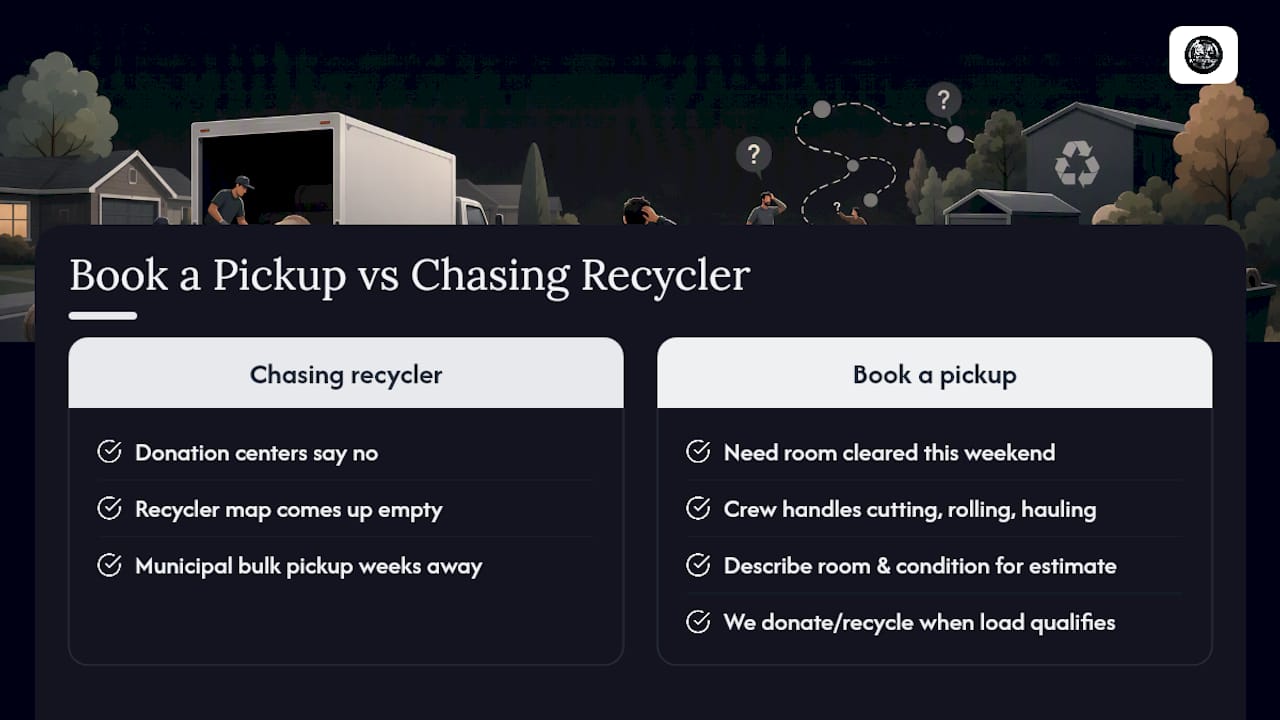
EasyScrap is the practical backstop when donation centers say no, the recycler map comes up empty, or your municipality's bulk pickup window is three weeks away and you need the room cleared this weekend. We serve several local areas with a crew that handles the cutting, rolling, and hauling so you don't have to.
Getting a quote is simple: describe the room size and carpet condition, and we'll give you a straightforward estimate before we show up. We donate and recycle whenever a load qualifies, so you're not automatically sending everything to a landfill just because DIY options ran out. If the job includes more than carpet, old furniture, an appliance, or a full basement cleanout, our junk removal services cover that in the same visit.
Ready to stop chasing down recyclers and just get the room cleared? Request a free quote for junk removal and pick a pickup time that works for you.
Where to Check Local Rules Before You Haul Anything
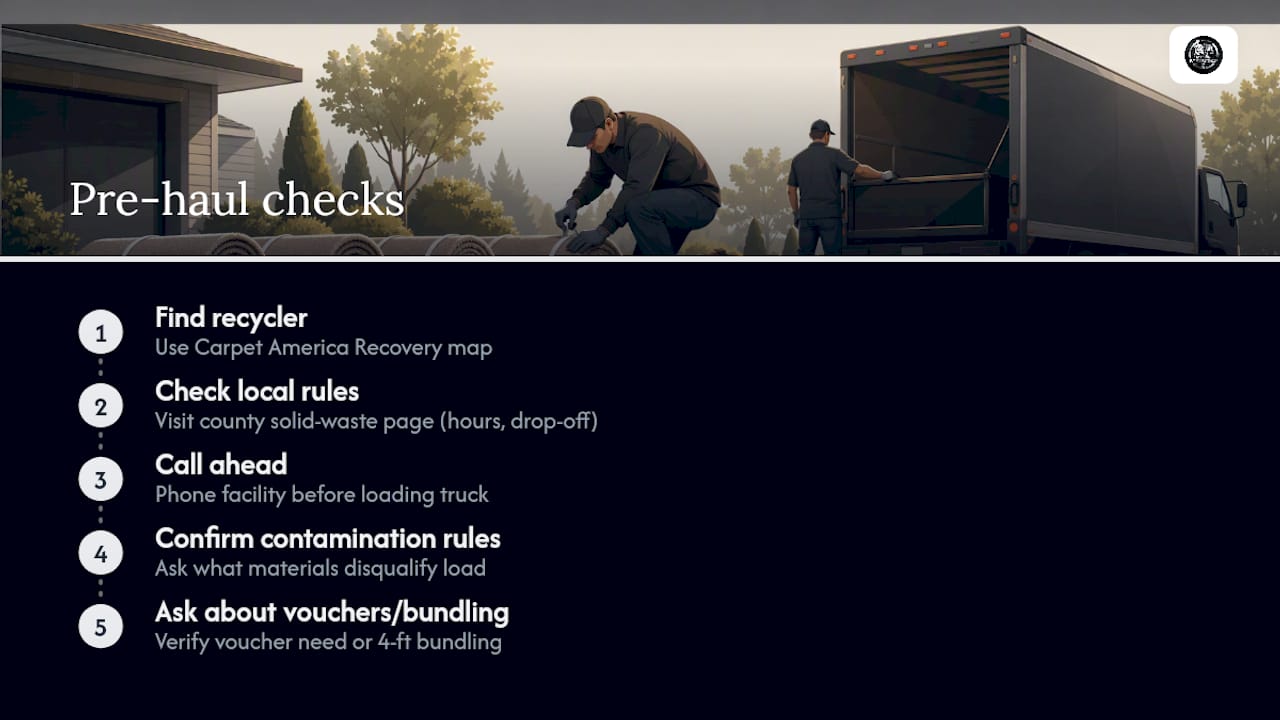
Start with the Carpet America Recovery Effort collector map to find active recyclers near you, then check your county's solid-waste page, like Hillsborough County's guidance, for drop-off rules and hours. Call before you load the truck. Confirm contamination rules, and ask if a voucher or bundling requirement applies to your load.