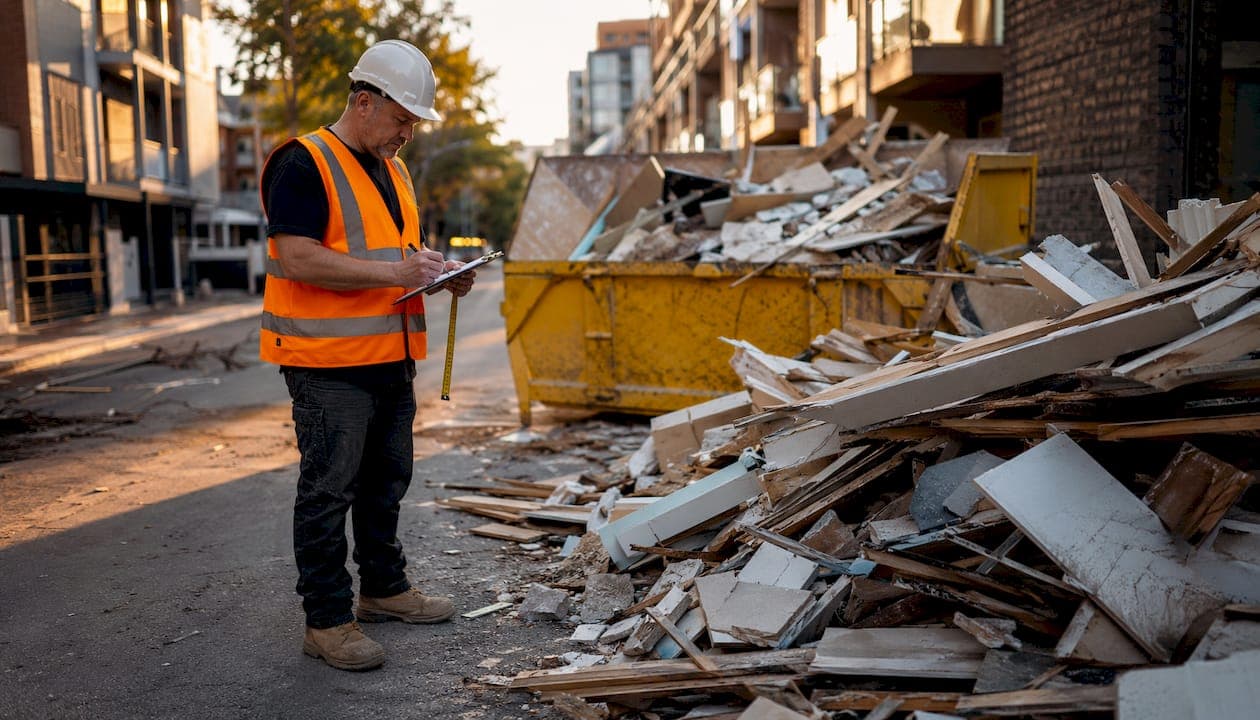
Professional construction debris removal typically runs $300–$1,200 for most residential jobs, with a national average around $450. Before you call anyone, measure your debris volume in cubic yards and get at least three quotes. That single step prevents the most common budgeting mistake: accepting the first number you hear.
Immediate next steps:
-
Measure your debris pile (length × width × height in feet, then divide by 27 to get cubic yards)
-
Pull out any hazardous materials — asbestos, lead paint, refrigerant-bearing appliances — and note them separately
-
Decide whether you want a roll-off dumpster, full-service pickup, or a DIY transfer-station haul
What to have ready when you call a hauler: approximate cubic yards or room dimensions, a material breakdown (concrete, drywall, wood, mixed), photos of the pile and access points, any known hazardous items, and your preferred pickup window.
Table of Contents
What does construction debris removal actually cost?
Professional removal costs between $300 and $1,000 for most residential projects, but that range hides a lot of variation. A bathroom gut costs far less than a whole-house renovation teardown. The table below gives you a fast reference.
| Job Size | Approx. Cubic Yards | Common Service Option | Sample Price Range |
|---|---|---|---|
| Small (bathroom remodel) | 3–6 cu yd | Full-service junk removal | Typically $300–$1,000 per job, with smaller projects toward the lower end of that range |
| Medium (kitchen or single-room demo) | 8–15 cu yd | Roll-off dumpster or full-service | $300–$1,000 for most jobs, with larger and heavier loads possibly exceeding the upper end |
| Large (whole-house renovation) | 20+ cu yd | Roll-off dumpster, multiple hauls | Often $1,000 or more, with some projects reaching several thousand dollars |
Per-unit pricing gives you another way to sanity-check a quote:
-
Per cubic yard: prices vary with material and region
-
Per ton: disposal facility charges vary, often accompanied by hauling fees
-
Per truckload: small truck loads commonly start at modest fees, with full loads costing more
Urban markets like Boston often have higher rates than rural areas due to steeper landfill tipping fees and labor costs. If your project is in a metro area, budget toward the top of any range you see published nationally.

The cost drivers that actually move your quote
Volume is the starting point, but it rarely stays the only factor once a hauler looks at your job. Here is what pushes prices up or down most reliably:
-
Volume (cubic yards): The baseline for almost every quote. More debris means more truck space and more disposal fees.
-
Weight (tons): Heavy materials like concrete, brick, and tile trigger per-ton surcharges. A load that looks like 5 cubic yards of drywall weighs far less than 5 cubic yards of broken concrete.
-
Material type: Mixed C&D loads often cost more to dispose of than single-stream loads. Concrete routed to a C&D processor is cheaper per ton than mixed debris sent to a general landfill.
-
Hazardous materials: Asbestos, certain paints, and refrigerant-bearing appliances require separate handling and can add $150–$300 or more to a job. Never mix these into a general debris load.
-
Accessibility: Stairs, narrow hallways, long carries from a basement or upper floor, and limited truck access all add labor time. Some haulers charge a flat stair fee; others bill by the hour.
-
Local tipping fees: These vary by county and facility. A transfer station in rural New Hampshire charges differently than a facility inside Route 128 in Massachusetts.
-
Labor intensity: Sorting, breaking down large pieces, and loading dense material takes longer. Jobs that require crew time beyond a standard load get billed accordingly.
Pro Tip: Ask every hauler whether their quote includes a weight cap. Many volume-based quotes flip to per-ton billing once the load exceeds a threshold, usually around one ton per cubic yard for heavy materials. Getting that cap in writing before the truck arrives saves real money.
Weight-based surcharges catch people off guard most often on concrete, dirt, and brick. A single cubic yard of concrete weighs roughly 1.5 tons. If your quote is volume-based and you have a pile of broken slab, confirm whether weight overages are included or billed separately.
How haulers price jobs and how to estimate yours
Four pricing models cover most of the market. Understanding which one applies to your job lets you compare quotes on equal footing.

The four pricing models
| Model | How It Works | Best For |
|---|---|---|
| Per cubic yard (volume) | Price × estimated cubic yards | Light mixed debris, drywall, wood |
| Per ton (weight) | Price × actual weight at scale | Concrete, brick, dirt, tile |
| Per truckload (load-based) | Flat fee per truck, quarter to full | Small-to-medium jobs with mixed material |
| Hourly + labor | Crew rate × hours, plus disposal | Complex jobs, tight access, sorting required |
Truck-volume pricing is the most common model for residential jobs. Haulers typically size loads as quarter, half, three-quarter, or full truck. A full standard junk-removal truck holds roughly 10–13 cubic yards.
Converting your measurements into a quote request
-
Measure each debris pile as a rectangular volume: length (ft) × width (ft) × height (ft).
-
Divide by 27 to convert cubic feet to cubic yards.
-
Add 20–25% for inefficient packing (debris rarely stacks perfectly).
-
Identify heavy materials separately. Note how many cubic yards are concrete, brick, or tile versus light mixed debris.
-
Match to truck size. Divide your total cubic yards by 10–13 to estimate how many full truckloads you need.
-
Apply a per-yard or per-ton rate from the table above to get a rough estimate before quotes arrive.
Worked example: A kitchen demo leaves a pile roughly 8 ft × 6 ft × 4 ft. That is 192 cubic feet, or about 7.1 cubic yards. Add 20% for packing inefficiency: approximately 8.5 cubic yards. At $80 per cubic yard, the estimate is around $680 before disposal fees. If the pile includes a concrete countertop, flag that separately for potential weight surcharges.
Extra charges that show up after you agree to a price
The quote you receive is rarely the final number if you have not asked the right questions upfront. These are the fees that appear most often:
-
Minimum charges: Most haulers have a job minimum, often $150–$250, regardless of how small the load is.
-
Tipping fees: The disposal facility charges the hauler per ton or per load. Some haulers include this; others pass it through as a line item.
-
Weight surcharges: When a load exceeds the weight cap on a volume quote, the overage is billed per ton. Concrete and tile are the usual culprits.
-
Hazardous waste handling: Separate disposal path, separate fee. Budget $150–$300+ for items like asbestos-containing materials or refrigerant appliances.
-
Stair and long-carry fees: Basement and attic cleanouts with multiple flights or long distances from the pile to the truck add labor time that haulers bill explicitly.
-
Wait time: If the crew arrives and cannot access the debris (locked gate, items not ready), many companies charge a wait-time fee after 15–30 minutes.
-
Permit and street-closure costs: Placing a dumpster on a public street in many cities requires a permit. In Boston, that can add $50–$150 to the job.
Questions to ask every hauler before you commit:
-
Is disposal included, or is it a separate line item?
-
What is the weight cap on this quote, and what is the overage rate?
-
Are there stair or long-carry fees for my specific access situation?
-
What happens if the load contains hazardous material discovered on pickup day?
-
Is there a permit required for the dumpster placement, and who handles it?
Photograph your debris pile before the crew arrives. If a dispute arises over load size or material type, photos give you a clear reference point.
Which removal method fits your job and budget?
The right method depends on how much debris you have, how fast you need it gone, and how much physical work you want to do yourself.

| Method | Typical Cost Range | Labor Required | Best For |
|---|---|---|---|
| Full-service junk removal | Moderate to higher upfront cost per load | None (crew loads) | Speed, convenience, and mixed loads |
| Roll-off dumpster rental | Moderate cost per container | You load it | Multi-day projects, large volume |
| DIY haul to transfer station | Disposal fees charged per ton at the facility gate | High | Very small loads, budget-conscious |
| C&D processor drop-off | Varies by material stream | Medium | Sorted concrete, wood, metal |
Full-service removal bundles labor, hauling, and disposal into one price. DIY landfill trips cost less per ton at the gate but add your time, vehicle wear, and potential mixed-load surcharges that close the gap fast. For a real-world look at how demolition material disposal plays out on a residential project, the demolition and material disposal process illustrates how sorting decisions made early affect total cost.
When to choose each option:
-
Full-service removal: You need it gone in one day, the debris is mixed, or access is difficult. The labor savings often justify the premium.
-
Roll-off dumpster: You are working over several days or weeks and want to load at your own pace. Rental periods are typically around seven days, adjustable by arrangement.
-
DIY transfer-station haul: Your load is small, you have a truck or trailer, and the material is non-hazardous. Works best for clean single-material loads.
-
C&D processor: You have sorted concrete, brick, clean wood, or metal and want to avoid landfill surcharges on those streams.
Scheduling matters too. Full-service crews can often arrive same-day or next-day for smaller jobs. Dumpster delivery usually needs 24–48 hours of lead time, and permit processing for street placement can add another day or two in urban areas.
How to estimate your job and get three meaningful quotes
Follow these steps before you contact anyone. Haulers give sharper quotes when you hand them specific information rather than asking them to guess.
-
Sketch your debris area. Walk the site and note every location where debris is staged or will be staged.
-
Measure each pile using length × width × height in feet, divide by 27, and add 20% for packing inefficiency.
-
Separate hazardous from non-hazardous. Flag asbestos, lead paint, refrigerant appliances, and chemical containers before any hauler sees the job.
-
Identify heavy materials. Note cubic yards of concrete, brick, tile, or dirt separately from light mixed debris.
-
Choose your preferred method (full-service, dumpster, DIY) so you can request comparable quotes.
-
Prepare your quote request with: total estimated cubic yards, material breakdown, photos of the pile and access points, any hazardous items, desired pickup date, and your address.
-
Contact at least three haulers and send the same information to each so you are comparing equivalent scopes.
-
Compare line by line. Check whether disposal is included, whether there is a weight cap, and whether stair or access fees apply.
Measurement example: A bathroom demo leaves debris in a 5 ft × 4 ft × 3 ft pile. That is 60 cubic feet, or 2.2 cubic yards. Add 20%: roughly 2.7 cubic yards. One quarter-truck load covers it comfortably.
Checklist for your quote request:
-
Photos of the debris pile from two angles
-
Approximate cubic yards (or room dimensions)
-
Material types and any hazardous items
-
Access notes (stairs, distance from truck, parking restrictions)
-
Preferred pickup date and any flexibility
Why Massachusetts rules change your disposal cost
Massachusetts bans a range of C&D materials from standard landfill disposal, which directly affects what you pay and where your debris can go. City of Boston guidance lists asphalt, brick, concrete, treated and untreated wood, and clean gypsum wallboard among materials that require private haulers rather than municipal curbside pickup. That means if you are doing construction debris disposal in Boston, you cannot rely on standard trash service for any of those materials.
At the state level, MassDEP’s C&D waste ban requires that covered materials be diverted to authorized C&D processors rather than general landfills. The practical effect: your hauler must route certain materials to a licensed facility, which changes both the tipping fee and the routing cost. RecyclingWorks Massachusetts notes that C&D processors often offer cost-competitive rates compared with landfill disposal for mixed loads, and that sorted materials sent directly to recycling markets are even cheaper.
A facility like ReSource Roxbury accepts a wide range of non-hazardous C&D materials and can process mixed loads, which makes it a practical option for construction debris disposal in the Boston area. For larger Massachusetts projects, source separation of concrete, metal, wood, and cardboard into dedicated containers sends cleaner streams directly to recycling markets and can reduce net disposal cost compared with mixed-load landfill fees.
Steps to stay compliant and control cost in Massachusetts:
-
Check your city’s public works page for material-specific disposal rules before the project starts
-
Ask your hauler which facility they use and confirm it is a licensed C&D processor for banned materials
-
Consider source separation for concrete, metal, and clean wood on jobs larger than a single room
-
Contact MassDEP or RecyclingWorks MA directly for project-specific guidance on larger demolition jobs
Practical ways to lower your total disposal cost
Most cost savings happen before the truck arrives. The decisions you make during the project, not after, determine how much you pay.
High-impact tactics:
-
Source separate metal, wood, and cardboard. Clean streams go to recycling markets at lower cost than mixed loads. On a large job, this can meaningfully reduce your disposal bill.
-
Donate usable items. Cabinets, fixtures, doors, and flooring in good condition can go to Habitat for Humanity ReStores or similar organizations. That material leaves your site for free. A garage cleanout that includes reusable items is a good example of where donation routing saves money.
-
Consolidate loads. Two half-truck pickups cost more than one full-truck pickup. Stage debris in one location and schedule a single removal when the pile is complete.
-
Schedule off-peak. Mid-week pickups and non-peak seasons sometimes carry lower rates. Ask directly.
Lower-effort tactics:
-
Get at least three quotes and send identical information to each hauler.
-
Photograph your load before pickup to avoid disputes over size or material type.
-
Confirm all fees in writing, including weight caps, tipping fees, and any access surcharges.
-
Ask whether the hauler has a recycling or donation program that reduces your net cost.
Pro Tip: Source separation pays off most on jobs generating more than 10 cubic yards of debris. Below that threshold, the time and space required to maintain separate containers often costs more in crew hours than the disposal savings justify. For a single bathroom remodel, mixed-load removal is usually the faster and cheaper call.
Key Takeaways
Construction debris removal costs typically fall within a few hundred to around a thousand dollars for most residential jobs, and the most effective budgeting step is measuring your cubic yards and getting three itemized quotes before committing to a hauler.
| Point | Details |
|---|---|
| National cost range | Most residential jobs generally cost $300–$1,000, with average costs often cited near $450. |
| Volume drives the baseline | Measure cubic yards (length × width × height ÷ 27) and add 20% for packing inefficiency before requesting quotes. |
| Weight surcharges are common | Concrete, brick, and tile often trigger per-ton billing; ask every hauler for the weight cap on any volume-based quote. |
| Local rules affect price | Massachusetts bans many C&D materials from landfill; authorized processors and source separation can reduce cost and keep you compliant. |
| Easyscrapofficial for local jobs | Easyscrapofficial offers insured crews, same-day options, and donation/recycling routing for construction debris removal in the Lawrence, Andover, Boston, Lowell, and Haverhill area. |
The tradeoff most homeowners get wrong
The conventional wisdom on construction debris removal is that DIY is cheap and full-service is expensive. That framing is too simple, and it leads people to underestimate the real cost of doing it themselves.
A DIY landfill trip costs a disposal fee charged per ton at the facility gate, typically at a relatively low rate compared to full-service options. That sounds like a bargain until you factor in the time to rent or borrow a truck, make multiple trips for a medium-sized job, pay mixed-load surcharges at the facility, and deal with the compliance risk of showing up with a load a transfer station will not accept. On a kitchen demo with 15 cubic yards of mixed debris, the DIY math often lands within $200–$400 of a full-service quote, and the full-service option includes labor, compliance, and same-day completion.
The compliance piece is what people underestimate most. In Massachusetts, routing the wrong material to the wrong facility is not just an inconvenience; it is a regulatory problem. A hauler who knows the local C&D processor network handles that routing automatically. For a homeowner doing it once, the learning curve has a real cost.
That said, full-service is not always the right call. For a small bathroom remodel generating 3–4 cubic yards of light mixed debris, a DIY transfer-station run is perfectly reasonable if you have access to a truck and a few hours. The decision point is usually around 8–10 cubic yards: below that, DIY is viable; above it, the labor and compliance savings from full-service start to close the price gap fast.
Get an accurate quote from Easyscrapofficial
Knowing the national ranges is useful. Getting a number that actually reflects your job, your access, and your material mix is what you need to budget with confidence.

Easyscrapofficial handles construction debris removal across Lawrence, Andover, Boston, Lowell, and Haverhill with an insured crew, same-day availability on most jobs, and a donation and recycling workflow that keeps usable material out of the landfill. There are no guessing games on load size: send photos and dimensions, and you get a clear quote before anyone shows up. For jobs that include appliances with refrigerants or other regulated items, the crew knows the disposal path and handles it correctly.
To get the most accurate quote, have this ready when you reach out:
-
Photos of the debris pile from two angles
-
Approximate cubic yards or room dimensions
-
Material breakdown (concrete, drywall, wood, mixed, any hazardous items)
-
Access notes (stairs, distance to truck, parking)
-
Preferred pickup date
Reach out through the EasyScrap services page to describe your job and get a free quote. Same-day scheduling is available for most residential construction cleanouts in the service area.
Useful sources for local rules and tipping fees
These are the most reliable places to check disposal requirements, tipping fees, and C&D recycling options before your project starts.
-
Boston.gov Public Works / Trash: Lists which materials Boston does not accept in curbside pickup and confirms that C&D debris requires private haulers. Start here for any construction debris disposal in Boston.
-
RecyclingWorks Massachusetts: State-run guidance on C&D material management, source separation best practices, and links to case studies showing real disposal cost outcomes.
-
MassDEP Solid Waste Policies and Guidance: Primary regulatory source for Massachusetts waste bans, C&D disposal rules, and licensed facility lists.
-
MassDEP Landfills, Transfer Stations, and Recycling Facilities: Searchable list of licensed disposal and recycling facilities across Massachusetts, updated periodically by MassDEP.
-
ReSource Roxbury / ReSource Waste Services: A C&D recycling facility serving the Boston area that accepts non-hazardous construction materials and offers dumpster rental with pricing based on size, location, and material type.
-
Your city or town’s public works page: Search “[your city] construction debris disposal” or “[your city] transfer station tipping fee” to find local rates and permit requirements. Municipal pages are the fastest way to get current tipping fees for your specific area.