
Most people calling around for junk removal quotes have no idea what a fair price looks like. Here’s the short answer: junk removal costs typically run $350–$ 550for a standard residential load, with minimum fees starting around $70–$150 and full truckloads reaching $900–$1800 or more. The national average falls in the mid-range of typical junk removal costs per job.
Pricing almost always comes down to how much truck space your stuff fills. Most companies divide a truck into fractions and charge accordingly:
-
A small portion of a truckload may cost between $70 and $150
-
A quarter truckload typically costs more, scaling with volume
-
Half and three-quarter truckloads cost more accordingly
-
Full truckloads are at the highest end of the price scale
Minimum charges exist because sending a crew and truck for a single bag of trash isn’t worth it for any company. Even if you only have a few items, expect to pay at least $70–$150 just to get someone out there.
Table of Contents
What factors drive your junk removal price up or down?
Junk removal pricing layers in several cost components at once: volume, labor, fuel, disposal fees, and overhead. Understanding each one helps you anticipate your quote before anyone shows up.

Volume and truck space is the biggest lever. The more of the truck your junk fills, the more you pay. Simple.
Item type and weight matter too. Heavy items like concrete, tile, or a cast-iron tub cost more to haul because they burn more fuel and stress the truck. Bulky but light items, like patio furniture, take up space without the weight penalty.
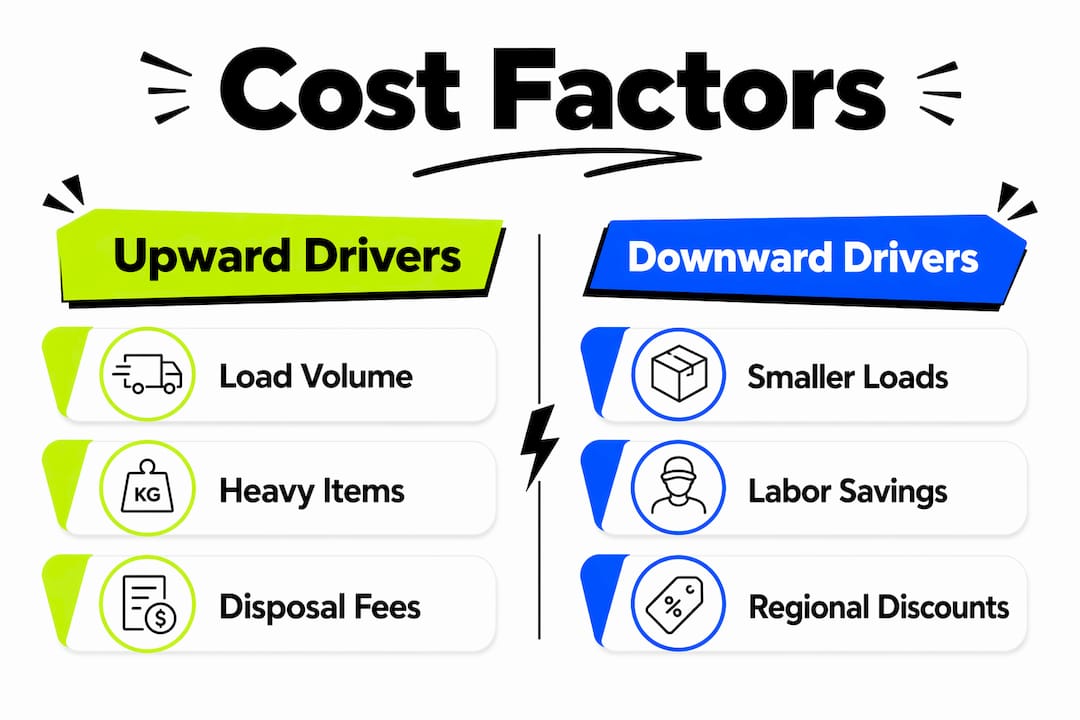
Labor complexity shifts costs fast. In-home pickups cost more than curbside because crews have to navigate hallways, staircases, and tight spaces. A basement full of old furniture takes longer than a pile at the curb. Typical labor runs $100–$300 depending on job size and difficulty.
Other factors that affect your final bill:
-
Location: Local dump fees and labor rates vary city to city. More on this below.
-
Access difficulty: Narrow driveways, no elevator, or items requiring disassembly all add time.
-
Hazardous materials: Anything requiring special handling gets priced separately.
-
Permits: Rarely needed for residential jobs, but large commercial cleanouts sometimes require them.
Most companies bundle labor, hauling, fuel, and disposal into one quote rather than itemizing each line. That’s actually helpful for budgeting since you get one number, not a surprise invoice.
How much does removal cost by item type?
Not all junk is priced the same. A mattress and a bag of old clothes both take up space, but one has a mandatory disposal fee attached. Here’s a realistic breakdown:
| Item Type | Typical Removal Cost |
|---|---|
| Mattress | $75–$150 |
| Bulky furniture (sofa, sectional) | $75–$800 |
| Major appliances (fridge, washer) | $70–$150 |
| Electronics (TVs, computers) | $20–$95 |
| Carpet (per room) | $75–$150 |
| Building/construction materials | $100–$800 |
| Hazardous waste | $150–$300 |
| Hot tub | $450–$800 |
A few items deserve special attention. Hazardous waste disposal runs $150–$300 or higher because automotive fluids, batteries, and similar materials require certified handling. Whole tires are banned from most landfills entirely and need special processing. Mattress disposal fees typically add $40–$90 on top of standard load pricing because many states require mattresses to be recycled separately.
Construction debris is its own category. A bathroom renovation generates tile, drywall, lumber, and fixtures, all of which are heavy and fill a truck fast. Expect to pay toward the higher end of the scale for any demo cleanup.
Pro Tip: If you have a mix of items, ask for a volume-based quote rather than per-item pricing. Larger loads often benefit from volume-based pricing.
Dumpster rental vs. full-service junk removal: which costs less?
The honest answer: it depends on how much labor you’re willing to do yourself.

Dumpster rentals typically cost several hundred dollars per week, varying by size, rental length, and permit needs. You load it yourself, on your schedule. Full-service junk removal is generally more expensive because it includes labor for lifting, loading, and hauling.
| Factor | Dumpster Rental | Full-Service Removal |
|---|---|---|
| Typical cost | $600–$1200/week | $70–$1800/load |
| Labor | You do it | Crew handles everything |
| Timeline flexibility | Days to weeks | Usually same or next day |
| Permit needed | Sometimes (street placement) | Rarely |
| Best for | Long projects, large volumes | Quick cleanouts, heavy items |
| Overage fees | Yes, if weight limit exceeded | Usually included in load price |
Full-service wins on convenience, especially for heavy appliances, furniture, or anything requiring two people to safely move. Dumpster rental wins when you’re doing a multi-week renovation and need the container sitting there while you work.
One thing people miss: dumpster rentals charge the same rate regardless of how much you fill them. So if you rent a 20-yard dumpster and only fill half, you’ve paid for space you didn’t use. Full-service pricing scales with what you actually have.
How location and local factors affect what you pay
Regional pricing differences can push costs 10%–20% above or below the national average based on local labor rates and dump fees alone. Massachusetts, for example, averages around $390 per load compared to roughly $240 in Arkansas, according to state-level cost data.
Key local variables that affect pricing include landfill and transfer station fees, labor market conditions, fuel prices for hauling, and the level of competition among providers.
Easyscrapofficial serves Lawrence, Andover, Boston, Lowell, and Haverhill with transparent, upfront pricing that accounts for local disposal costs. The crew is fully insured, and every job includes eco-friendly sorting: usable items get donated or recycled rather than dumped. For garage cleanouts or basement cleanouts, where access complexity and volume both push costs higher, having a local team that knows the area’s disposal infrastructure makes a real difference in what you pay.
Get a straight price from Easyscrapofficial

Budgeting for junk removal gets a lot easier when you’re not guessing. Easyscrapofficial gives homeowners and property managers in the Greater Boston and Merrimack Valley area a fast, no-surprise path to a clean space. No hidden disposal fees tacked on at the end, no crew that disappears after the quote. You get a free estimate, a fully insured team, and same-day availability when the schedule allows.
Whether it’s a single appliance removal or a full estate cleanout, Easyscrapofficial handles the heavy lifting and hauls everything away, donating and recycling what can be saved. Get your free quote at easyscrapofficial.com/junk-removal and know exactly what you’re paying before anyone shows up.
Key Takeaways
Full-service junk removal costs $70–$800 depending on load size, item type, and location, with most residential jobs landing between $150 and $350.
| Point | Details |
|---|---|
| Average cost range | Most residential loads cost $150–$350; full truckloads reach $600–$800. |
| Volume drives pricing | Trucks are divided into fractions; small portions start at $75–$125, scaling up from there. |
| Item type adds cost | Hazardous waste, hot tubs, and construction debris push prices toward the high end. |
| Location shifts rates | Regional labor and dump fees can move your quote 10%–20% from the national average. |
| Easyscrapofficial | Serves Greater Boston and Merrimack Valley with free quotes, insured crews, and eco-friendly disposal. |