
Hire a licensed junk-removal crew that handles dust control and routes material to recyclers first. That’s the short answer. Tile isn’t ordinary trash: it’s heavy, often laced with silica-laden thinset, and curbside programs typically won’t take it. A professional crew like Easyscrapofficial removes the tile, pulls the adhesive, controls the dust, and hauls everything away in one visit.
Quick alternatives if you need a backup:
-
Dumpster rental: You load it yourself; costs roughly $600–$1200 per week but most loads go to a landfill.
-
Transfer-station drop-off: You haul it yourself; accepted at most municipal facilities and cheaper than full-service hauling.
-
Donate or sell: Unbroken, clean tile in good condition can go to Habitat for Humanity ReStore or a local marketplace.
Pro Tip: Send photos of the tile area to any crew before booking. A virtual photo estimate takes five minutes and prevents surprise charges on job day.
Table of Contents
How do you choose the right tile removal service?
Prioritize four things above all else: dust-control capability, full thinset removal, an insured crew, and a clear recycling or disposal commitment. Everything else is secondary.
Questions to ask before you book:
-
How do you capture silica dust during removal?
-
Does your scope include thinset and adhesive removal, or just the tile itself?
-
Which disposal facilities do you use, and can you document where the debris goes?
-
Is the crew licensed and insured?
-
Will you provide a written quote broken down by labor, hauling, and disposal fees?
Red flags to watch for:
-
Vague per-square-foot pricing with no line items
-
No answer on dust control (“we just wet it down” is not a plan)
-
Refusal to name the disposal facility
-
Quotes that exclude thin set removal without saying so
Pro Tip: Get a virtual photo estimate first, then confirm with a written on-site quote. The two together eliminate almost every billing dispute.
What does professional tile removal actually involve?
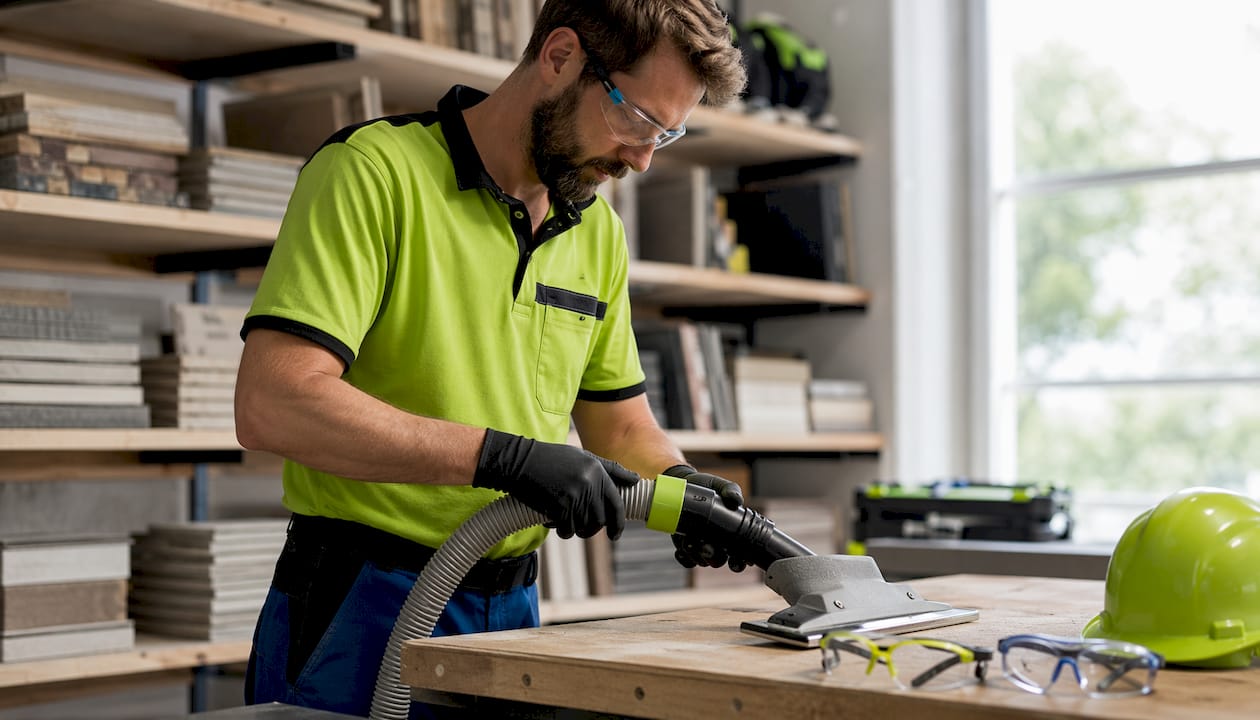
Most homeowners assume tile disposal is just hauling. It isn’t. It’s demolition, dust management, subfloor preparation, and debris routing, and skipping any step creates problems for the next flooring installation.
Here’s the typical sequence a qualified crew follows:
-
Containment and sealing — doorways and HVAC vents are sealed to stop dust migration.
-
Source-capture dust extraction — HEPA filtration and source-capture vacuums pull silica dust the moment it’s created, before it goes airborne.
-
Tile removal — ceramic, porcelain, or stone tiles are broken and lifted.
-
Thinset and adhesive removal — the most labor-intensive step; leftover thinset causes uneven surfaces and forces costly rework before any new floor can go down.
-
Surface grinding or scraping — the subfloor is cleaned to a flat, installation-ready condition.
-
Debris sorting and loading — recyclable ceramic is separated from mixed waste where local infrastructure allows.
Silica dust is classified as a serious respiratory hazard by OSHA and NIOSH. During tile and thinset demolition in an enclosed space, silica concentrations routinely exceed OSHA’s permissible exposure level. Source-capture HEPA systems are the only reliable way to keep those levels safe indoors.
On the recycling side, ceramic tile waste can substitute for natural gravel and serve as recycled aggregate in concrete, producing comparable compressive strength in properly processed mixes. That’s a real circular-economy outcome, not just marketing language. That said, full-scale industrial recycling still depends on local infrastructure, so ask your crew which facilities in your area actually accept ceramic before assuming it won’t go to a landfill.
What drives the cost and timeline for a tile job?
Price varies more than most homeowners expect, and the gap usually comes down to two things: whether thinset removal is included and whether dust-control equipment is on the truck.
Main cost drivers:
-
Square footage and volume — most crews quote by truckload or cubic yard; a standard pickup truck holds roughly 1–2 cubic yards of broken tile.
-
Thinset removal — adds labor time and often a grinding step; jobs without it are faster but leave the subfloor unready.
-
Dust-control equipment — HEPA-capable setups cost more to run but protect your home.
-
Access — stairs, long carries, or tight parking add time and cost.
-
Disposal routing — recycling facilities sometimes charge processing fees; landfill tipping fees vary by county.
| Method | Speed | Effort on your end | Eco routing | Typical cost range |
|---|---|---|---|---|
| Professional haul-away | Same day to 2–3 days | Minimal | Recycling possible | — |
| Roll-off dumpster rental | You set the schedule | You load it | Usually landfill | $600–$1200/week |
| Transfer-station drop-off | You set the schedule | You haul it | Varies by facility | Low tipping fee |
Cost ranges sourced from Angi’s junk removal cost data.
Timeline in practice:
-
Small bathroom floor (under 100 sq ft): same-day or next-day pickup in most markets.
-
Mid-size kitchen or living area: 1 full business day for removal and loading.
-
Large jobs with grinding and dust-control setup: 2–3 days.
Pro Tip: Ask for a quote that breaks out labor, dust-control, hauling, disposal fee, and any recycling or processing fees as separate line items. A single lump number makes it impossible to compare bids.
How should you prepare your home before the crew arrives?
Simple prep speeds the job and keeps costs from creeping up. A crew that walks into a clear, accessible space starts immediately instead of spending the first hour moving furniture.
Before the crew arrives:
-
Clear furniture and fragile items from the work area and adjacent rooms.
-
Cover or tape off HVAC intake vents in the demo zone (even with a dust-control crew, belt-and-suspenders prep helps).
-
Secure pets and children away from the work area for the full duration.
-
Confirm truck access and parking near the entrance; a long carry adds time.
-
Mark any tiles you want saved before the crew starts.
-
If demo is near a wet area (bathroom, laundry), turn off the water supply to that zone.
Electrical shutoffs near the work area are best left to the crew or a licensed electrician. Don’t assume the demo won’t reach a junction box.
Pro Tip: Photograph the space and send the images to the crew before their visit. A good photo set lets them show up with the right equipment and give you a more accurate written estimate.
Key Takeaways
Hiring a dust-control-capable, insured junk-removal crew is the safest and most eco-friendly way to handle tile disposal, with thinset removal and recycling routing as the two factors that separate a good job from a costly one.
| Point | Details |
|---|---|
| Hire insured, dust-capable crews | Source-capture HEPA systems prevent silica exposure; standard crews without them create a health risk. |
| Thinset removal matters | Skipping adhesive removal leaves an uneven subfloor and forces expensive rework before new flooring can go in. |
| Recycling is often available | Ceramic tile can be processed into recycled aggregate; ask your crew which local facilities accept it. |
| Alternatives have real trade-offs | Dumpster rental ($100–$300/week) and transfer-station drop-off cost less but put the labor and routing on you. |
| Easyscrapofficial is the recommended option | Insured crew, free quotes, same-day scheduling where available, and a recycling-first disposal policy. |
The part most guides skip about tile removal
The conventional wisdom treats tile disposal as a cost problem. It isn’t. It’s a health and subfloor problem that happens to cost money.
Every article tells you to “wear a dust mask.” What they don’t tell you is that a standard N95 mask does almost nothing when silica concentrations in an enclosed room exceed OSHA’s permissible exposure level by multiple factors, which they routinely do during thinset demolition. The only real protection is source-capture at the point of creation, meaning the right equipment on the grinder before the dust goes airborne, not a filter over your face after it already has.
The same logic applies to thinset. Homeowners skip it to save money, then spend more fixing a wavy subfloor six months later. Professional crews that include full adhesive removal in their scope aren’t upselling you. They’re completing the job.
Recycling is the third underestimated piece. Ceramic tile waste genuinely can become recycled aggregate in concrete, and that’s not a niche outcome. It’s a documented, technically viable pathway. The catch is local infrastructure: not every transfer station or recycler accepts ceramic, so the question to ask isn’t “do you recycle?” but “which facility takes it and how do you verify it?”
Ready to get your tile hauled? Here’s what Easyscrapofficial includes
Easyscrapofficial handles the full scope of tile and construction debris removal: insured crews, free on-site or virtual estimates, same-day scheduling where available, and a recycling-first disposal policy that routes ceramic waste away from landfills whenever local facilities allow. No mystery pricing, no surprise fees for thinset or access.
To get a quote, have three things ready: photos of the space, an approximate square footage, and any access details (stairs, parking restrictions, tight doorways). Send those over and you’ll get a written estimate fast.
For tile jobs, combined cleanout work, or any construction debris that needs to go, book your removal through Easyscrapofficial or browse the full list of available services to see what else the crew can take in the same visit.