Most professional junk haulers carry insurance, but not all of them, and the gap matters more than most customers realize. Commercial auto coverage is legally required on any vehicle used for business, and workers' compensation is mandatory in 49 states once you hire staff. General liability isn't usually mandated by state law, but commercial clients routinely require a $1 million per-occurrence policy before they'll sign a contract. A noticeable share of solo and van operators skip coverage anyway, which is exactly why verification matters before you hire, and why carrying the right policies matters if you're the one running the truck.
TL;DR:
- Insurance gaps are common among solo operators and small fleets, making verification crucial before hiring or being hired.
- General liability typically requires a $1 million per occurrence limit, but damage to property in custody needs separate coverage.
- Commercial auto insurance is legally mandatory for business vehicles, as personal policies exclude business use, risking claim denial.
- Workers' compensation becomes compulsory once you hire a W-2 employee in 49 states, due to high risks from manual lifting and vehicle accidents.
- Costs vary based on fleet size, payroll, and claims history, with small operators paying a few thousand dollars annually for basic coverage.
Table of Contents
- Why Insurance Matters for Junk Haulers: Core Risks and Who It Protects
- Core Policies Junk Haulers Need (Detailed Coverage Breakdown)
- How Much Insurance Typically Costs and What Drives Price
- What Commercial Clients and Property Managers Typically Require
- How to Verify a Hauler's Insurance: Step-by-Step COI Checklist
- Common Coverage Gaps and Pitfalls Specific to Junk Hauling
- How to Buy Insurance for a Junk Hauling Business
- Publisher Perspective: How an Insured EasyScrap Crew Operates
- An Operator's Take on Minimum Coverage
- Requesting a Certificate of Insurance from EasyScrap
- Sources
Why Insurance Matters for Junk Haulers: Core Risks and Who It Protects
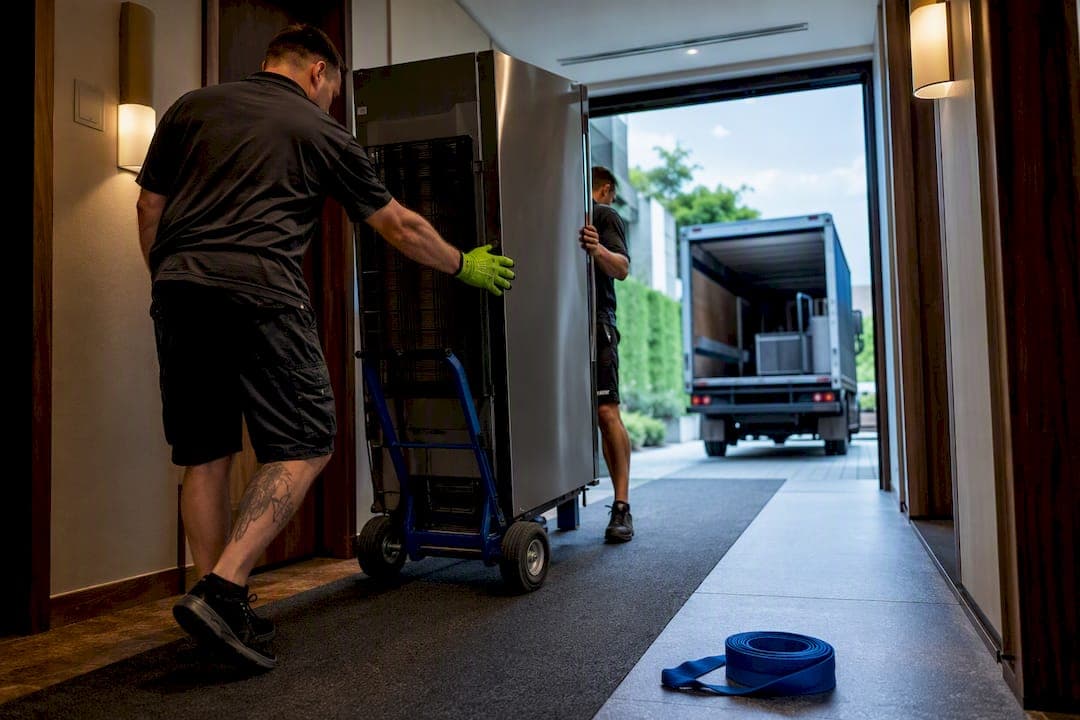
Junk hauling looks simple from the outside. Load stuff, haul it away, get paid. The risk profile tells a different story. A crew member drops a refrigerator on a hardwood floor. A truck backs into a customer's fence. An employee throws out their back lifting a sectional sofa that weighed twice what it looked like. A stolen dolly or a damaged pressure washer sitting in the truck bed. Each of these is a normal Tuesday in this business, and each one can turn into a claim that costs more than a year of premiums.
Different policies protect different people. General liability covers damage to a customer's property or injury to a customer or bystander. Commercial auto covers accidents involving your trucks on the road or at a job site. Workers' compensation covers your own employees when they get hurt on the job. Inland marine or tools coverage protects your equipment and, in some cases, the items you're temporarily responsible for while hauling them.
The physical demands of this work are real. BLS injury data broken down by industry consistently shows manual material handling and vehicle-related incidents among the leading causes of nonfatal workplace injury. Lifting, carrying, and loading heavy, awkward objects all day is exactly the kind of repetitive strain and acute-injury risk that drives workers' comp claims in this trade, highlighting the importance of professional contractor services that prioritize risk management and insurance. If you're running crews instead of working solo, that statistic isn't abstract. It's your Monday morning.
Core Policies Junk Haulers Need (Detailed Coverage Breakdown)
Coverage in this industry isn't one policy. It's a stack, and each layer handles a specific kind of exposure.
General liability is the foundation. It covers third-party bodily injury and property damage, things like a customer tripping over a hose or a wall getting scraped during a couch removal. The industry baseline runs $1 million per occurrence with a $2 million aggregate, and most property managers and commercial accounts won't sign a vendor agreement without it. One catch operators miss constantly: standard general liability often excludes damage to property that's in your custody or control, meaning the item you're actively moving. That gap needs its own conversation with your agent.
Commercial auto is non-negotiable, and not just because it's smart. Personal auto policies specifically exclude business use, so if you're using your truck to haul for pay and something happens, your personal insurer can and will deny the claim. Commercial auto policies typically run with a combined single limit covering both bodily injury and property damage per accident rather than splitting them into separate sub-limits.
Workers' compensation kicks in the moment you put a W-2 employee on the payroll in 49 of the 50 states. This isn't optional paperwork. Given how much of this job involves lifting mattresses, appliances, and construction debris, comp claims for strains and falls are common, and the statutory requirement exists because insurers and regulators both know it.
Inland marine coverage protects tools, equipment, and sometimes goods in transit that sit outside a standard property policy. If you've got a few thousand dollars in dollies, straps, and power tools riding around in your truck, this fills a real gap.
Umbrella and pollution/environmental liability matter as you scale. An umbrella policy extends your liability limits once a big claim exceeds your general liability or auto limits. Pollution liability becomes relevant fast in this trade because of a specific exposure most haulers underestimate.
- General liability: third-party injury and property damage, $1M/$2M typical baseline
- Commercial auto: covers business-use vehicle accidents, required by law
- Workers' compensation: statutory once you have employees, covers on-the-job injury
- Inland marine: protects tools and equipment in transit
- Umbrella: extends limits above your underlying policies
- Pollution/environmental: covers hazardous disposal exposures like refrigerants
Pro Tip: If you handle old refrigerators, air conditioners, or freezers, ask your agent specifically about pollution liability tied to refrigerant handling. Standard general liability policies often exclude environmental contamination claims entirely, and EPA violations carry their own separate penalty exposure.
How Much Insurance Typically Costs and What Drives Price
Pricing depends heavily on fleet size, payroll, and how long you've been operating claim-free, but rough benchmarks give you a starting point for budgeting.
| Coverage | Typical Annual Range (1 Truck) | What Drives the Price |
|---|---|---|
| General liability ($1M/$2M) | $700 to $1,400 | Claims history, service mix, location |
| Commercial auto (per vehicle) | $1,800 to $4,200 | Driving record, vehicle type, state |
| Workers' compensation | Varies by payroll and state | Employee count, class code, wage totals |
| Inland marine/tools | Add-on, varies by equipment value | Total insured equipment value |
A one-truck owner-operator with no employees often pays in the low thousands annually for combined general liability and commercial auto insurance, according to broker cost breakdowns for small hauling operations. Add a second truck, and both your auto premium and your liability exposure climb. Add your first W-2 hire, and workers' comp enters the picture as a real line item, typically calculated against payroll under a specific classification code for junk removal and hauling labor.
State matters more than people expect. Workers' comp rates vary significantly by state because each state runs its own rating bureau or uses NCCI classification data differently. A hauler in one state can pay noticeably more per payroll dollar than a hauler doing identical work across the border.
Buying order affects price too. Most brokers recommend locking in commercial auto first since it's the one policy you legally cannot operate without, then layering general liability, then adding workers' comp the moment you bring on staff. Insurer cost guidance for debris removal businesses generally supports bundling auto and general liability with a single carrier when possible, since package pricing often beats buying each policy separately.
What Commercial Clients and Property Managers Typically Require
Landing recurring commercial work, property management contracts, real estate cleanouts, retail chains, almost always means clearing a paperwork bar before you swing the first hammer or lift the first box.
- A current Certificate of Insurance. This document lists your carrier, policy numbers, coverage limits, and effective dates. Clients want to see it before you set foot on their property, not after.
- Additional insured endorsement. Many commercial clients and property managers require you to add them as an additional insured on your general liability policy, which extends a layer of your coverage to protect them if a claim arises from your work on their site.
- Minimum limits that match their risk tolerance. A $1 million per-occurrence limit with a $2 million aggregate is the common floor for vendor agreements. Larger property management firms or national retail accounts sometimes push for $2 million per occurrence on higher-risk jobs.
- Annual renewal proof. Recurring accounts typically ask for an updated COI every year at renewal, not just at signing, since policies lapse or get canceled mid-term more often than people assume.
Skipping any one of these steps is usually a fast way to get disqualified from a bid before pricing even enters the conversation.
How to Verify a Hauler's Insurance: Step-by-Step COI Checklist
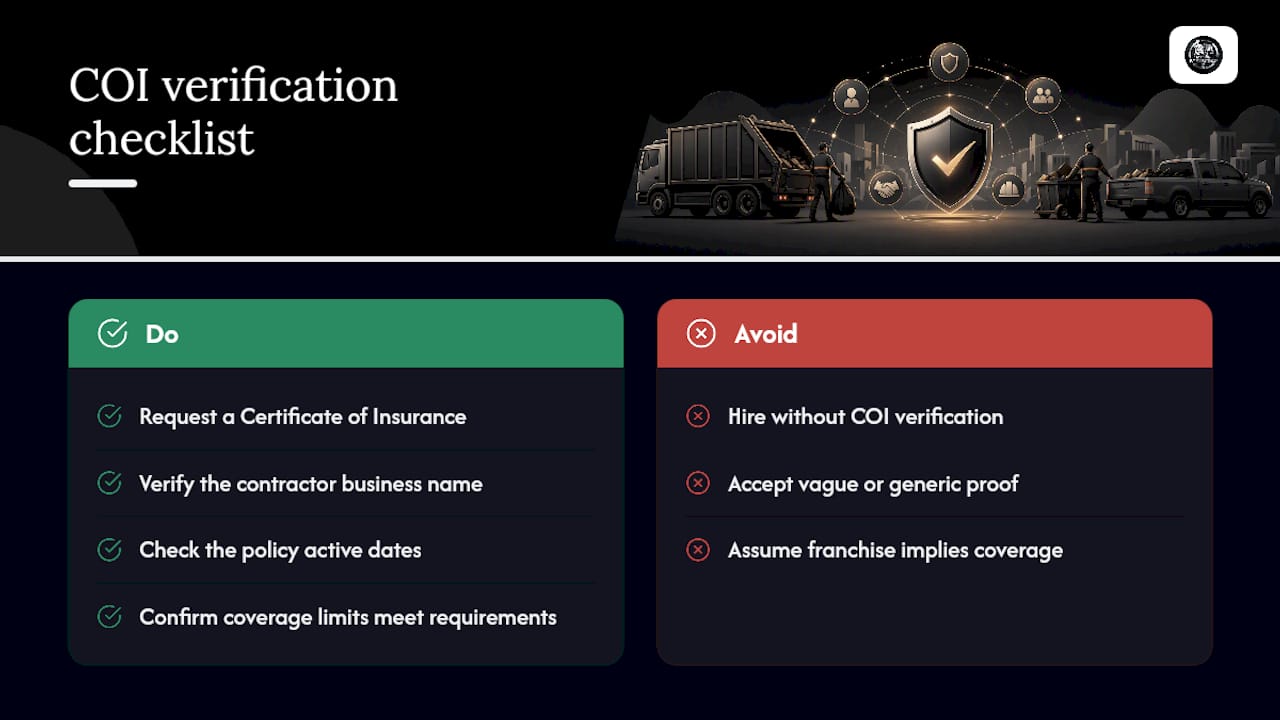
A Certificate of Insurance is only useful if you actually check it. Here's what that looks like in practice.
- Ask for the COI directly and confirm the insured name matches the exact business name or LLC you're hiring, not a similarly named entity or a subcontractor.
- Check the effective and expiration dates on the certificate, since a policy that lapsed last month is worthless paper.
- Call the agent or producer listed on the document to confirm the policy is active. Certificates can be issued and then the underlying policy canceled without the certificate holder ever finding out, so a quick phone call closes that gap.
- Confirm the coverage limits match what you need, particularly if you're a property manager requiring $1 million per occurrence.
- Watch for hesitation. Legitimate vendors provide a COI without friction, and companies that stall, dodge the question, or can't produce a certificate quickly are telling you something.
Pro Tip: Keep a copy of every COI you collect from subcontractors or crews you hire on a per-job basis. If a claim surfaces months later, you'll want documented proof that coverage was active on the date of service, not just a verbal assurance.
Common Coverage Gaps and Pitfalls Specific to Junk Hauling
Even insured operators get burned by gaps they didn't know existed. Four show up constantly in this trade.
- Care, custody, and control exclusions. Standard general liability policies often deny claims for damage to an item while it's actively in your possession, meaning the antique dresser you're carrying down the stairs might not be covered if you drop it. Ask specifically about endorsements that close this gap.
- Personal auto exclusions. Using a personal vehicle for paid hauling work voids coverage the moment an insurer discovers the business use, leaving you personally liable for the entire claim.
- Worker misclassification. Treating employees as 1099 contractors to avoid workers' comp premiums creates legal exposure that often costs far more than the premium you were trying to dodge, including back taxes, penalties, and denied comp claims.
- Refrigerant disposal violations. Appliances containing refrigerant fall under EPA Section 608 rules, and improper disposal can trigger federal penalties separate from any insurance claim entirely.
How to Buy Insurance for a Junk Hauling Business
Buying coverage in the right order saves money and closes gaps faster than buying everything at once and hoping it fits.
- Start with commercial auto since you legally cannot operate a hauling vehicle for business without it, and personal auto won't step in.
- Add general liability next, targeting the $1 million per-occurrence baseline most commercial clients expect.
- Add workers' compensation the moment you hire your first W-2 employee, since the requirement kicks in immediately in nearly every state.
- Layer in inland marine coverage once your tools and equipment reach a value worth protecting separately from your general policy.
- Consider an umbrella policy as your revenue and job volume grow, since a single serious claim can exceed your underlying limits faster than most operators expect.
Get quotes from specialty insurance brokers who work with hauling and debris removal businesses specifically, since general commercial agents sometimes miss trade-specific exclusions. Have your vehicle titles, estimated payroll, and prior claims history ready before you call. When comparing quotes, look past the premium number and read the exclusions section, particularly around care, custody, and control and any environmental carve-outs.
Publisher Perspective: How an Insured EasyScrap Crew Operates
Easyscrapofficial runs insured crews across same-day junk removal, appliance and furniture pickups, and full property cleanouts. That coverage isn't a marketing line, it's the reason a commercial property manager or landlord can hire the crew without absorbing the risk themselves.
Customers or commercial clients who need proof can request a Certificate of Insurance directly, matching the same verification steps outlined above: correct business name, active dates, and limits that meet the property's requirements. That's the standard any operator should be held to, whether they're hiring a national franchise or a two-truck local crew.
An Operator's Take on Minimum Coverage
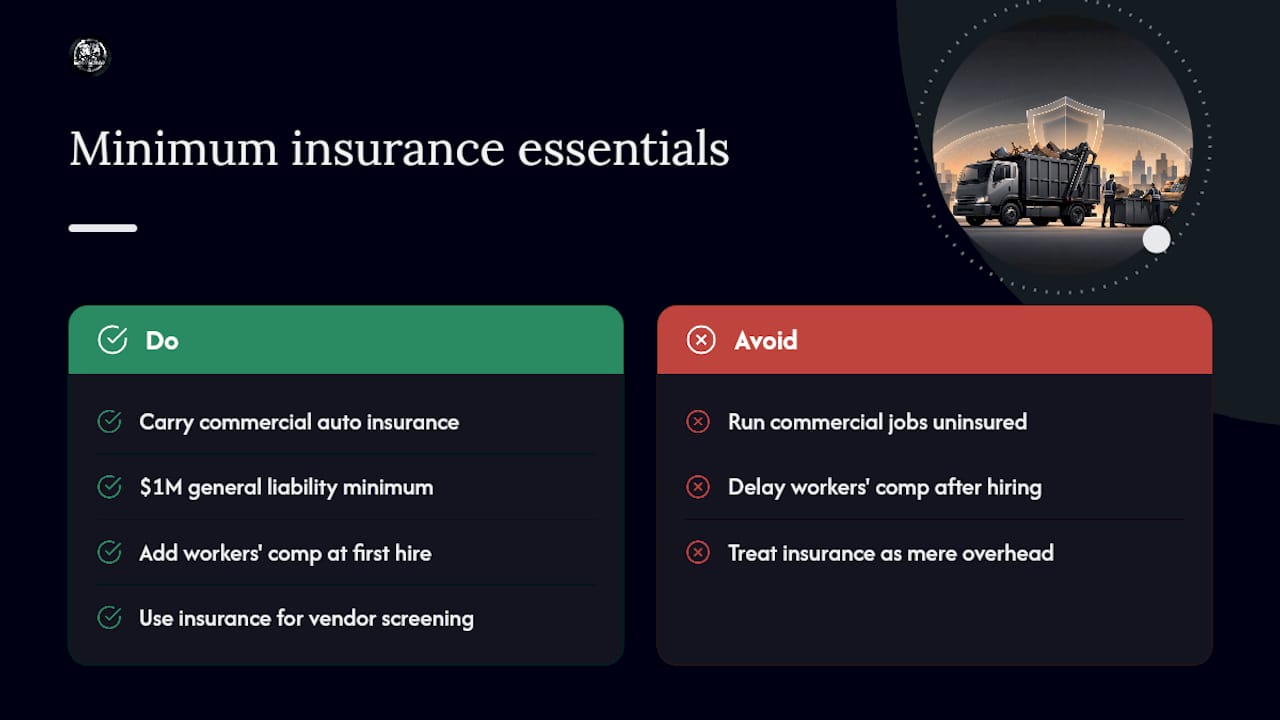
Every operator asks the same question eventually: what's the floor? Commercial auto and $1 million general liability aren't optional if you want to survive one bad accident or one lawsuit from a damaged floor. Add workers' comp the day you hire your first employee, no exceptions, no waiting to see if you'll get away without it.
The business case is straightforward too. Being properly insured is what gets you past the vendor screening for property management contracts, real estate cleanouts, and commercial accounts that pay better and more consistently than one-off residential jobs. Insurance isn't overhead here. It's the price of admission to the work that actually grows a hauling business.
— Easy
Requesting a Certificate of Insurance from EasyScrap
Some junk removal companies provide a Certificate of Insurance on request, without delay, because a customer asking to see one is doing exactly what this article recommends. Expect the certificate to list the business name, active policy dates, and liability limits, the same details covered in the verification checklist above.
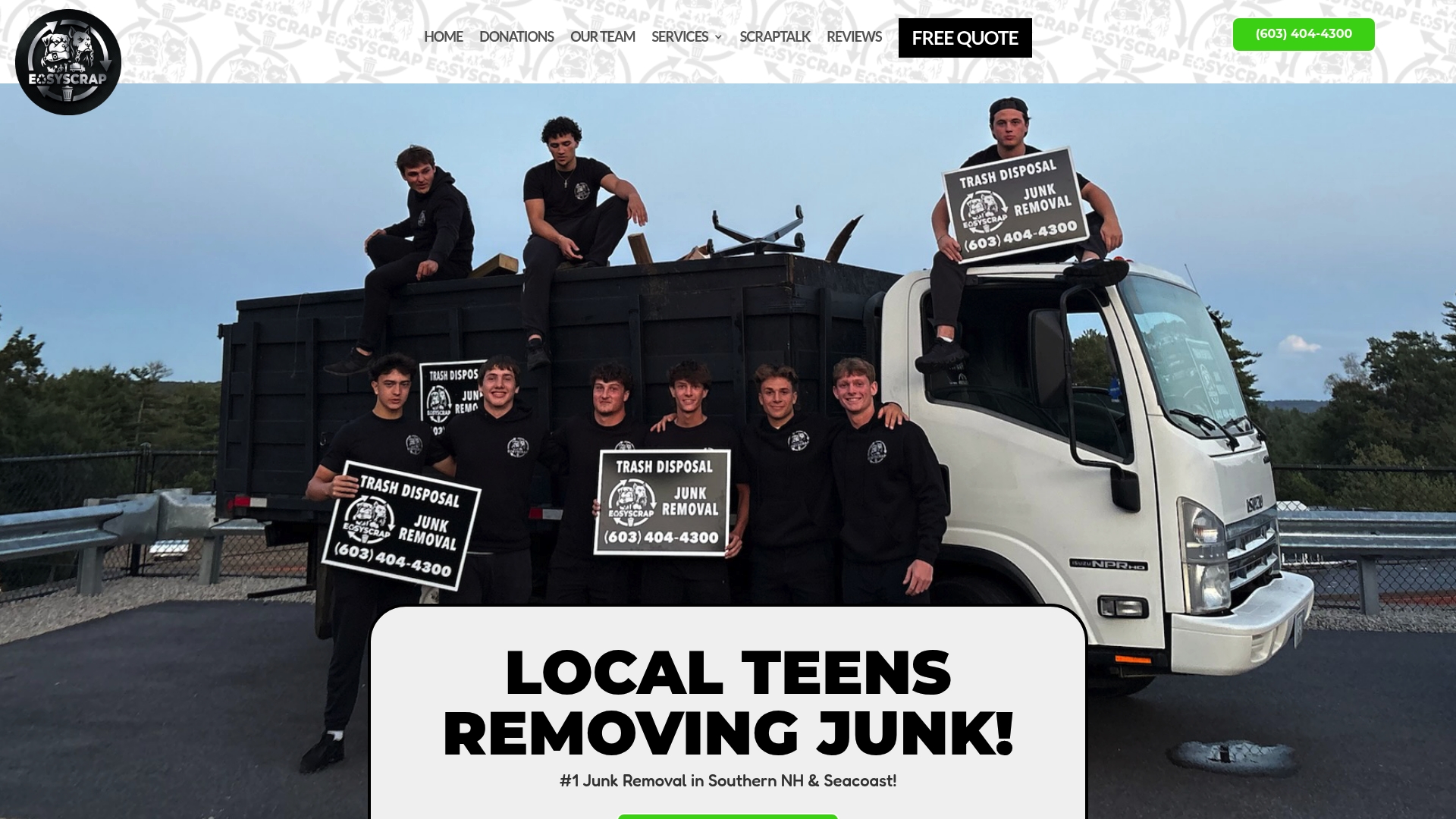
If you're a homeowner, landlord, or property manager comparing a franchise crew against a smaller local outfit, the real difference is how fast you get a straight answer and a truck on-site. Easyscrapofficial books same-day junk removal with an insured crew, handling everything from a single refrigerator or mattress to a full garage cleanout, without the multi-day scheduling gaps some larger operations require. Request a free quote and ask for the COI up front. It should take one phone call, not three follow-ups.
Sources
- Junk Removal Insurance Requirements 2026 | GL, Auto & EPA Guide | Coverage Criteria
- BLS: Nonfatal injuries and illnesses counts by industry (2024)
- Junk Removal Insurance - Get Fast & Free Quotes
- Junk Removal Insurance Coverage