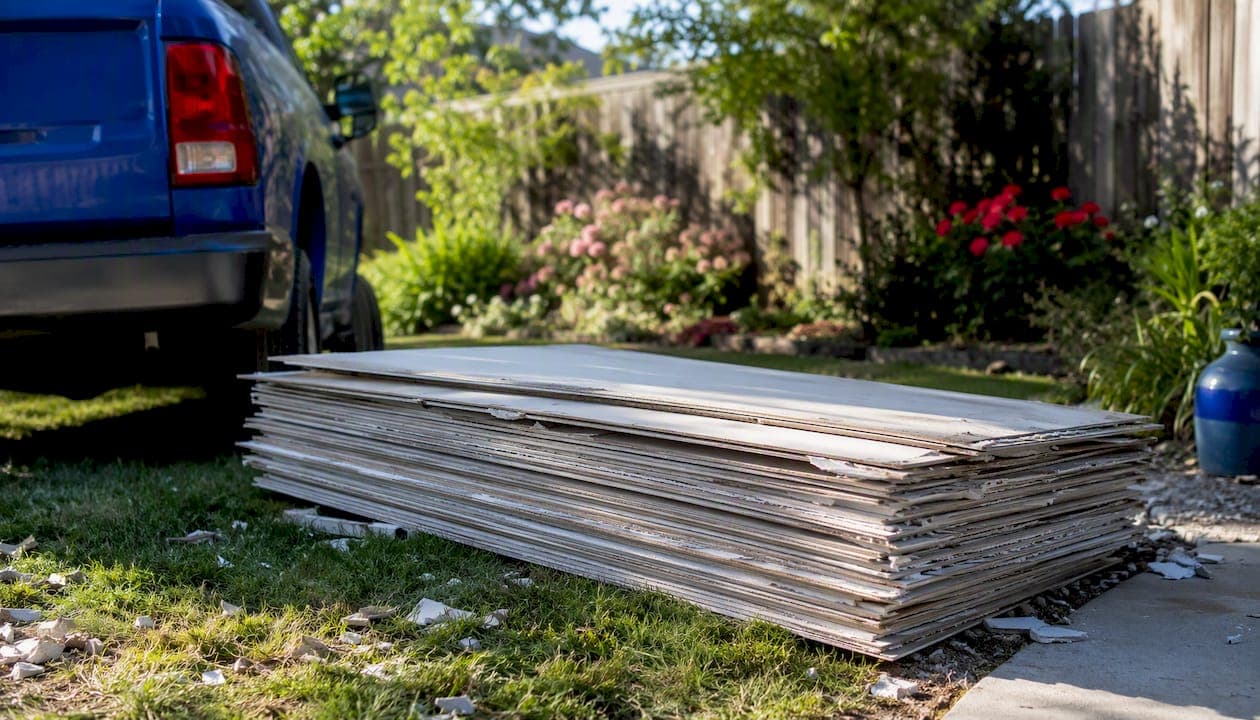
For most U.S. home remodels, clean drywall should be recycled when possible. If it can't be recycled, take it to a construction and demolition (C&D) transfer station, a landfill that accepts gypsum board, or hire a licensed hauler to handle it. Most municipal trash services won't take large volumes, so planning ahead is the move that saves you time, money, and a rejected load.
Before you load anything into a truck, run two quick checks:
- Is the drywall clean? No paint, texture coat, joint compound, tape, or visible mold? Clean gypsum can go to a recycling facility. Anything contaminated goes to a C&D landfill or requires special handling.
- Was it installed before 1980? Drywall and joint compound from that era may contain asbestos. Stop, don't disturb it further, and get it tested before removal.
Your primary lawful destinations:
- Gypsum recycling facility — for clean, uncontaminated drywall only
- C&D transfer station — accepts mixed construction debris including drywall
- Municipal landfill that accepts drywall — check local rules; not all do
- Licensed hazardous-waste or abatement facility — required for asbestos-containing material
- Licensed hauler like Easyscrapofficial — they handle sorting, transport, and proper disposal for you
Key Takeaways
Clean drywall should be recycled when possible; contaminated or mixed loads belong at a C&D facility, and any pre-1980 material requires testing before removal.
| Point | Details |
|---|---|
| Recycle clean gypsum first | Uncontaminated drywall with no paint, tape, or mud qualifies for gypsum recycling at no or low cost. |
| Test pre-1980 drywall for asbestos | Joint compound from before 1980 may contain asbestos; stop DIY removal and hire a certified inspector. |
| Separate loads to cut costs | Mixing clean gypsum with painted or muddy scraps eliminates recycling eligibility and raises disposal fees. |
| Call the facility before you haul | Confirm accepted materials, prep requirements, and fees to avoid rejected loads and wasted trips. |
| Easyscrapofficial for fast local pickup | Insured crews serve Lawrence, Andover, Boston, Lowell, and Haverhill with same-day construction debris removal. |
Table of Contents
- Where you can legally take drywall in the U.S.
- How to prepare drywall for drop-off, recycling, or pickup
- Hazards and special handling: asbestos, lead paint, mold, and water damage
- Service and cost options: dumpsters, transfer stations, and junk haulers
- What drywall recycling actually looks like
- Decision checklist: how to pick the right disposal method or hauler
- How to find and verify local drywall drop-off and recycling centers
- Legal regulations and compliance for drywall disposal
- Environmental impact of drywall disposal methods
- Typical cost ranges for drywall disposal by method and region
- Homeowner vs. commercial quantity limits
- When and how to hire a professional drywall hauling service
- What most homeowners get wrong about drywall disposal
- Easyscrapofficial handles drywall and construction debris removal
- Official and helpful resources for verifying local rules
- Sources
Where you can legally take drywall in the U.S.
The U.S. doesn't have one national rule for sheetrock disposal. What's available depends on your county, municipality, and sometimes your state. That said, the options are fairly consistent across most markets.
C&D transfer stations are the most common destination for post-construction debris removal. They accept mixed loads that include drywall, wood, metal, and concrete, then sort and divert recyclable material. C&D recycling programs can include mandatory recovery goals and often maintain directories of accepted materials and Class 2 landfills that take gypsum board.
Gypsum recycling facilities accept clean drywall cut-offs and sometimes used residential board, but requirements vary. Some facilities accept new drywall with a declaration form, while used residential drywall may only be accepted under strict bagging, labeling, and quantity limits. Always call ahead.
Municipal landfills that accept drywall are an option in many counties, though not all. Some county-level transfer stations explicitly list drywall/gypsum board as accepted material with specific hours and fees posted online.
Municipal drop-off days occasionally include C&D debris for residential customers, usually with strict weight or volume limits. These work for small bathroom or single-room remodels, not a whole-house gut.
Curbside pickup is rarely an option for drywall at renovation scale. Small amounts (a few broken pieces) may be accepted depending on local ordinance, but anything from a real remodel will exceed weight limits and likely get left behind.
- Residential customers typically get more lenient quantity limits than contractors
- Some facilities refuse contractor loads entirely, or charge higher rates for them
- Always confirm whether your load will be classified as residential or commercial before you show up
Pro Tip: Call the facility before you haul. Ask specifically: "Do you accept used residential drywall?" and "What are your prep requirements?" Showing up with a rejected load costs you a trip and possibly a disposal fee anyway.
How to prepare drywall for drop-off, recycling, or pickup
Rejected loads are one of the most common and avoidable problems in drywall waste removal. A little prep work at the job site keeps your load accepted and your costs down.
Step-by-step prep:
- Pull all fasteners. Remove nails, screws, and staples from every piece. Metal contamination is a leading reason recycling facilities reject loads.
- Separate clean from dirty. Keep uncoated, unpainted gypsum board in one pile. Painted, textured, or mudded pieces go in a separate pile for C&D disposal.
- Remove trim, tape, and backing. Paper tape, corner bead, and joint compound residue disqualify drywall from most recycling streams.
- Break large sheets if needed. Some facilities require pieces under a certain size for processing. Check before you go.
- Double-bag contaminated or moldy material. If local rules require it (and many do), use heavy 6-mil poly bags, seal them completely, and label the bags clearly.
- Secure your load for transport. Drywall dust is a respiratory hazard and a road hazard. Cover the load with a tarp and tie it down.
What to have on hand before you start:
- Heavy-duty work gloves
- N95 or P100 dust mask
- Safety glasses
- 6-mil poly bags (for contaminated material)
- Tarps and tie-down straps
- A pry bar or screw gun for fastener removal
Hazards and special handling: asbestos, lead paint, mold, and water damage
This is where drywall disposal stops being a logistics question and becomes a safety one.
How to spot suspect drywall:
- Installed before 1980: joint compound from that era commonly contained asbestos
- Textured "popcorn" or "orange peel" finishes applied before 1980 are high-risk
- Tar paper or unusual backing materials visible at the edges
- Visible black or green mold, soft spots, or water staining
- Crumbling or chalky texture that seems unusual
If any of these apply, stop DIY removal. NIOSH recommends specific dust-control measures and PPE when handling drywall, and for suspected asbestos-containing material, those controls aren't enough on their own. You need a licensed abatement contractor to test and remove it.
Testing and next steps for suspect material:
- Hire a certified asbestos inspector to collect samples (do not sample it yourself)
- Results typically come back within a few days from an accredited lab
- If positive, a licensed abatement contractor must handle removal and disposal at a permitted hazardous-waste facility
- Lead paint on drywall surfaces adds another layer: EPA's RRP Rule applies to pre-1978 homes
For mold-damaged or water-saturated drywall, the material is generally not recyclable. Bag it, label it, and confirm with your local C&D facility whether they accept it or whether it needs to go to a special waste stream.
The chemical risk is real: when gypsum mixes with organic waste in a landfill, it can produce hydrogen sulfide gas. Proper separation and recycling reduce this environmental and safety risk significantly.
Service and cost options: dumpsters, transfer stations, and junk haulers
The right method depends on your project size, timeline, and whether your drywall is clean or contaminated.
| Disposal Method | Typical Cost Range | Best For |
|---|---|---|
| C&D transfer station drop-off | $50–$150 per load (weight-based) | Small to mid-size remodels with vehicle access |
| Dumpster rental (weekly) | $300–$600 for a 10–20 yard bin | Larger projects, multi-day demolition |
| Junk removal pickup | $150–$400 depending on volume | No vehicle, mixed debris, time-sensitive jobs |
| Gypsum recycling facility | Often free or low-cost for clean loads | Clean cut-offs from new construction |
| Asbestos abatement | Varies widely; get multiple quotes | Pre-1980 material confirmed or suspected |
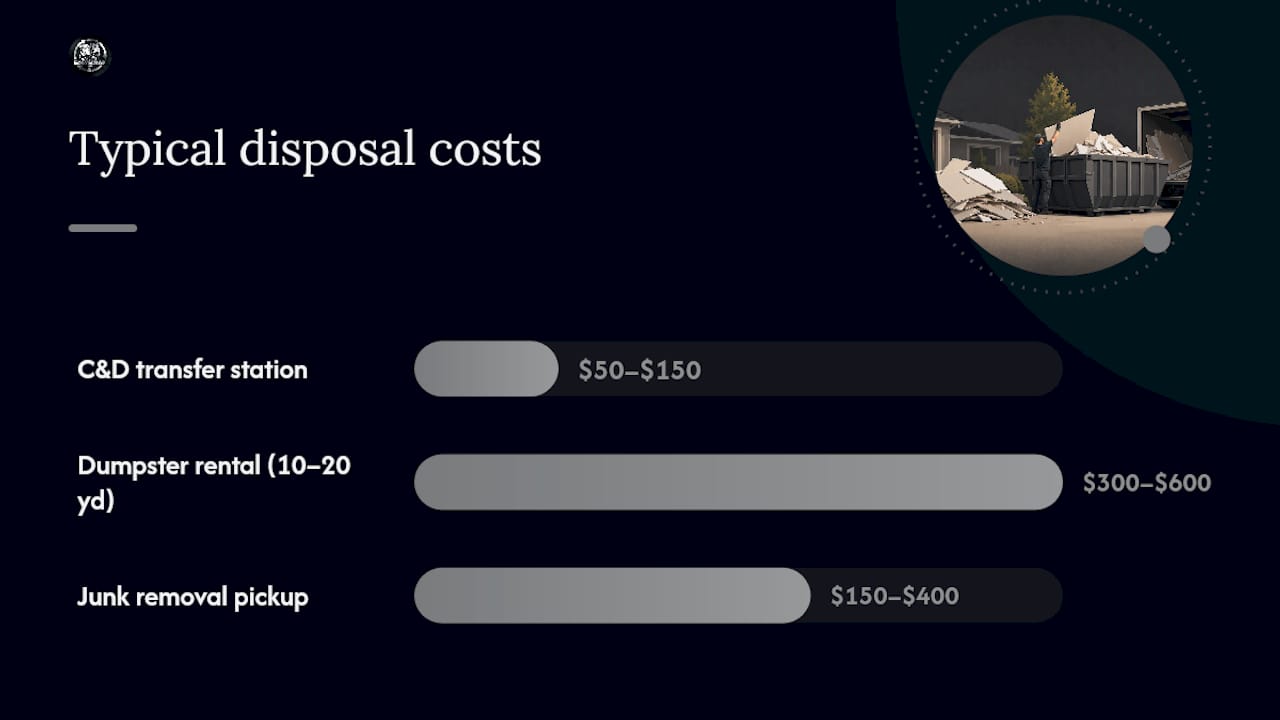
County C&D facilities commonly publish item-level fees and weight-based rates — verify those before you haul, because minimum-load fees and recyclable-content requirements can change your math fast. For a deeper look at budgeting, the construction debris removal cost guide breaks down pricing by project type.
Costs spike when drywall is wet, contaminated, or mixed with non-recyclable debris. Separating clean gypsum from the rest is the single most effective way to keep fees down.
What drywall recycling actually looks like
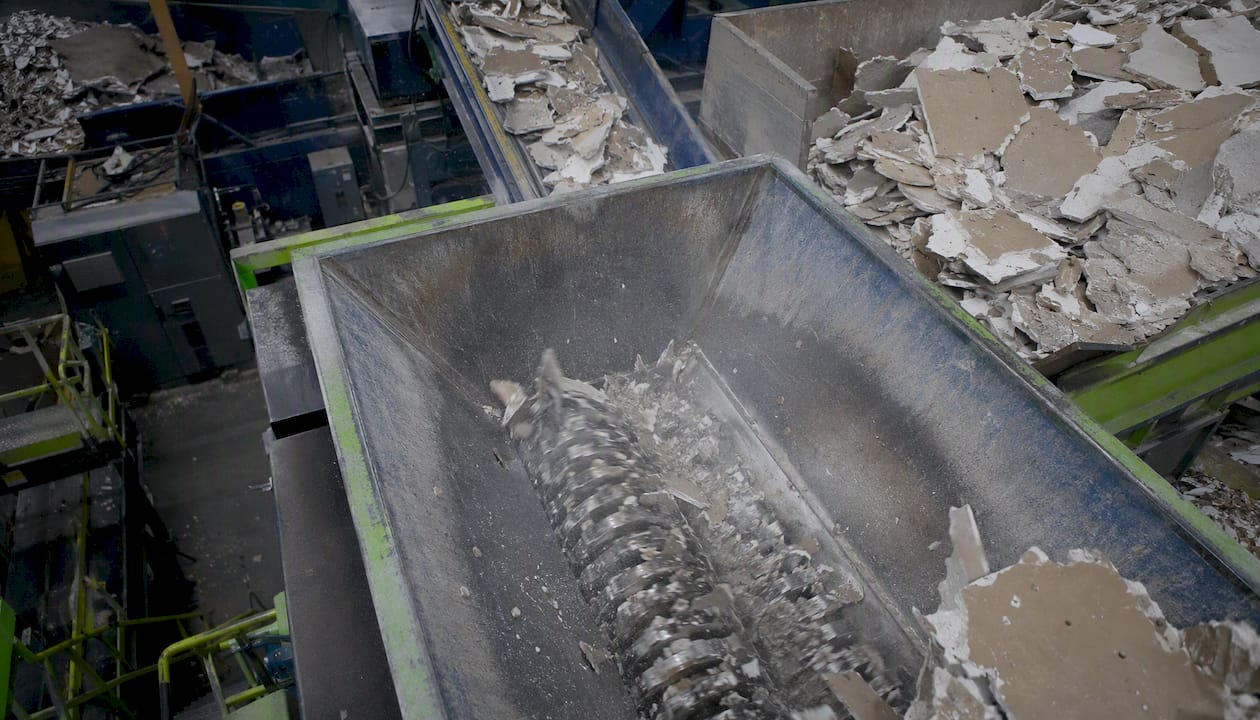
Clean gypsum board goes through a straightforward process at a recycling facility: paper facing is stripped or separated, the gypsum core is ground into powder, dried if needed, and then used as feedstock for new drywall manufacturing or as a soil amendment in agriculture. It's a genuinely closed-loop material when it's clean.
The limits are strict, though:
- No paint, texture coatings, or joint compound residue
- No tape (paper or mesh)
- Some facilities accept only new cut-offs, not used residential board
- Quantity limits apply at many drop-off locations
- Wet or mold-damaged drywall is never recyclable
The environmental case for recycling is solid. Drywall mixed with organic waste in a landfill can generate hydrogen sulfide, a toxic gas. Keeping clean gypsum out of the landfill avoids that reaction and reduces the volume of material that needs to be managed long-term. When recycling isn't an option because of contamination, the C&D landfill is the correct destination, not the regular trash.
Decision checklist: how to pick the right disposal method or hauler
Work through these factors in order before you commit to a method:
Decision factors:
- Project size: A single bathroom remodel might fit in a truck bed. A whole-house renovation needs a dumpster or hauler.
- Contamination risk: Any pre-1980 material or visible mold changes the entire plan.
- Timeline: Same-day hauler pickup beats a two-day dumpster delivery if you're on a tight schedule.
- Vehicle access: No truck? A hauler is cheaper than renting one plus paying disposal fees.
- Local rules: Some municipalities require permits for dumpsters on public streets.
- Cost: Separating clean gypsum almost always reduces your total bill.
Questions to ask a hauler or facility:
- What materials do you accept, and are there any restrictions on used residential drywall?
- How do you price it — by weight, volume, or flat fee?
- Are your crews insured, and do you provide a disposal certificate?
- Can you handle same-day or next-day pickup?
- Do you separate and recycle clean gypsum, or does everything go to landfill?
A licensed hauler like Easyscrapofficial is the right call when the job is time-sensitive, the load is heavy, you suspect contamination, or you simply don't want to deal with the logistics. Planning debris removal before demolition begins prevents blocked workspaces and secures the right container or crew before your project stalls.
How to find and verify local drywall drop-off and recycling centers
- Search your county's solid-waste website first. Look for a "C&D debris" or "construction and demolition" page. Most counties list accepted materials, fees, and hours.
- Use specific search phrases. Try "drywall recycling near me," "C&D transfer station [your county name]," or "gypsum board drop-off [city]."
- Check state environmental agency directories. South Carolina DES, for example, maintains a directory of C&D recyclers and Class 2 landfills — most state agencies have something similar.
- Call before you haul. Confirm: Do they accept whole sheets or broken pieces only? Clean loads only? Residential or contractor? What are the fees and hours?
- Ask about declaration forms. Some facilities require a signed form stating the material is free of asbestos or hazardous substances.
- Confirm load-weight rules. Many facilities weigh loads in and out; minimum fees apply even for small amounts.
For demolition-scale projects, a demolition and material disposal contractor can coordinate facility access, permits, and hauling in one step, which is worth the cost on larger jobs.
Legal regulations and compliance for drywall disposal
U.S. drywall disposal law operates at three levels: federal, state, and local. At the federal level, the EPA regulates C&D debris broadly, and the Clean Air Act governs asbestos-containing material, requiring licensed abatement and disposal at permitted facilities. Those rules apply everywhere.
State rules vary considerably. California, for instance, has mandatory C&D recycling diversion requirements in many jurisdictions. Oregon Metro enforces authorized-facility rules and can penalize contractors who use non-approved disposal sites. Massachusetts and New Hampshire, where Easyscrapofficial operates, follow state solid-waste regulations that classify drywall as C&D debris rather than municipal solid waste, which means it generally cannot go in a standard trash bin at scale.
At the local level, some municipalities require a permit to place a dumpster on a public street. Others restrict the hours during which C&D debris can be transported. A few counties have mandatory recycling content requirements for C&D loads. Check your city or county solid-waste office before you start, not after.
Illegal dumping of drywall carries real penalties. Fines vary by jurisdiction but can run into hundreds or thousands of dollars per incident, and the material is traceable if it carries identifying information from the job site.
Environmental impact of drywall disposal methods
Landfilling drywall isn't neutral. When gypsum board degrades in contact with organic waste, it produces hydrogen sulfide, a toxic gas that creates odor problems and poses risks to landfill workers and nearby residents. That's the core reason many jurisdictions push for separation and recycling.
Recycling clean gypsum is genuinely low-impact. The material is reused as feedstock for new board or as a soil amendment, reducing the need to mine virgin gypsum. Manufacturing new drywall from recycled gypsum uses less energy than processing raw ore.
The worst environmental outcome is illegal dumping. Drywall left in fields, drainage areas, or wooded lots leaches sulfates into soil and groundwater over time.
Best practices to minimize harm:
- Separate clean gypsum at the job site before anything gets mixed
- Recycle what qualifies; landfill only what doesn't
- Never mix drywall with organic waste in the same bin if you can avoid it
- Choose a hauler who documents where material goes
Typical cost ranges for drywall disposal by method and region
Costs shift based on region, load size, and contamination. These are general U.S. ranges:
DIY drop-off at a C&D facility: $50–$150 per load for a typical pickup truck load, weight-based. Minimum fees often apply regardless of load size.
Dumpster rental: $300–$600 per week for a 10–20 cubic yard bin, varying by market. Urban markets (Boston, New York) run higher. Rural markets run lower.
Junk removal pickup: $150–$400 for a partial load; $400–$700 or more for a full truck. Pricing depends on volume and whether the crew needs to carry material from inside the home.
Gypsum recycling: Often free or nominal cost for clean new cut-offs. Used residential board may carry a small per-ton fee.
Asbestos abatement: Costs depend on the quantity of material and local contractor rates. Get at least three quotes from licensed abatement contractors.
Separating clean gypsum from mixed debris before disposal is the most reliable way to reduce costs across all methods.
Homeowner vs. commercial quantity limits
Most facilities draw a clear line between residential and commercial loads, and it affects both what's accepted and what you pay.
Residential homeowners typically get more lenient treatment. Small quantities (under half a ton, roughly) may be accepted at municipal drop-off events or curbside in some jurisdictions. Many C&D facilities have a lower minimum fee for residential customers and don't require the same documentation as contractors.
Commercial and contractor loads face stricter rules. Some recycling facilities refuse contractor loads entirely because of liability concerns around contamination. Others require a business account, a waste manifest, or proof of insurance. If you're a contractor disposing of client-site material, check whether the facility classifies your load as residential or commercial before you arrive.
The practical threshold for most homeowners: if you're generating more than a pickup truck load of drywall, you're in dumpster or hauler territory, and you should confirm facility rules before hauling yourself.
When and how to hire a professional drywall hauling service
Hire a professional when any of these apply: the load is too heavy or bulky to move safely, you suspect asbestos or mold, you don't have a vehicle rated for the weight, or you need the debris gone fast.
Criteria for choosing a trustworthy provider:
- Licensed and insured: Ask for proof. An uninsured crew that gets injured on your property is your liability.
- Transparent pricing: A reputable hauler gives you a clear quote before they start, not a surprise bill at the end.
- Disposal documentation: Ask whether they provide a receipt or certificate showing where the material was taken. This protects you if questions arise later.
- Recycling practices: Ask whether they separate and recycle clean gypsum or send everything to landfill. The answer tells you a lot about how they operate.
- Reviews and references: Check Google reviews and ask for references from similar jobs.
Easyscrapofficial's heavy-item hauling capabilities and insured crews make them a practical option for homeowners in the Lawrence, Andover, Boston, Lowell, and Haverhill areas who need drywall and construction debris removed without the logistics headache.
What most homeowners get wrong about drywall disposal
The biggest mistake isn't illegal dumping. It's waiting until the drywall is already piled in the driveway to figure out where it goes. By that point, the dumpster isn't booked, the facility hasn't been called, and the project is stalled.
The second mistake is mixing everything together. Clean gypsum that gets tossed in with painted scraps, muddy offcuts, and general trash loses its recycling eligibility instantly. That costs money twice: once in higher disposal fees, once in the missed opportunity to recycle for free or near-free.
From a hauler's perspective, the jobs that go smoothly share one thing: the homeowner separated the clean drywall, pulled the fasteners, and called ahead. The jobs that get complicated are the ones where nobody thought about disposal until demolition was already done.
A few practices that consistently reduce cost and hassle:
- Decide on your disposal method before you start demolition
- Keep a dedicated pile for clean, recyclable gypsum from day one
- Book a hauler or dumpster at least a few days before you need it
- Confirm facility requirements with a phone call, not an assumption
Easyscrapofficial handles drywall and construction debris removal
When you'd rather spend your weekend finishing the remodel than hauling sheetrock to a transfer station, Easyscrapofficial picks up the load. The crew handles drywall, mixed construction debris, and post-renovation cleanouts across Lawrence, Andover, Boston, Lowell, and Haverhill, with same-day availability when you need it fast.
Every job comes with an insured crew, upfront pricing, and a commitment to recycle or donate what qualifies. No surprise fees, no renting a truck, no figuring out which facility takes your specific load. Get a free quote or book a pickup and have the debris gone before your next project phase starts. For a full look at what the crew handles, check the complete service list.
Official and helpful resources for verifying local rules
Check these sources before you haul or hire:
- EPA C&D debris guidance and state program information — South Carolina DES example of state-level C&D program structure
- Dane County C&D Recycling fee schedule — example of county-level pricing and load-prep rules
- City of Vancouver drywall disposal policy — illustrates strict bagging and declaration requirements some facilities use
- RC Waste county-level drywall acceptance example — shows how local transfer stations list accepted materials and conditions
- Easyscrapofficial construction debris removal — local hauler serving the greater Boston and southern New Hampshire area
For the final word on what's accepted in your area, contact your city or county solid-waste office directly. Rules change, fees update, and a two-minute phone call beats a rejected load every time.
Sources
- How to Dispose of Drywall | Frontier Waste Solutions
- Dane County C&D Recycling Pricing & Rules (PDF)
- Disposing of drywall | City of Vancouver
- Construction & Demolition Debris | South Carolina Department of Environmental Services