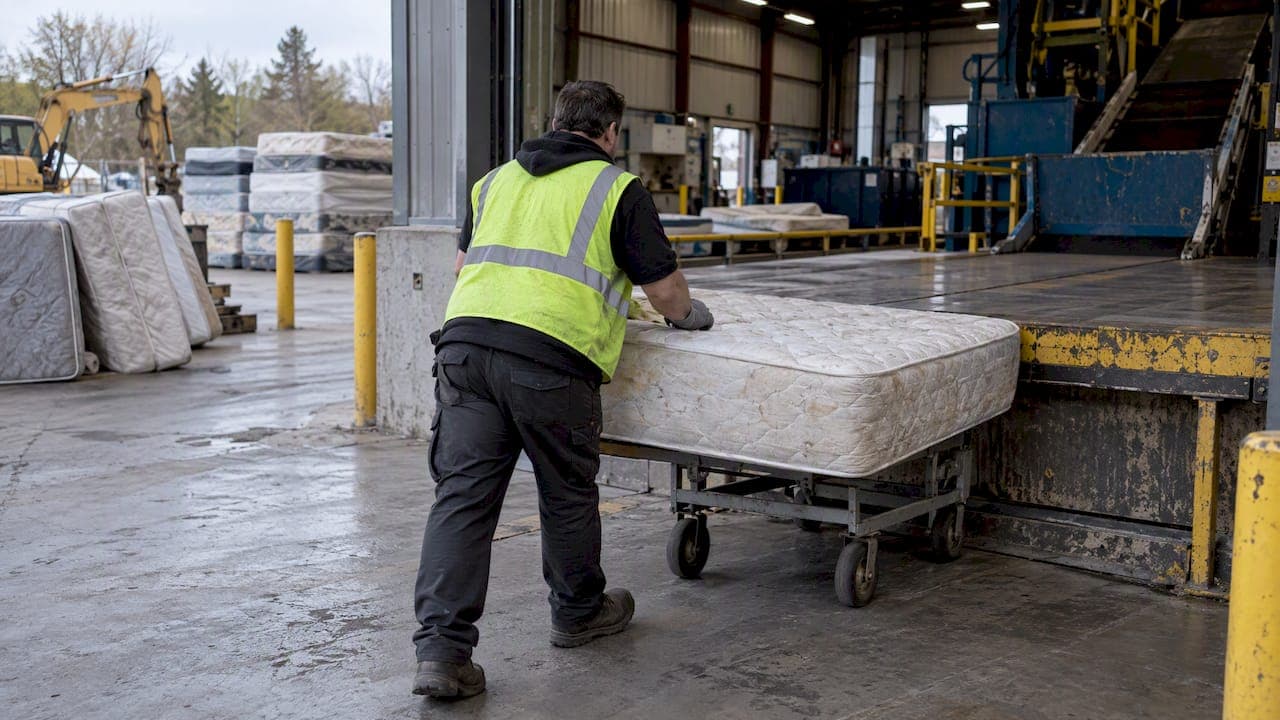
You cannot put a mattress or box spring in your regular trash in Massachusetts. Since November 1, 2022, the state's waste ban regulation (310 CMR 19.017) has prohibited disposing of, incinerating or transferring mattresses for disposal at landfills and waste-to-energy facilities. In practice, that means your old mattress has to be recycled, donated or reused. Exactly how you do that depends on your town, because each municipality sets up its own system.
This guide covers what the ban includes, the one exception, how to find your local option, what it typically costs and when it makes sense to hand the job to a hauler.
TL;DR
- Mattresses and box springs of every size have been banned from Massachusetts trash disposal since November 1, 2022.
- There is no single statewide way to get rid of one. Your town or city decides whether it offers curbside pickup, a drop-off or nothing at all.
- Municipal recycling usually costs about $15 to $100 per piece to the town, and many towns pass some or all of that on to you as a fee.
- Mattresses contaminated by mold, bed bugs, bodily fluids or oil are exempt, but you should document the condition.
- If your town offers nothing or the schedule does not fit, a private hauler can take it away, ideally to a recycler or a charity.
Table of Contents
- What the ban actually covers
- The exception: contaminated mattresses
- How to get rid of a mattress legally in Massachusetts
- What disposal costs
- Mattresses, box springs and frames: the details people miss
- Our perspective: what we see on the job
- When a hauler makes sense
- Book a mattress pickup with us
- Where the rules may go next
- FAQ
- Sources
What the ban actually covers
The rule is aimed at the facilities that receive trash, and it also bans transporting mattresses for disposal. It is not a fine written for a homeowner with one old bed, but a hauler or a trash collector cannot legally take a mattress to a landfill or incinerator.
The definition is broad. According to MassDEP's guidance for municipalities, all sizes are included: crib, twin, twin XL, full, queen, king and California king. The state's FAQ on the mattress and textile ban also confirms that full-foam and mattress-in-a-box products fall under the rule, along with box springs.
The definition excludes some things, including pet bedding, strollers, playpens, car seats and similar infant items, liquid-filled or air-filled bedding without upholstery (waterbeds, basic air mattresses), and the mattress built into a futon or sofa bed. The guidance document lists them in the regulatory definition. If you are unsure about a particular item, call your local department of public works or the MassDEP regional office before it goes to the curb.
Why the state did it
MassDEP reports that more than 600,000 mattresses and box springs are discarded in Massachusetts every year. They are a poor fit for landfills and incinerators. Per a state case study on Cambridge's program, they take up a lot of truck space, are hard to compact, and can get caught in mechanical equipment. Once disassembled, more than 75% of the components can be recycled: steel springs, foam, wood and fiber.
The ban is also part of the state's plan to cut trash disposal 30% by 2030, the target stated in the MassDEP guidance linked above.
The exception: contaminated mattresses
A mattress that cannot be recycled safely is not covered by the ban. Per the state FAQ, mattresses contaminated with mold, bodily fluids, insects such as bed bugs, oil or hazardous substances can go to standard solid waste disposal.
A few practical points follow from that:
- Document it. MassDEP does not strictly require a Contaminated Mattress Certification Form, but it recommends that you record the condition and how the mattress was stored. Photos taken before it goes out are a simple way to do that.
- Keep it dry and wrapped. A mattress that got wet because it sat in the rain at the curb for a week is not a contaminated one in the eyes of a recycler, and a hauler may refuse it.
- Tell your hauler. If you suspect bed bugs, say so when you book. A responsible crew will bag and handle it differently, and it should not be mixed with items bound for donation.
Be honest about this exemption. It covers mattresses that are truly unrecyclable, not ones that are merely old, stained or lumpy.
How to get rid of a mattress legally in Massachusetts
The state guidance lists the municipal models: curbside collection, scheduled drop-off, a transfer station or recycling center, a periodic collection event, or no municipal service at all. Here is how those play out for you, in the order we suggest checking them.
1. Donate it, if it is in good shape
Donation is the top of the waste hierarchy, and the state's mattress recycling guide points residents to the Beyond the Bin Recycling Directory to find charities that may accept good-quality mattresses. Be realistic: many charities will not take a used mattress for hygiene reasons, so call first and ask what condition they accept. A sagging, stained or damaged mattress is a recycling job, not a donation.
2. Use the retailer haul-away
If you are buying a new mattress, ask about removal at checkout. The same state guide notes that many furniture and mattress retailers will take away the old one when they deliver the new one. It is usually the easiest option, so confirm it is offered, whether there is a fee, and that the old mattress goes to recycling.
3. Check your town's program
There is no uniform statewide process. As the state's municipal guidance puts it, each municipality sets its own logistics, funding and fees. Look on your town or city website, or call the DPW, for:
- Whether mattresses are picked up at the curb, and whether you need an appointment
- Whether there is a transfer station or drop-off day
- The fee per mattress and per box spring
- Any limit on how many you can set out
Do not put a mattress out with your regular trash unless your town says it is a scheduled mattress pickup. Collectors can reject it, and an abandoned mattress on the sidewalk can draw a notice from the town.
4. Hire a private hauler
The state is clear that municipalities do not have to provide collection. In towns that don't, about 27% of residents statewide live without a municipal mattress program or where program data is unavailable, and those households have to find and pay for a private recycler or hauler themselves. Even in towns that do have a program, a hauler can be the better choice when you have a stairway, several pieces, a bed frame to take apart or a move-out deadline.
What disposal costs
There is no standard price, which is why you should call before you decide. What the state's research shows:
| Item | What it tells you |
|---|---|
| Municipal cost to recycle one mattress | Typically $15 to $100 per piece, statewide average estimated at $30 to $45 |
| Cambridge example | The city pays a $30 curbside collection fee per mattress, and MassDEP grant funding covers the $16 per-piece recycling cost (same document) |
| Chelsea example | Residents who are not city trash customers pay $40 per item for city pickup (same document) |
Those figures are what municipalities pay or charge, and your own fee can be higher or lower. Some towns absorb the cost, others pass it along. Note the state's own caution: municipal officials have reported that fees can sometimes encourage illegal dumping. It is one reason a free or cheap legitimate option matters, and a reason not to leave a mattress behind a building or at a vacant lot. That is a violation, and it can cost far more than the pickup fee.
Mattresses, box springs and frames: the details people miss
Box springs count. The ban covers box springs as well as mattresses, so a bed set is two items. Our guide to box spring disposal explains how to check your town's rules before you pay for a pickup.
Frames are different. A bed frame is generally wood or metal furniture rather than a mattress, but pickup rules vary. Taking it apart and checking what your hauler accepts avoids a rejected pickup, and we cover the steps in our bed frame disposal guide.
Bedding is separate. Sheets, comforters and pillows fall under the textile ban rather than the mattress rule. See our overview of textile recycling in Massachusetts for how to handle them.
Wrap it for the move. If it is going to donation or recycling, keep it clean and dry until pickup. A mattress bag from a hardware store helps, and a rainy curb night can turn a recyclable mattress into a rejected one.

Multiple units. Landlords, property managers and investors clearing several units often hit town limits on how many mattresses can be set out or collected at one time. Ask for the limit up front, and plan a hauler for the overflow.
Our perspective: what we see on the job
We haul away furniture and household junk in Lawrence, Andover, Boston, Lowell and Haverhill, and mattresses are one of the items people ask about most. A few things stand out from that work.
First, the ban is simple, but the process is not. People assume that a rule that applies statewide has a statewide answer, and it doesn't. The question we get most is some version of "my town said no, now what?" The answer is to find out what your town offers first, because a scheduled municipal pickup may cost you less than a private service.
Second, timing matters more than price for most of our customers. A move-out, an estate cleanout or a tenant turnover has a date, and waiting for a municipal appointment may not fit it. That is when a same-day or flexible-schedule pickup earns its keep.

Third, we think the right goal is to keep usable things in use. We donate and recycle whenever possible, and we work with local charities. A mattress in clean, sound condition may have a second life. One that does not is a recycling item, and we would rather you know that up front than be surprised.
Finally, we would not ask you to pay for a service you do not need. If your town offers inexpensive curbside recycling and you can wait for the pickup date, use it.
— Easy
When a hauler makes sense
A professional pickup is worth a call when:
- Your town has no program, or the next drop-off day is weeks away.
- You are on a deadline, such as a closing, a move-out or a rental turnover.
- You cannot move it yourself. A queen or king mattress is awkward on stairs, and a box spring is worse.
- There is more than a mattress. If you are also clearing a bed frame, couch, dresser or a full room, one trip is cheaper and easier than four separate arrangements.
- You are managing a property. Realtors, landlords and investors often need a unit cleared in one visit, with no one on site.
If you are in the Boston area, our mattress disposal guide for Boston walks through free pickup versus same-day removal in more detail.
What to ask any hauler
- Where does the mattress go: recycling, donation or somewhere else? Because of the ban, it must not go to a landfill or incinerator unless it is a documented contaminated one.
- Is the price per item or per load, and is stair carry or heavy lifting extra?
- Is the crew insured?
- Will you get a written or text quote before the crew arrives?
Book a mattress pickup with us
If your town has no mattress program, or you need the bed out this week, we offer mattress disposal with an insured crew, free quotes and same-day junk removal. We take care of the lifting, and we donate or recycle whenever possible. Clearing more than a bed? Our junk removal service and furniture removal service can take the whole room in one visit. You can also start from our home page to see everything we handle.
Where the rules may go next
The ban may not be the last word. The state's Extended Producer Responsibility Commission has looked at the current patchwork of 351 separate municipal programs and the gaps it leaves, and its report recommends that the Legislature enact a producer-funded program for mattresses. Until a law passes, the current system holds: the ban applies, your town decides the local process, and private services fill the gaps. Check the MassDEP waste ban page for updates.
FAQ
Is it illegal to throw a mattress in the trash in Massachusetts?
Yes, in effect. Since November 1, 2022, mattresses and box springs are banned from disposal and from transport for disposal at landfills and waste-to-energy facilities. A trash hauler cannot legally take one to those facilities, so most will leave it behind unless your town runs a mattress program.
Can I dispose of a mattress myself?
Yes, if you take it to a legitimate recycling or donation outlet. Your town's drop-off or transfer station is the usual place, or a charity if the mattress is in good condition. What you cannot do is put it in the trash, haul it to a landfill or leave it on a curb or lot. Call your DPW first to confirm the fee and the hours.
What if my mattress has bed bugs or mold?
Contaminated mattresses are exempt from the ban and can go to standard solid waste disposal, according to the state FAQ. MassDEP recommends documenting the condition and how it was stored, for example with dated photos. Tell your hauler or town in advance so it is handled correctly.
Does the ban apply to businesses and landlords?
Yes. The ban applies to residents and businesses alike, and the state counts both among those who discard mattresses. Landlords and property managers clearing units must send mattresses to recycling or donation, and should keep a record of where they went.
How much does it cost to get rid of a mattress?
It depends on where you live. Municipalities typically pay $15 to $100 per mattress to recycle it, and some pass that on as a fee, while others cover it. Private haulers set their own prices, so ask for a quote that spells out what is included.
Sources
- Waste Ban on Mattresses and Textiles: frequently asked questions (Mass.gov)
- Mattress Waste Disposal Ban & Recycling Guidance for municipalities (Mass.gov)
- Mattress recycling guide (Mass.gov)
- Curbside mattress recycling case study: City of Cambridge (Mass.gov)
- EPR Commission mattress background and recommendations, August 2025 (Mass.gov)
- Commission draft final report (Mass.gov)
- MassDEP waste disposal bans (Mass.gov)