
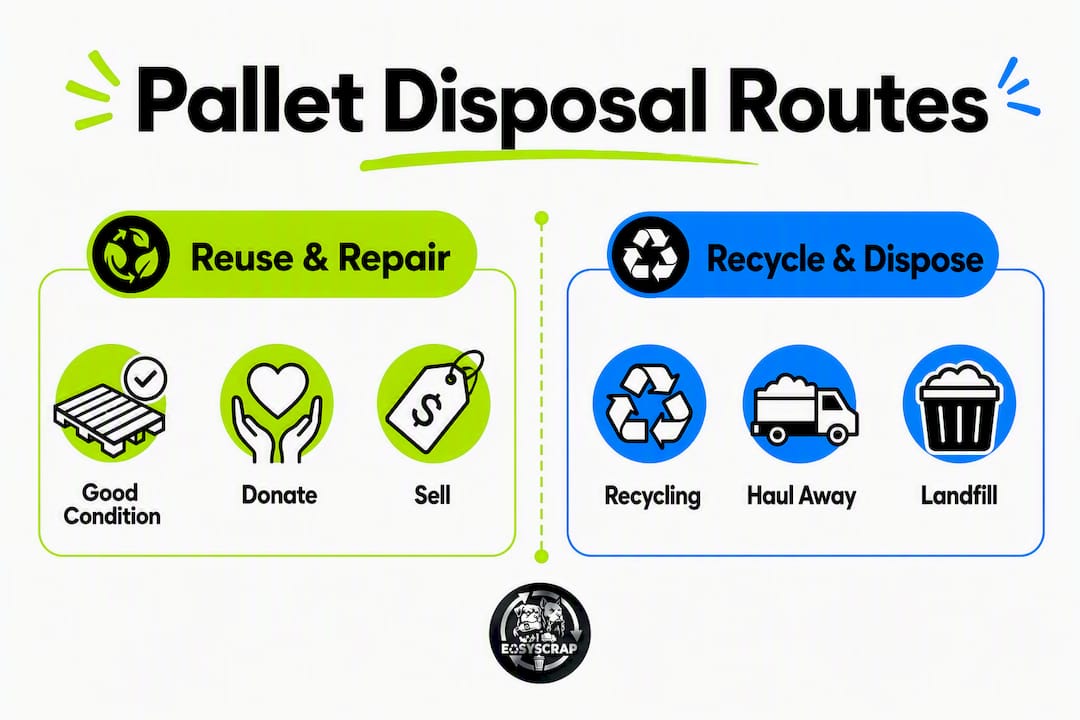
If you need to get rid of pallets, the first step is checking their condition. Good pallets get reused, sold, or donated. Damaged ones go to specialized recyclers. Contaminated or mixed loads go to a paid hauler. One rule applies no matter what: do not put pallets in curbside recycling — they jam sorting equipment and are rejected by virtually every municipal program.
Here is the short version by situation:
Homeowners with a few pallets:
- Condition is good? List them free on a local community exchange or offer them to a garden center.
- Broken but not contaminated? Call a local pallet yard or drop them at a wood recycler.
- Mixed, dirty, or you just need them gone fast? Book a junk removal pickup.
Businesses with ongoing or large volumes:
- Standard 48x40 GMA pallets in good shape? Sell or trade them back through a pallet yard or recycler buyback program.
- Damaged or nonstandard? Route to a chipping or biomass facility.
- High volume, mixed condition, or compliance documentation needed? Hire a removal service with on-site sorting.
Table of Contents
- Which pallet disposal route is right for your situation?
- How to prioritize reuse and repair before anything else
- Where and how to sell, give away, or trade your pallets
- How pallet recycling and processing actually works
- How do you find pallet recyclers and drop-off points near you?
- When should you hire a haul-away or junk removal service?
- What does pallet removal or recycling typically cost?
- How to prepare pallets for pickup or drop-off
- What you need to know about treated wood, contamination, and local rules
- Why reuse and repair should come before recycling or disposal
- Key Takeaways
- The part most guides skip about pallet disposal
- Get your pallets picked up fast with Easyscrapofficial
- Useful sources and directories
Which pallet disposal route is right for your situation?
The table below maps the five main options against the factors that actually determine which one fits.
| Route | Best for | Who accepts | Condition required | Typical cost | Environmental outcome |
|---|---|---|---|---|---|
| Reuse / repair | Single pallets, small batches | Pallet yards, warehouses, retailers | Good to repairable | Free or small repair cost | Highest: keeps material in use |
| Sell / donate | Clean, standard pallets | Pallet buyers, garden centers, breweries, nonprofits | Good, standard size | Free to small payment | High: direct reuse |
| Specialized recycling | Damaged, non-reusable wood | Pallet recyclers, chippers, biomass facilities | Damaged, clean (no contamination) | Free to small fee | Medium: material recovery |
| Paid junk removal | Mixed loads, large volumes, urgency | Junk haulers (e.g., Easyscrapofficial) | Any condition | Fee based on volume/labor | Variable: hauler routes to best outcome |
| Landfill (last resort) | Contaminated, chemically treated | Transfer stations | Any | Disposal fee | Lowest: avoid if possible |
Pro Tip: Remove plastic wrap, strapping, and loose debris before any pickup or drop-off. Contamination is the single most common reason recyclers reject a load — and it can turn a free pickup into a paid disposal job.
How to prioritize reuse and repair before anything else
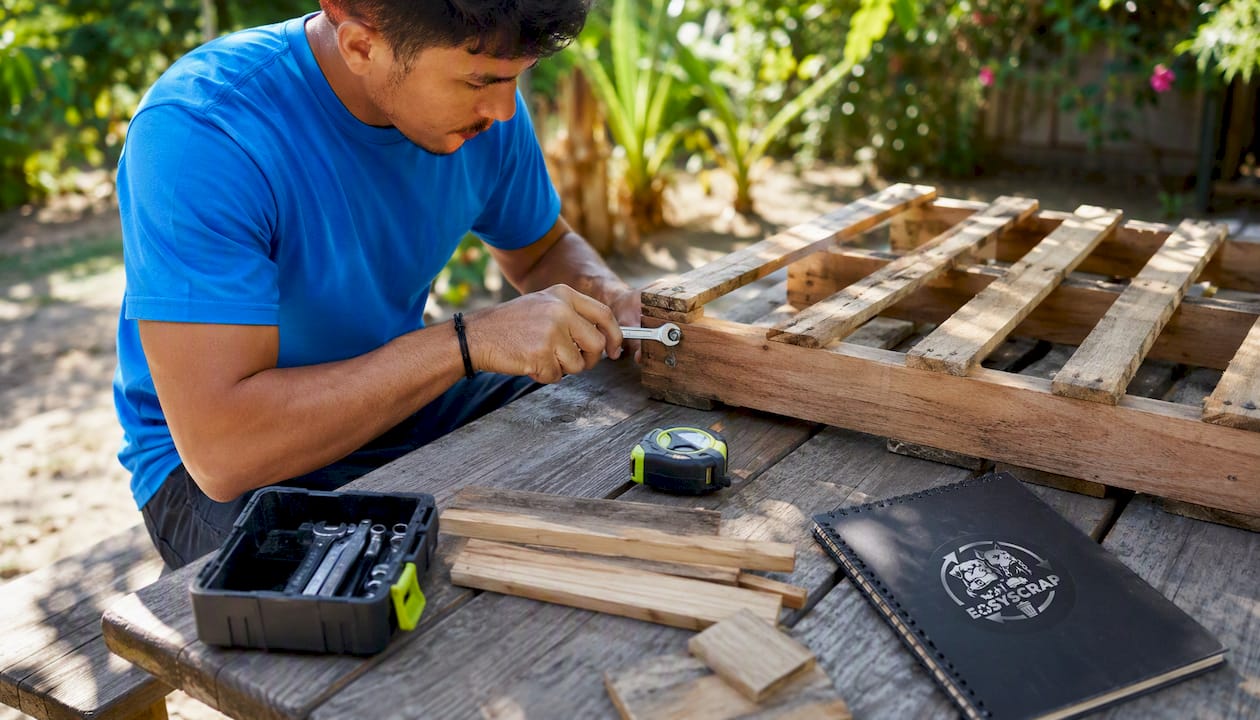
Reuse and repair is the lowest-cost, highest-impact choice for any pallet that still has structural integrity. A standard GMA 48x40 pallet in good condition is worth real money to pallet yards and recyclers. A broken one that you spend ten minutes fixing is worth the same.
Inspection: what to check before deciding
- Size: Is it a standard 48x40 inch GMA pallet? Non-standard sizes have a much smaller resale market.
- Structural integrity: Push down on each corner. Any give in the stringers (the long side boards) means load-bearing capacity is compromised.
- Deck boards: Count broken or missing boards. One or two missing boards is repairable. More than that, and repair costs outweigh value.
- Contamination: Look for oil stains, chemical residue, food waste, or mold. Any of these usually disqualifies a pallet from reuse.
- Treatment markings: Check the pallet stamp. "HT" means heat-treated — safe for reuse. "MB" means methyl bromide treated — not safe, do not reuse.
Basic repairs you can do yourself
- Replace a broken deck board with a matching-width board and ring-shank nails.
- Hammer down or remove protruding nails before handling or stacking.
- Reinforce a cracked stringer with a companion board nailed alongside it.
Wear gloves and safety glasses when working with old pallet lumber. Splinters from weathered wood are surprisingly sharp, and hidden nails are a real hazard.
Condition quick-reference:
- Good: All boards intact, no contamination, HT stamp present. Sell or reuse.
- Repairable: One or two boards missing or cracked, no contamination. Fix and reuse.
- Scrap: Multiple broken boards, contamination, MB stamp, or structural failure. Route to recycler or hauler.
Where and how to sell, give away, or trade your pallets
Selling or donating is often free and sometimes profitable for clean, standard pallets. The market for used GMA pallets is active, and buyers are often local.
Common channels worth trying first:
- Local pallet yards and recyclers: Many will pick up clean, standard pallets for free or pay a small per-pallet rate. Call ahead with your count and condition.
- Community exchanges: Platforms like Craigslist, Facebook Marketplace, and Nextdoor move pallets quickly when listed with clear photos and dimensions. Free listings often get responses within hours.
- Garden centers and nurseries: They use pallets constantly for display and storage and often prefer free pickup arrangements.
- Breweries and small manufacturers: These businesses go through pallets fast and frequently source locally to cut costs.
- Nonprofits and community organizations: Habitat for Humanity ReStores and similar organizations sometimes accept clean pallets for building projects or resale.
When you list pallets, include: the count, dimensions (48x40 or other), wood type if known, the HT stamp confirmation, and whether you offer loading help or require the buyer to load. A photo showing the stack condition closes deals faster than any description.
Pro Tip: List pallets in batches of 10 or more when possible. Buyers who need volume will pass on a listing of two or three, but a batch of 20 gets calls. If you only have a few, offer them alongside other free materials to make the trip worth someone's time.
How pallet recycling and processing actually works
Recycling pathways vary by material, and knowing the difference helps you avoid a wasted trip.
Wood pallets follow this sequence at most facilities: inspection for reuse potential, separation by condition, repair and resale for good units, then chipping or grinding for damaged wood. Chips go to mulch or biomass energy recovery, particleboard manufacturing, or biomass energy recovery. Some recycling firms buy or accept clean, repairable pallets and send unrecoverable wood to chipping, so the load rarely ends up entirely in one stream.
Plastic HDPE pallets have a more predictable end-of-life path. HDPE can be reground and remolded into new plastic products, and pooled plastic pallet systems shift that end-of-life responsibility to the provider entirely. If your business uses rented or pooled plastic pallets, the provider typically handles return and recycling.
Metal pallets are reclaimed through standard scrap metal channels. Most scrap yards accept them without issue.
| Material | Common acceptance path | Key caveats |
|---|---|---|
| Untreated wood (HT stamp) | Reuse, repair, resale, or chipping | Must be clean; no oil or chemical contamination |
| Chemically treated wood (MB stamp) | Special disposal only | Cannot be reused or chipped for mulch |
| HDPE plastic | Regrind and remold, or pooled return | Confirm facility accepts HDPE — not all do |
| Composite / mixed material | Limited options; facility-specific | Call ahead; many facilities decline composites |
How do you find pallet recyclers and drop-off points near you?
Start with your county solid waste office and pallet recycler directories, then expand from there. Most county offices maintain lists of local drop-off sites or can refer you directly to a pallet recycler. Contact them first for local rules and resources before driving a load anywhere.
Reliable lead sources:
- Pallet recyclers by state directory (Wood Packaging Global): searchable by state, lists facilities with contact info.
- State recycling market directories: Most state environmental agencies publish searchable databases of recyclers by material type. Search "[your state] recycling market directory" to find yours.
- County solid waste or recycling district pages: Search "[your county] solid waste recycling" for local drop-off rules and facility lists.
- Municipal recycling pages: Some cities list pallet-specific drop-off events or permanent sites.
- Industrial scrap brokers: For large volumes, brokers can arrange pickup and often have relationships with multiple facilities.
Before you haul anything, ask the facility:
- Do you accept pallets in my condition (damaged, contaminated, non-standard)?
- Is there a drop-off fee, or do you offer free or paid pickup?
- What materials do you NOT accept (plastic, composite, MB-treated)?
- Do you require an appointment?
A quick sample workflow: search your state's recycling directory for "wood pallets," filter by your county, call the top two results with your pallet count and condition, confirm acceptance and any fees, then schedule drop-off or pickup. That process takes about 15 minutes and saves a wasted trip.

When should you hire a haul-away or junk removal service?
Hire a hauler when you need same-day removal, have mixed or contaminated pallets, are dealing with large volumes, or simply cannot handle transport safely on your own. Trying to move a stack of 30 pallets in a pickup truck is both a safety risk and a logistical headache.
Large-scale removal services can accept mixed-condition loads, sort on-site, and route materials to repair, donation, recycling, or disposal. They can also provide documentation for compliance if your business needs a disposal record.
What to expect from a quality pallet removal service:
- On-site sorting by condition and material
- Insured crew handling all loading and transport
- Routing to donation, recycling, or appropriate disposal based on condition
- Compliance documentation available on request
- Same-day or next-day scheduling for urgent removals
Easyscrapofficial offers exactly this for homeowners and businesses in the Lawrence, Andover, Boston, Lowell, and Haverhill areas. The crew is insured, the pickup can be same-day, and usable pallets get routed to donation or recycling rather than the landfill. For a full-service junk removal that handles the sorting and hauling so you don't have to, that's the call to make.
Pricing is typically based on:
- Volume (number of pallets or cubic yards of material)
- Labor required (stacking, loading, tight access)
- Distance and travel time
- Whether the load is clean or mixed/contaminated
Have this information ready when you call for a quote: total pallet count, approximate condition (good, damaged, contaminated), location and access (loading dock, driveway, basement), and whether you need same-day service.
Pro Tip: If you're clearing out a garage or warehouse and pallets are just part of the load, bundle them into a single removal job. Most haulers price by volume, so combining pallets with other junk removal often costs less than two separate trips. Easyscrapofficial handles garage cleanouts and mixed loads in one visit.
What does pallet removal or recycling typically cost?
Costs vary by condition and volume. Clean, standard pallets often move for free or generate a small payment. Damaged or contaminated pallets usually carry a processing fee or disposal charge.
- Sell/donate (good pallets): Free to a small per-pallet payment, depending on local demand and pallet quality. Some pallet yards pay $1–$5 per GMA pallet in good condition, though rates vary by region and market.
- Recycler drop-off (damaged, clean wood): Often free for clean wood. Some facilities charge a small per-pallet or per-load fee for damaged material.
- Recycler pickup (volume): Free pickup is common for large clean loads; mixed or contaminated loads may carry a fee.
- Paid junk removal: Priced by volume and labor. Expect a minimum charge for small loads, with pricing scaling by cubic yard or pallet count for larger volumes. Travel fees and loading labor may apply.
- Landfill disposal: Transfer station fees vary by county, typically charged by weight or volume.
Watch for these billing practices:
- Minimum charges: most haulers have a job minimum regardless of load size.
- Travel fees: longer distances from the service area may add a surcharge.
- Loading labor: tight access or heavy stacking adds time, which adds cost.
- Contamination surcharges: a load that arrives dirtier than described may be reclassified and repriced.
Timeframes are equally variable. A community exchange listing can move pallets in a day. A recycler pickup for a large clean load typically schedules within a week. Paid junk removal with Easyscrapofficial can happen same-day.
How to prepare pallets for pickup or drop-off
Clean preparation is the difference between a smooth pickup and a rejected load. Do this before any hauler or recycler arrives:
- Remove all plastic wrap, strapping, and banding. Loose plastic contaminates wood recycling streams and is a common rejection trigger.
- Clear loose debris. Sweep off dirt, broken boards, and any product residue from the pallet surface.
- Separate contaminated or treated units. Pull out any MB-stamped or visibly contaminated pallets and set them aside. Never mix them into a clean load.
- Stack and bundle for safe handling. Stack pallets flat, no more than 4–5 feet high for stability. Secure bundles with strapping if you have it.
- Label treated or special-condition pallets. A simple piece of tape with "MB" or "contaminated" written on it prevents confusion during sorting.
- Confirm truck access. Make sure the pickup location has enough clearance for a standard box truck or flatbed. Tight driveways or low overhangs need to be flagged when you book.
For businesses generating pallets regularly, keep a brief log of pallet counts, condition, and disposal method. Some states and industries require disposal documentation, and having records ready saves time if you're ever audited.
Safety note: Always wear gloves when handling old pallets. Protruding nails, splinters, and unstable stacks are the most common injury sources. Never stand under a stacked pallet load during loading or unloading.
What you need to know about treated wood, contamination, and local rules
Treated or chemically contaminated pallets often cannot be resold or accepted by standard recyclers and may require a separate disposal stream entirely.
How to read the pallet stamp:
- HT = heat-treated. Safe for reuse, resale, and standard wood recycling.
- MB = methyl bromide treated. A chemical fumigant. Do not reuse, do not chip for mulch, do not compost. Requires special disposal.
- DB = debarked only. Generally safe for reuse.
- No stamp or illegible stamp: Treat as unknown. When in doubt, route to a recycler who can assess it, or ask your hauler.
Municipal rules to know:
- Pallets are excluded from curbside recycling in virtually every U.S. municipal program. Placing them at the curb risks a fine and damages sorting equipment.
- Drop-off rules vary by county. Some transfer stations accept clean wood pallets; others do not. Always call before you haul.
- Businesses in some states face specific wood waste disposal bans or requirements. Check your state environmental agency's waste disposal rules.
Storage and fire safety:
- Do not store large pallet stacks indoors or against a building. Dry wood pallets are a significant fire hazard.
- Keep outdoor stacks away from structures, ideally on a hard surface with clearance on all sides.
- Limit stack height to reduce collapse risk during storage or loading.
"Pallets should not be placed in your recycling cart or bin. They are too large for the recycling process and can damage equipment at the recycling facility." — Cuyahoga County Solid Waste District
Why reuse and repair should come before recycling or disposal
The environmental case for reuse-first is backed by EPA data on wood in the municipal solid waste stream. In 2018, the EPA measured roughly 18.1 million tons of wood generated in the U.S. municipal solid waste stream. Only about 3.1 million tons were recycled, a 17.1% recycling rate, while approximately 12.15 million tons went to landfills. That gap is enormous, and most of it is avoidable.
The numbers in context: The wood recycling rate means that many tons of wood waste, including pallets, ended up landfilled in 2018. Reuse keeps material out of that stream entirely.
Every pallet that gets repaired and reused avoids both the landfill input and the energy cost of processing. Recycling recovers material value but still consumes energy in chipping, transport, and remanufacturing. Reuse skips all of that.
For businesses with steady pallet needs, pooled plastic pallet systems take this logic further. The provider owns the pallets, manages returns, and handles end-of-life recycling. The business never deals with disposal at all. That closed-loop model is the highest-efficiency option for high-volume operations.
The waste hierarchy is simple: reuse first, repair second, recycle third, dispose only when necessary. Following it in that order is both the most sustainable and usually the cheapest path.
Key Takeaways
Reuse and repair is the most cost-effective and environmentally responsible first step for pallet disposal, with recycling or paid removal as the correct fallback when pallets are damaged, contaminated, or high-volume.
| Point | Details |
|---|---|
| Never use curbside recycling | Pallets damage sorting equipment and are excluded from virtually every U.S. municipal curbside program. |
| Reuse-first saves money and landfill space | EPA data shows that in 2018, only about 17.1% of wood in the municipal solid waste stream was recycled while approximately 12.15 million tons went to landfills; reuse keeps pallets out of the landfill stream entirely. |
| Condition determines your route | HT-stamped, standard GMA pallets can be sold or donated; MB-stamped or contaminated pallets require special disposal. |
| Prepare pallets before any pickup | Remove plastic wrap, separate contaminated units, and stack safely to avoid rejection fees. |
| Easyscrapofficial handles what you can't | For mixed, contaminated, or large-volume loads, Easyscrapofficial offers insured same-day pickup with recycling and donation routing. |
The part most guides skip about pallet disposal
Most pallet disposal advice stops at "find a recycler." That's fine as far as it goes, but it misses the more important question: why are you generating disposal-bound pallets in the first place?
For homeowners, the answer is usually a one-time situation, and the reuse or donation route genuinely solves it. But for businesses, a steady stream of disposal-bound pallets is often a sign of a procurement or storage problem, not a disposal problem. Buying low-quality or nonstandard pallets, storing them in conditions that accelerate damage, or not tracking pallet return rates all create disposal costs that a better upstream decision would eliminate.
The businesses that handle pallet waste management best are not the ones with the most efficient disposal contracts. They're the ones that have reduced the disposal volume itself, through standardized pallet specs, return agreements with suppliers, or pooled systems. Disposal is the last resort in the waste hierarchy for a reason: it means the material's value has already been lost.
That said, some disposal is always going to happen. When it does, the right call is fast, responsible, and documented. That's where a service like Easyscrapofficial earns its keep: not as a permanent solution to a procurement problem, but as the clean, efficient exit when you need one.
Get your pallets picked up fast with Easyscrapofficial
When reuse and recycling routes aren't practical, fast and responsible removal is the next best move. Easyscrapofficial offers insured local pickup for pallets and mixed loads across Lawrence, Andover, Boston, Lowell, and Haverhill, with same-day availability and a commitment to recycling and donation routing before anything goes to landfill.
No sorting required on your end. The crew handles loading, on-site separation, and hauls everything away. To get a quote, have your pallet count, condition, and location ready, then book your pallet pickup directly through the Easyscrapofficial services page. Free quotes, no obligation, and same-day slots available for urgent removals. For larger cleanouts that include pallets alongside other items, the full services page covers every removal type in one booking.
Useful sources and directories
- Wood: Material-Specific Data | U.S. EPA: — The primary source for U.S. wood waste generation, recycling rates, and landfill volumes. Use this to understand the scale of the problem and verify the 17.1% recycling rate figure.
- Tips for Businesses Generating Pallets | NC DEQ: — Practical state-level guidance on pallet condition, acceptance criteria, and how to connect with local recyclers and solid waste offices.
- Pallet Foundation: Industry association for the pallet sector; useful for understanding industry standards, GMA specifications, and pallet management best practices.
- Nature's Packaging: Wood packaging industry resource covering sustainability, lifecycle data, and the environmental case for wood pallets versus alternatives.