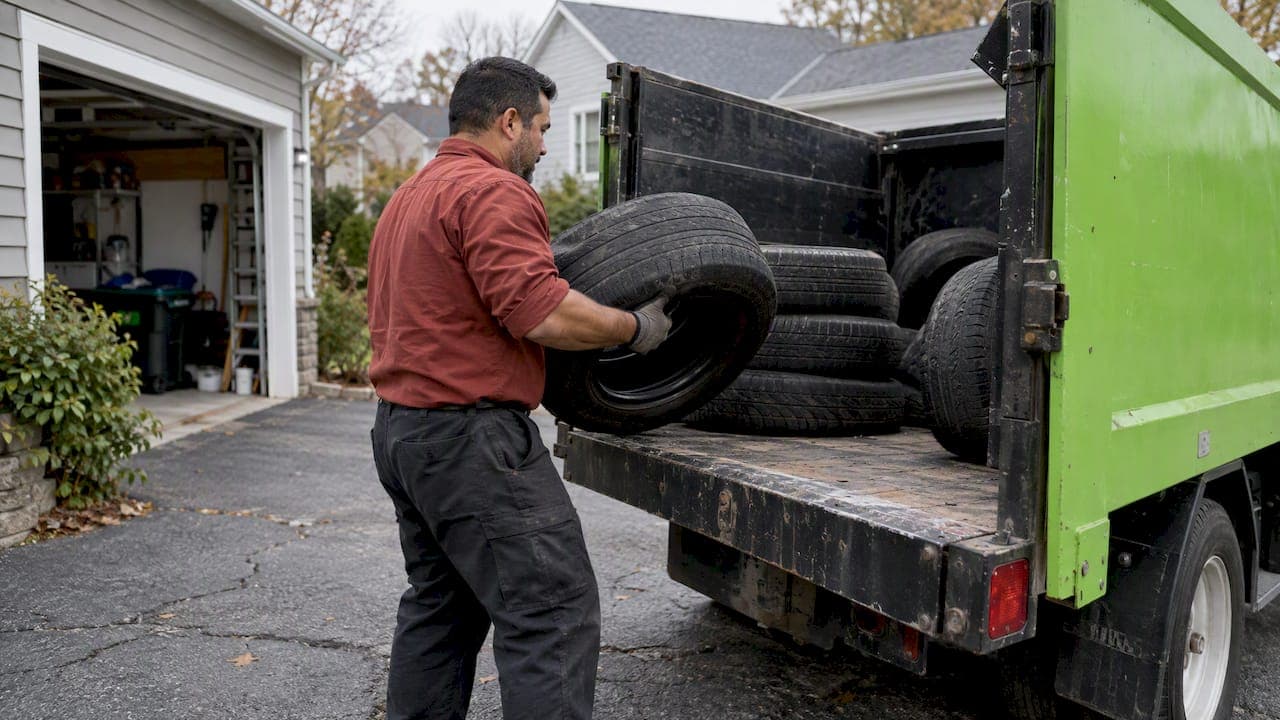
You have five realistic ways to get rid of old tires: hand them to a tire retailer when you buy new ones, drop them at your town's transfer station, use a municipal collection or amnesty event, take them to a facility that accepts scrap tires, or hire a permitted hauler. Which one fits depends on how many tires you have, how long they have been sitting, and what else needs to leave the property.
The one thing you should not do is put whole tires in the regular trash. In Massachusetts, whole tires are banned from landfills, and the rules reach the people who hire haulers too. Below we compare each route, with real fees, so you can pick the cheapest legal option for your situation.
TL;DR
- Whole tires cannot go out with household trash in Massachusetts. They have to be processed, shredded or recycled through a legal channel.
- Cheapest routes: a retailer when you buy new tires, or your town's transfer station. Transfer station fees we found run from about $5 to $10 per passenger tire, and they vary by town.
- For a pile of tires from a garage, basement, shed or estate, a permitted hauler is the practical answer, and you should ask for proof of where the tires went.
- Old, weathered tires are harder to recycle, and stockpiles create fire and mosquito risks, so do not let them sit.
Table of Contents
- Why you can't throw tires in the trash
- Your tire disposal options compared
- What happens to a tire after you drop it off
- The risk of letting tires pile up
- Who is responsible if a hauler dumps your tires illegally?
- Our perspective: tires are the item that gets forgotten
- When EasyScrap fits
- A quick decision guide
- FAQ
- Sources
Why you can't throw tires in the trash
Massachusetts introduced its first waste bans in 1990, and they restrict what can be landfilled or burned at solid waste facilities. Whole tires are on that list. Your trash hauler is not allowed to take them, and a disposal facility that finds them can reject the load.
The reasons are practical. Whole tires tend to work their way up through a landfill, they are a fire load, and they hold water. Tire piles are also well-known breeding sites for mosquitoes, including species that carry West Nile virus, and a tire fire is hard to put out. The EPA's scrap tire cleanup guidebook covers these hazards in detail for solid waste managers.
New Hampshire residents face similar practical limits. Municipal transfer stations there take tires as a separate, fee-based category rather than with household trash.
Your tire disposal options compared
| Option | Typical cost | Best for | Watch out for |
|---|---|---|---|
| Retailer when buying new tires | Often free or a small per-tire fee | 1 to 4 tires, replacing a set | Many shops will not take tires you did not buy from them |
| Town transfer station | About $5 to $10 per passenger tire in the examples below | A few tires, residents with a sticker or ID | Limits, rim rules, resident-only access |
| Amnesty or bulky waste event | Free or reduced | Residents who can wait for the date | Per-household caps, fixed schedule |
| Scrap tire facility or drop-off | Fee per tire, varies by size | Larger quantities you can haul yourself | Trucking, size surcharges |
| Permitted junk hauler | Quoted by the job | Piles, cleanouts, no truck or time | Confirm legal disposal |
Option 1: Let the tire retailer take them
If you are replacing tires, this is usually the simplest path. South Carolina's environmental agency notes that in most cases the retailer keeps and takes responsibility for old tires when you buy new ones. Shops often fold a small disposal charge into the installation bill, and some waive it when you buy there.

Ask for the fee before the work starts, so it is not a surprise on the invoice. If you have extra old tires in the garage, ask whether they will take those too. Many will, for a per-tire fee, but some will not.
Option 2: Drop them at the transfer station
Most towns in northeastern Massachusetts and southern New Hampshire run a transfer station or recycling center that takes tires for a fee. Fees are set town by town, so check yours before you load the car.
To give you a sense of the range, Littleton, Massachusetts lists tires at $10 each in its fiscal 2027 fee schedule, effective July 1, 2026. That same brochure repeats the state rule: whole tires are banned from landfills, and shredded tires are acceptable. In New Hampshire, the state recycling council's list of example transfer station fees (updated October 28, 2025) shows one district charging $5 per passenger car or truck tire, while another charges more for tires with rims or debris. Treat those as examples, not your town's price.
Things to confirm by phone or on the town website:
- Whether you need a resident sticker or proof of address
- Whether tires on rims cost more
- Whether there is a per-visit limit
- Whether the town accepts tires from landlords or businesses (many accept residential only)
If your goal is to keep disposal costs down generally, this guide to reducing household waste and saving money is a good place to look for other low-cost local options.
Option 3: Watch for amnesty days and bulky waste events
Many towns and counties hold periodic collection days where residents can drop off a limited number of scrap tires free or at a reduced fee. Texas's environmental commission, for example, points residents to bulky trash collection events sponsored by local government as a place to get rid of tires at home.
The tradeoff is timing. If you are a Realtor with a listing going live Friday, you cannot wait for the spring event. If you are a homeowner who has had four tires behind the shed for a year, it can be the cheapest route. Check your town's DPW page for the schedule and per-household limit.
Option 4: Take them to a facility that accepts scrap tires
Some private recyclers and landfills accept tires directly, usually for a per-tire fee that rises with size. Passenger tires cost the least, and truck, tractor and oversized tires cost much more. Call ahead: policies differ on rims, quantity limits and whether they take residential loads. The Texas guidance above notes that a landfill may accept tires directly but will usually charge for it.
This works if you have a pickup and a morning free. It stops being worth it once the trips, fees and loading time add up.
Option 5: Hire a permitted hauler
If you have a pile of tires, or the tires are one item among many in a cleanout, a professional hauler saves the most effort. Tennessee's waste tire program is a good example of how states regulate this: waste tires must be collected, transported, processed and reused or disposed of through authorized channels. The principle is the same elsewhere, and the person who hands tires to an unlicensed hauler can end up with the problem.
Before you hire anyone, ask these questions:
- Is the company insured?
- Where do the tires go, and can you show proof of disposal or a manifest?
- Will the quote cover every item you want gone, in one visit?
- Do they reuse, donate or recycle when possible?
What happens to a tire after you drop it off
Environmental agencies rank tire handling like this: reduce, reuse (including retreading), recycle, recover energy, and landfill last. Recycling usually means grinding tires into crumb rubber, which goes into products like rubberized asphalt, running tracks and floor mats, or shredding into rubber mulch.

Burning tires as fuel is common, but it is a lower rung. The EPA says using scrap tires as fuel is not recycling but is a beneficial use, because recovering the energy beats landfilling.
There is a practical lesson here for homeowners. A fresh tire from a shop is easy to process. A tire that has sat in a yard collects water, dirt and debris, which makes high-value recycling harder, and it is more likely to end up as fuel. The sooner an old tire goes into the system, the better its odds.
The risk of letting tires pile up
It is easy to say you will deal with the tires later. A few reasons not to:
- Mosquitoes. Standing water in tires is a classic breeding spot.
- Fire. Tire fires burn hot, give off heavy smoke and are hard to extinguish.
- Stockpile rules. Regulators and fire officials can define a large accumulation of tires as a stockpile, even when you intend to reuse them, which can bring permit or fire-safety requirements. Check with your local fire department and the Massachusetts Department of Environmental Protection if you have a significant number.
- Enforcement. MassDEP does penalize tire handlers. In 2022 it assessed a $16,080 penalty against a New Bedford tire company for solid waste violations. That case involved a business, but it shows the state takes tire handling seriously.
If you own a property with a large pile you did not create, such as an inherited house or a purchased investment property, talk to your local board of health or conservation office early. The EPA guidebook describes voluntary agreements between property owners and regulators for cleaning up scrap tires, which can help avoid enforcement trouble.
Who is responsible if a hauler dumps your tires illegally?
This part surprises landlords, property managers and investors. Under Massachusetts waste ban rules, restrictions cover disposal, transfer for disposal and contracting for disposal of banned items. In plain terms, hiring someone to dispose of banned material is covered too, not only dumping it yourself.
The practical protection is simple. Hire an insured company, ask where the tires go, and keep the paperwork when you are moving many tires. A low flat price from a stranger with a pickup and no business name is a red flag.
Our perspective: tires are the item that gets forgotten
We run junk removal and cleanouts around Lawrence, Andover, Boston, Lowell and Haverhill, so we see how tires turn up in practice. They are rarely the reason someone calls. They are the items behind the lawn mower in the garage, stacked in the basement bulkhead, or left by a previous owner in the shed, and they surface once the cleanout starts.
Our view is simple. If you have one or two tires and a free Saturday, the transfer station or the shop that sells you new tires is usually the cheapest option, and you should use it. If the tires are part of a bigger job, such as a garage, basement, attic, estate or a property you are preparing to list, it makes more sense to have one insured crew clear everything in one visit than to make three separate trips with a loaded trunk.
We also care where things end up. We donate and recycle whenever possible, and we would rather you ask us how a particular item will be handled than guess. When you request a quote, tell us how many tires there are and whether they are on rims, and we will tell you what we can do with them.
— Easy
When EasyScrap fits
If your tires are part of a larger clear-out, our junk removal service is built for that: you point at what goes, and our insured crew handles the loading and hauling. Quotes are free, and we offer same-day scheduling. Common jobs where tires show up include garage cleanouts and basement cleanouts, and our full list of services covers estate cleanouts, construction debris and yard waste too.
Realtors and investors preparing a property for the market can bundle tires with furniture, appliances and everything else in a single visit. Tell us up front about any tires so we can plan for them, and visit EasyScrap to request a quote.
A quick decision guide
One to four tires, you are buying new: ask the shop to take the old ones and confirm the fee before installation.
One to four tires, no new purchase: call your transfer station and ask about fees, limits and whether they take tires on rims.
A handful of tires, no rush: wait for the next town collection day, if your town holds one.
A pile, or tires mixed into a cleanout: book a licensed, insured hauler and ask for proof of proper disposal.
An inherited or purchased property with a large stockpile: call the board of health, ask about local requirements, then hire a hauler who can document where the tires went.
FAQ
Can I put old tires in my regular trash?
No, not in Massachusetts. Whole tires are banned from landfills, so your curbside hauler will not take them and a facility can reject a load that contains them. Use a retailer, a transfer station, a collection event or a permitted hauler instead.
How much does it cost to get rid of a tire?
It depends on where you go. In the fee schedules we found, a Massachusetts town charges $10 per tire and one New Hampshire district lists $5 for a passenger tire. Retailers often charge a small fee or include it with new tires. Fees for rims, truck tires and large tires are higher, so check your own town's schedule.
Will a tire shop take tires I didn't buy from them?
Some will for a per-tire fee, and some will not. Policies vary by shop, so call first and ask about fees and limits. Retailers are generally the easiest option when you are buying replacements at the same time.
What should I do with a big pile of tires on my property?
Do not burn or bury them, and do not leave them to collect water. Contact your local board of health or fire department about any stockpile rules, then use a permitted hauler and keep proof of where the tires went.
Sources
- MassDEP Waste Disposal Bans
- Fact sheet: Your business and the waste bans (Mass.gov)
- Scrap Tire Cleanup Guidebook (EPA)
- Tire-Derived Fuel (EPA)
- MassDEP penalty press release, 2022
- Mass.gov
- Littleton, MA Transfer Station fees, FY27
- Disposal fees at NH municipal transfer stations
- Where Can Residents Recycle Tires? (South Carolina DES)
- Disposing of Tires from Your Home (TCEQ)
- Waste Tire Program (Tennessee TDEC)
- Waste Tire Recycling and Proper Disposal (Indiana IDEM)