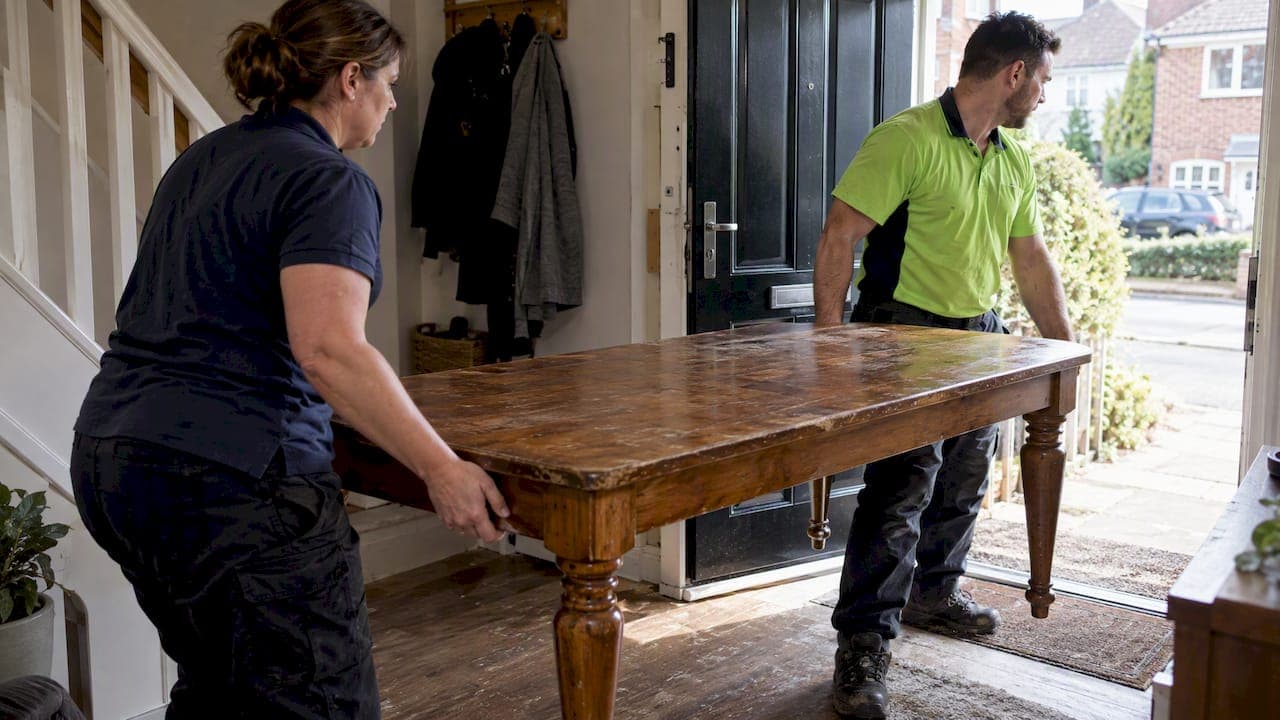
You have five realistic routes for old furniture: reuse or sell it, donate it, put it out with your town's bulky-item pickup, haul it to a transfer station, or pay a full-service hauler to carry it out of your house. The right one depends on the piece's condition, how much you have, how it gets out of the building, and what your town allows. This guide walks through each route, with the rules that trip people up in Massachusetts and southern New Hampshire.
TL;DR
- Usable furniture should go to reuse first: sell it, give it away, or donate it after a phone call to confirm the charity will take it.
- Damaged pieces usually go through town bulky pickup, a transfer station, or a paid hauler. Rules, limits and fees vary by town, so check before you carry anything to the curb.
- Mattresses and box springs are a separate case in Massachusetts. They have been banned from ordinary disposal since November 1, 2022.
- If the furniture is heavy, upstairs, or part of a bigger cleanout, a full-service crew is usually the fastest and safest route.
Table of Contents
- Start with condition, not material
- Route 1: Sell it or give it away
- Route 2: Donate it
- Route 3: Town bulky-item pickup
- Route 4: Transfer station or drop-off
- Route 5: Hire a full-service hauler
- Mattresses and box springs: the Massachusetts exception
- Special cases that change the plan
- Our perspective: what we see in people's homes
- Getting furniture picked up in the Merrimack Valley and Greater Boston
- A simple decision path
- FAQ
- Sources
Start with condition, not material
The first question is not "what is it made of?" but "could someone else use it tomorrow?" Couches, chairs, dressers, desks and bed frames mix wood, metal, foam, fabric and padding. According to the EPA's bulky items guide, that mix is why they often can't be recycled as a single item, and why reuse beats material recovery whenever the piece is still safe and functional.
Use this quick sort:
| Condition | Best first route | Fallback |
|---|---|---|
| Clean, sturdy, no odors or stains | Sell, give away, or donate | Hauler that donates usable items |
| Worn but structurally sound | Free listing, curb with a "free" sign where allowed | Bulky pickup or transfer station |
| Broken, soaked, moldy, pest history | Town bulky pickup or transfer station | Paid hauler |
| Mattress or box spring (Massachusetts) | Approved recycling or retailer take-back | Hauler that routes to recycling |
| Whole-room or whole-house cleanout | Sort for donation, then one hauler visit | Dumpster rental |
Route 1: Sell it or give it away
For furniture in good shape, reuse is usually the most resource-efficient choice. Public recycling guidance points to online marketplaces, charities, thrift stores and Habitat ReStore-type programs as the main outlets. The StopWaste moving and decluttering guide adds a simple trick for working items: post them online or leave them curbside with a "free" sign.
A few practical notes:
- Take clear photos in daylight and list exact dimensions. Buyers of furniture ask about size first.
- Price low for fast pickup. A free listing for a solid dresser often goes within a day.
- Set a pickup window and meet the person at the door. Don't leave a listed item on the curb overnight if rain is forecast.
- Be honest about smoke, pets and wear. It saves wasted trips.
If the piece is only tired, repair is worth a look. StopWaste's furniture repair page recommends considering repair or reupholstery before replacement, since keeping furniture in use avoids disposal altogether.
Route 2: Donate it
Donation works well for clean, usable pieces, but charities are choosy. Organizations may turn away stains, structural damage, odors, pest history, or items their volunteers can't safely move, so call ahead and describe the piece. Ask three things: do they take this item type, do they pick up or do you deliver, and will they give you a receipt.
In the Boston area we've written a separate guide on where to give furniture and when to call first. If you have a couch specifically, our Lowell guide covers legal ways to dispose of a couch, donation first.
Does donating get you a tax deduction?
Not automatically. The IRS says household goods generally must be in good or better condition, the deduction is normally limited to fair market value, and gifts of $250 or more need a written acknowledgment from the charity. Keep an itemized list, photos and the receipt. A removal invoice from a hauler is not a donation receipt.
If you claim more than $500 in noncash gifts, additional reporting applies, and Form 8283 is the relevant noncash-contribution form. Whether any of this helps depends on your filing situation, so confirm with a tax professional or CPA before counting on it.
Route 3: Town bulky-item pickup
Many towns include some bulky pickup with regular trash service, and it can be the cheapest route. It is also the one with the most fine print. Official guidance from StopWaste says bulky pickup may require advance scheduling, curb placement only on a specified date, item limits, or a fee.
Here is what that looks like locally:
- Andover, MA: the town's trash collection page says residents may put out one bulky item per week with regular trash, and lists sofas, loveseats, chairs, recliners, tables, desks and bookcases as examples. The same page lists mattresses and box springs among the items that can't go out this way.
- Lowell, MA: the city's Solid Waste and Recycling Office notes that mattresses, box springs and textiles are waste-ban items that can't be placed out with normal curbside collection.
Those are the rules as published today. Rules change, so call your DPW or check your town's website before you drag a sectional to the curb. The most common mistake is putting furniture out first and asking later. A piece left at the curb on the wrong day can mean a tag, a fine, or a pile that sits for weeks.
One limit is built into this route: one item per week doesn't help when you are clearing a bedroom set, a dining room and two couches.
Route 4: Transfer station or drop-off
If your town runs a transfer station, or you can use a commercial drop-off, you can bring damaged furniture yourself. Acceptance and charges vary by location. According to WM's drop-off information, fees can depend on weight and special-material rules, and the same page suggests checking whether furniture is in good enough condition to donate before dumping it.
The real cost of this route is logistics:
- You need a truck, SUV or trailer that fits the piece.
- You need at least one other adult to lift a sofa safely.
- You may need a resident sticker or proof of address.
- You will wait in line on a Saturday.
For one dresser, that's fine. For a sleeper sofa on a second floor, it is where backs get hurt.
Route 5: Hire a full-service hauler
The easiest option for most homeowners is scheduled removal: a crew comes in, carries the furniture out from wherever it sits, loads it, and routes it to reuse, recycling, transfer-station disposal or landfill according to local acceptance rules. It matters most when the furniture is heavy, inaccessible, or part of a larger cleanout. That describes grandparents who shouldn't be lifting, sellers with a closing date, and landlords turning a unit.
This is the service we provide. Our furniture removal service covers couches, beds, dressers, sectionals and similar pieces for homes and businesses in Lawrence, Andover, Boston, Lowell and Haverhill, and we also work in New Hampshire. We donate and recycle whenever possible, we carry insurance, and quotes are free.
When paying a hauler beats the free routes
- The piece won't fit through the door or needs to come down a staircase or out of a basement.
- You have more than one item, so the town's one-a-week allowance doesn't cover it.
- You have a deadline: a closing, a tenant move-in, a listing photo shoot.
- You can't lift it, and shouldn't try.
- You'd rather not coordinate a donation pickup, a transfer station trip and a mattress drop-off separately.
What a hauler won't do is turn your donation into a tax receipt. If you want to claim a deduction, donate directly and keep the charity's paperwork.
Mattresses and box springs: the Massachusetts exception
A method that works for a sofa can be illegal for a mattress. MassDEP states that the mattress disposal ban began November 1, 2022. Mattresses and box springs can't be sent to landfills, waste-to-energy facilities or transfer stations unless contaminated, so they need a recycling or approved collection route. The same guide notes how awkward they are to handle: expensive to transport, hard to compact, and rough on incinerator equipment, though mostly made of recyclable materials.

Separate them from the rest of the furniture before you plan the job. Retailer haul-away, municipal programs and recycling-focused haulers are the routes to look at. We cover this in more detail in our guides on mattress disposal in Boston and box spring disposal, and our mattress disposal service handles pickups directly. Bed frames have their own pitfalls, covered in our bed frame disposal steps.
New Hampshire's rules differ from the Massachusetts ban, so don't assume the same answer applies across the state line. Ask the transfer station or hauler what they accept.
Special cases that change the plan
Outdoor furniture
Plastic, metal and wood patio sets rarely qualify for donation once weathered, and they can be bulky. See our guide to outdoor furniture disposal before you assume the trash is your only choice.

Appliances sitting next to the furniture
Old furniture often shows up with a dead fridge or washer in the same basement. Appliances usually follow different rules than sofas. Our guide to appliance recycling in Massachusetts explains the options, and our appliance removal page covers pickup.
Estate cleanouts and rental turnovers
For an estate, renovation or investment-property turnover, don't treat every item alike. Combine routes:
- Walk the property and tag pieces that are clean and sturdy for donation or resale.
- Pull out mattresses and appliances so they can be routed separately.
- Send damaged, mixed-material furniture through a licensed bulky-waste or hauling channel.
- Schedule the haul after donation pickups, so the crew only handles what's left.
The EPA lists reuse centers and nonprofit redistribution as viable paths for gently used furnishings, and its Austin case study describes a grant-funded reuse warehouse for that purpose. It is an example of how reuse can work, not a service you can count on everywhere. For a sense of how multi-unit operators plan turnovers more broadly, this apartment turnover services page shows the kind of scope a property manager has to coordinate. For the furniture portion, our estate and cleanout services are built for exactly this.
Our perspective: what we see in people's homes
Most of the furniture we pick up isn't junk in the sense of worthless. It is a sofa that no longer fits a new place, a bedroom set from a parent's house, or a pile left by a prior tenant. The first thing we do on a call is ask what shape it's in, because that decides everything after it.
We tell people to try the free routes first when the furniture is clean and they have time. Donation and a free listing keep pieces in use, and a good charity is a better home for a solid dresser than any landfill. What we don't recommend is carrying a couch down a flight of stairs by yourself to save a fee.
Where we earn the call is the rest: heavy pieces, tight stairwells, a closing date, or a whole house to empty. We take the lifting, sort what can be donated or recycled, and keep mattresses on the right route. The most common problem we see is furniture put at the curb on the wrong day, so check your town's rule first, or call us and we'll tell you what applies.
— Easy
Getting furniture picked up in the Merrimack Valley and Greater Boston
If you are ready to stop planning and just clear the space, we offer same-day junk removal in Lawrence, Andover, Boston, Lowell and Haverhill. Send us what you have, and we'll give you a free quote before anything moves. Start with our furniture removal page, or look at junk removal if the job includes more than furniture. For a garage, basement or attic full of old pieces, see our basement cleanouts, garage cleanouts and attic cleanouts.
A simple decision path
- Is it clean and usable? Sell, give away, or call a charity.
- Is it a mattress or box spring in Massachusetts? Use an approved recycling route, not the trash.
- Is it damaged but easy to move? Check your town's bulky pickup rules or the transfer station.
- Is it heavy, upstairs, or one of many pieces? Book a crew.
- Do you want a tax deduction? Donate directly and keep the receipt and photos.
FAQ
What is the easiest way to get rid of old furniture?
For most people it is scheduled full-service removal, because a crew carries the furniture out and handles the disposal. If the piece is clean and usable, a free online listing is nearly as easy and keeps it out of the waste stream. Town bulky pickup is cheapest but depends on local limits.
Who takes old furniture for free?
Charities, thrift stores, Habitat ReStore-type programs and local nonprofits often take clean, usable pieces, and online buyers will take free listings. Call first, because many reject stains, damage, odors or pest history. Broken furniture usually has to go through bulky pickup, a transfer station or a paid hauler.
Can I put a couch at the curb?
Only if your town allows it. Some towns, like Andover, allow one bulky item per week with regular trash, but others require scheduling or a fee. Check your town's website or call the DPW before you move it outside.
Can I throw a mattress away in Massachusetts?
Not in the ordinary trash. MassDEP's ban has applied since November 1, 2022, so mattresses and box springs need a recycling or approved collection route. A retailer take-back, a municipal program or a hauler that recycles can handle it.
Sources
- EPA Bulky Items Quick Start Guide
- Cuyahoga Recycles: Furniture
- StopWaste: Moving and Decluttering
- StopWaste: Furniture Repair
- StopWaste: Bulky Items
- IRS: Donations may cut tax bills
- IRS Form 8283
- Town of Andover: Trash Collection
- City of Lowell: Solid Waste and Recycling
- WM: Landfills, Recycling Centers and Waste Drop-Off
- Mass.gov: Mattress Recycling
- EPA: City of Austin reuse case study