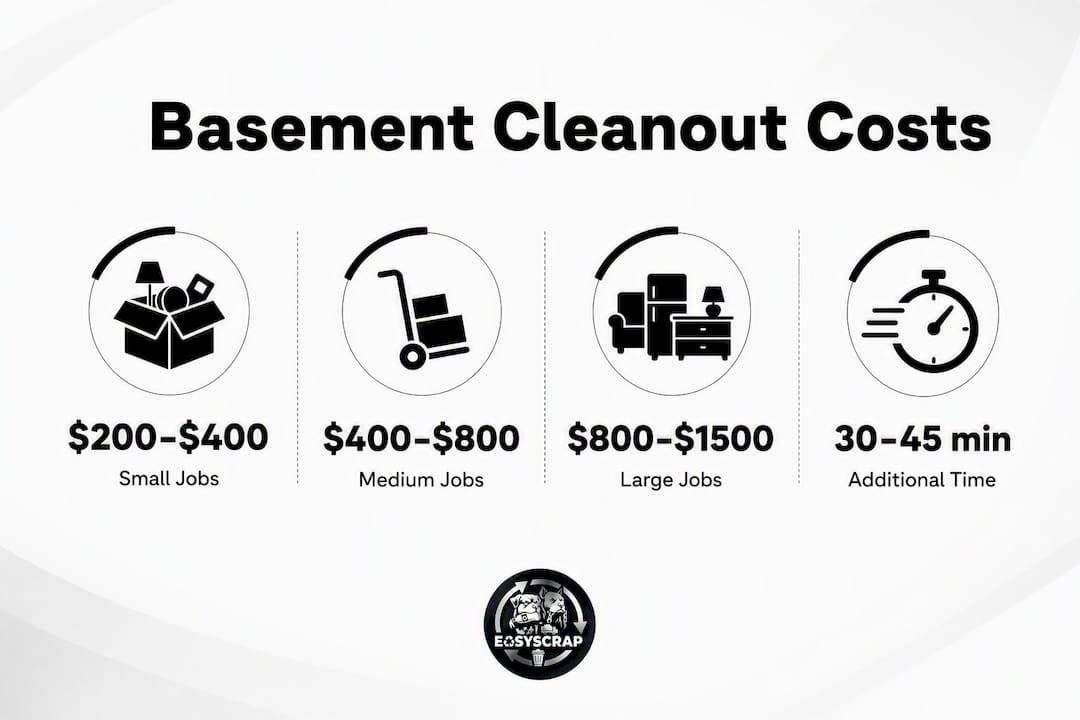
Most basement cleanouts in the U.S. typically cost hundreds to around one thousand five hundred dollars, with simple, lightly cluttered spaces landing toward the lower end and packed, multi-room basements with heavy furniture costing more. Single-item removals can start at lower prices, while large or hazardous jobs can be significantly higher.
Quick price snapshot: Typical prices for average basements cover a moderate range, with full, packed spaces costing more.
The fastest way to get an accurate number is to send a few photos to a local crew. Easyscrapofficial offers free, no-obligation quotes based on photos or an on-site visit, so you can get a real price before committing to anything.
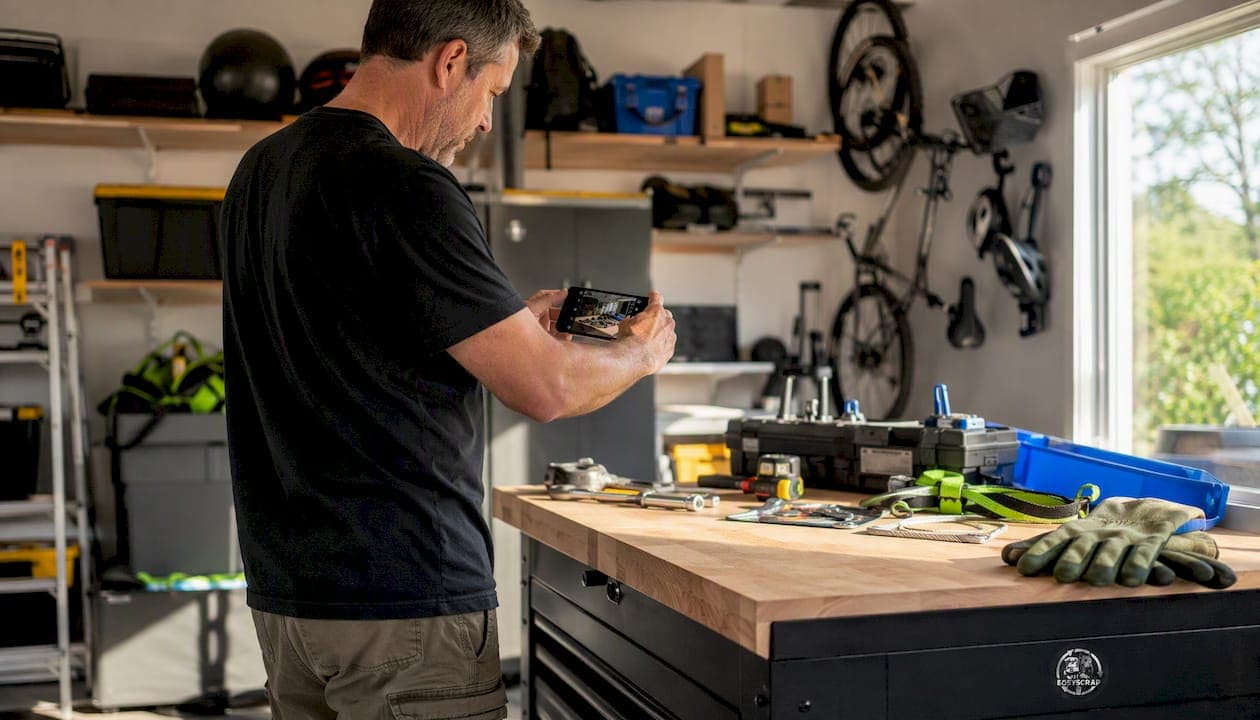
Pro Tip: Snap four photos before you call: a wide shot of the whole basement, a close-up of any heavy items (appliances, furniture), the staircase, and any water-damaged areas. That alone cuts the back-and-forth in half.

Table of Contents
- What does a basement cleanout typically cost?
- What drives the price up or down?
- How do cleanout providers charge?
- What does a professional cleanout include?
- How to prepare and what to expect on cleanout day
- DIY dumpster rental vs. hiring a pro: which makes more sense?
- How to lower your basement cleanout bill
- How long does a basement cleanout take?
- Hidden costs and why pro quotes vary so much
- What to send and ask when you request a quote
- Key Takeaways
- The part most homeowners get wrong about cleanout pricing
- Get a free basement cleanout quote from Easyscrapofficial
- Useful sources
What does a basement cleanout typically cost?
National data indicates a broad price range for most residential jobs. Here's how that breaks down by scenario:
| Scenario | What it looks like | Typical price range | Approx. truck volume |
|---|---|---|---|
| Small / light | Boxes, a few bags, minimal furniture | $200–$400 | a quarter to half truckload |
| Medium | Mixed furniture, appliances, boxes | $400–$800 | half to full truckload |
| Large / complex | Packed, unfinished, or water-damaged | $1,000+ | one or more truckloads |
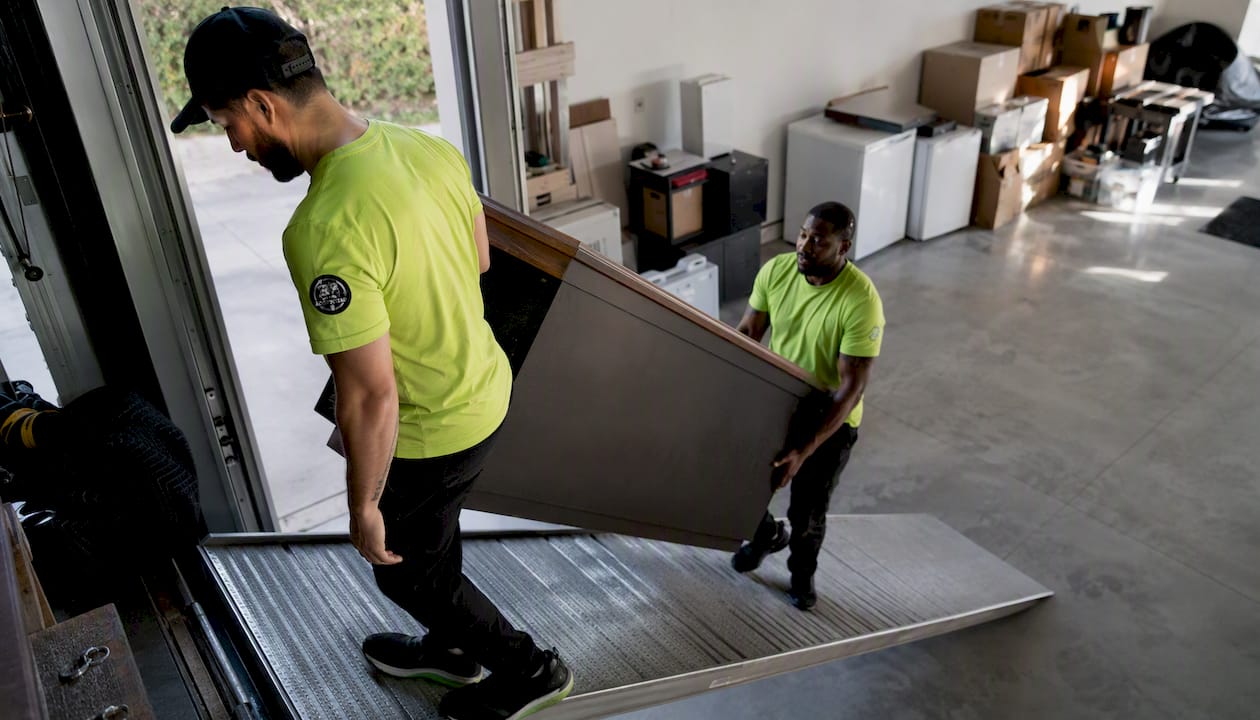
Localized guides confirm similar breakdowns: small cleanouts around $200–$400, medium jobs $400–$800, and large or complex projects regularly exceeding $1,000. The "complex" label matters here. A basement with a broken water heater, old paint cans, and a sectional sofa is a fundamentally different job than one with cardboard boxes and holiday decorations, even if both are the same square footage.
Sample job 1 (small): A small basement with mostly boxes, a broken lamp, and a few bags of clothing, completed quickly for a lower price.
Sample job 2 (medium): A medium-sized basement with furniture and boxes, standard staircase access, no water damage, costs moderately.
Sample job 3 (large/complex): A large, unfinished basement packed full with heavy and hazardous items, costing substantially more for cleanout, plus extra if mold remediation is needed.
What drives the price up or down?
The state of your basement is the single biggest variable. A tidy, accessible space costs far less than a packed, hazardous, or water-damaged one. Here's what providers actually price around:
- Volume and density. More stuff means more truck space, more labor, and higher disposal fees. A half-full basement costs roughly half what a packed one does.
- Item type. Heavy items like appliances, pianos, or hot tubs require more crew members and specialized handling. Fragile or awkward items slow the job down. Appliance removal often carries a separate line item.
- Stair access. Basement cleanouts are consistently priced higher than garage jobs because crews must carry everything up stairs. Steep, narrow, or switchback stairs can double the labor time on heavy items.
- Water or mold damage. Wet, moldy items are heavier, slower to handle, and sometimes require special disposal. If mold covers a significant area, remediation runs $2,500–$3,500 as a separate specialty service, on top of the cleanout.
- Hazardous materials. Old paint, solvents, propane tanks, and electronics can't go in a standard truck. Providers either charge a handling fee or won't take them at all.
- Crew size. A two-person crew on a tight staircase takes longer than a three-person crew with clear access. Crew size directly affects hourly costs.
- Local disposal fees. Landfill tipping fees vary by region and get passed through to you. Urban markets tend to run higher.
Pro Tip: Pull out everything you're keeping before the crew arrives. Providers who price by truck volume charge you for every cubic foot they haul, so clearing your "keep" pile first is the fastest way to shrink the bill.
How do cleanout providers charge?
Understanding the pricing model before you get a quote means you can compare estimates fairly. Most providers use one of four approaches:
| Pricing model | How it works | Best for | Watch out for |
|---|---|---|---|
| Volume / truckload | Priced by how much truck space your junk fills | Most residential cleanouts | Vague "truckload" definitions vary by company |
| Hourly | Charged per crew-hour | Small, quick jobs | Unpredictable total if the job runs long |
| Flat-fee / per job | One price for the whole job, quoted upfront | Predictable budgeting | May not account for surprises found on-site |
| Per-item | Each item has a set price | Single-item removals | Adds up fast on mixed loads |
Volume-based pricing is the industry norm for full cleanouts. Many providers bundle labor, hauling, travel, and disposal into a single volume quote, but others itemize disposal fees separately, especially for mattresses, electronics, or refrigerants.
Common line items to expect on a quote:
- Base labor and hauling (usually the largest portion)
- Disposal/landfill fees (sometimes included, sometimes separate)
- Stair-carry surcharge (common for basements specifically)
- Heavy-item fees (appliances, pianos, hot tubs)
- Special-material handling (electronics, paint, tires)
When you get two quotes that look very different, the first question to ask is whether disposal fees are included. A $600 "all-in" quote often beats a $450 quote that adds $150 in landfill fees at the end.
What does a professional cleanout include?
A standard professional basement cleanout covers the crew's labor, all hauling, and disposal or recycling fees. Most crews also do a basic sweep or tidy at the end, leaving the space broom-clean. That's the baseline.
What's typically included:
- Crew labor (loading, carrying, stair navigation)
- Truck hauling and transport
- Disposal or landfill fees (when all-inclusive pricing is used)
- Basic post-removal sweep
- Donation routing for usable items (varies by provider)
What's usually not included or costs extra:
- Mold remediation or water damage repair
- Hazardous waste disposal (paint, chemicals, propane)
- Deep cleaning or pressure washing
- Specialty removals (pianos, hot tubs, safes)
- Permit fees for oversized loads in some municipalities
The donation piece is worth asking about specifically. Easyscrapofficial donates and recycles usable items whenever possible, which can reduce the volume going to landfill and sometimes affects the overall quote. A couch in good condition that goes to a local charity takes less disposal cost than one headed to the dump.
How to prepare and what to expect on cleanout day
Most cleanouts follow a predictable sequence, and knowing it ahead of time removes a lot of stress.
- Before the crew arrives: Sort items into three piles: keep, donate/sell, and junk. Move your "keep" items to a separate area or label them clearly. Clear a parking spot for the truck as close to the basement entrance as possible.
- Crew arrival and walkthrough: The crew does a quick walkthrough to confirm the scope, check stair access, and flag any items that need special handling. If you booked based on photos, this is when they confirm or adjust the price.
- Removal: The crew loads items from the basement up the stairs and into the truck. Expect some noise and multiple trips. For medium jobs, this phase runs 1–3 hours.
- Post-removal sweep: Once the truck is loaded, the crew does a basic sweep of the space. They don't deep-clean, but they leave it clear.
- Payment and documentation: Payment is typically collected on-site. Ask for a receipt that itemizes what was removed and how it was disposed of.
A few practical notes: unlock any rooms the crew needs access to before they arrive. If you have pets, keep them secured. Tight or low-ceiling stairs slow the job, so mention that when you book. Understanding what cleanout companies actually do before they show up helps you set realistic expectations and avoid last-minute surprises.
DIY dumpster rental vs. hiring a pro: which makes more sense?
The honest answer depends on how much your time is worth and how complicated your basement is.
| Factor | DIY (dumpster rental) | Hiring a pro |
|---|---|---|
| Typical cost | $450–$1,000+ for the dumpster alone | $400–$1,500 for most jobs |
| Your labor | 10–30 hours of physical work | Near zero |
| Stair/heavy-item risk | You carry everything yourself | Crew handles it |
| Disposal complexity | You sort and load; restricted items are your problem | Provider handles sorting and disposal |
| Timeline | Dumpster sits for days or weeks | Job done in hours |
Dumpster rentals run roughly $450–$600 for a 10-yard container, $650–$800 for a 20-yard, and $850–$1,000+ for a 30-yard, before weight overage fees, restricted-item charges, or permit costs in some cities. Those hidden costs add up fast on a packed basement.
DIY makes sense when:
- Your basement is lightly cluttered and you have help
- You have a flexible timeline (dumpster can sit for a week)
- Items are light and easy to carry up stairs
Hire a pro when:
- There are appliances, furniture, or anything heavy to carry up stairs
- Mold, water damage, or hazardous materials are present
- You need it done in a day
- You're managing an estate or property turnover with a deadline
The stair factor is the tipping point most homeowners underestimate. Carrying a chest freezer up a narrow basement staircase is a two-person job at minimum, and doing it yourself without the right equipment is a real injury risk.
How to lower your basement cleanout bill
A few moves before the crew arrives can meaningfully cut the final number.
- Pre-sort ruthlessly. Pull out everything you're keeping and stage it away from the junk pile. Volume-based pricing means every cubic foot counts.
- Sell or donate first. List furniture and appliances on Facebook Marketplace or Craigslist before booking. Fewer items in the truck equals a lower quote.
- Disclose heavy and hazardous items upfront. Surprises on the day of the job sometimes trigger price adjustments. Tell the provider about the old refrigerator, the paint cans, or the broken treadmill when you request the quote.
- Ask about included disposal. Some providers bundle it; others add it at the end. Knowing this before you compare quotes prevents sticker shock.
- Schedule off-peak. Mid-week slots sometimes come with better availability and, occasionally, better pricing than weekend rush bookings.
- Ask about volume discounts. If you're also clearing a garage or attic, bundling jobs with the same crew often costs less than two separate bookings.
How long does a basement cleanout take?
Duration scales with volume and stair difficulty more than square footage.
- Small, lightly cluttered basement: 1–2 hours with a two-person crew
- Medium basement (mixed furniture and boxes): 2–4 hours
- Large or packed basement: 4–8 hours, sometimes split across two days
- Complex jobs (water damage, hoarding-level clutter, heavy specialty items): Multi-day with a larger crew
Stair difficulty adds time in a non-linear way. A single heavy appliance on a steep staircase can add 30–45 minutes to a job that would otherwise take two hours. Crew size helps, but there's a physical limit to how many people can work a narrow staircase at once.
For scheduling: same-day availability is common for smaller jobs. Larger or more complex cleanouts benefit from a next-day or scheduled slot so the crew can bring the right equipment and crew size. If you're on a tight deadline (property sale, lease end), book at least a few days out and confirm truck size when you do.
Hidden costs and why pro quotes vary so much
The gap between a $400 quote and a $1,200 quote for what looks like the same basement usually comes down to a few factors providers see that homeowners miss.
The real cost drivers aren't always visible in photos. Stair-carry difficulty, item weight, restricted materials, and local landfill tipping fees affect the final price in ways that square-footage estimates alone can't capture. Providers quoting low without inspecting key factors may adjust prices on-site.
Stair-carry difficulty is often a larger cost driver than volume. Challenging stairs require more labor and crew size, making basement cleanouts costlier than garage jobs.
Mold and water damage require separate remediation services, which can be quite expensive, adding significantly to total costs.
Reputable providers offer free on-site or photo-based estimates precisely because accurate pricing requires seeing the actual conditions. Any quote given purely over the phone without photos or a visit should be treated as a rough ballpark, not a firm price.
What to send and ask when you request a quote
Getting an accurate estimate comes down to giving the provider enough information to price the job correctly the first time.
Photo checklist:
- Wide shot of the full basement (or multiple shots if it's large)
- Close-up of any appliances, furniture, or heavy items
- A shot of the staircase from top to bottom
- Any areas with water damage, mold, or hazardous materials
Questions to ask the provider:
- Is disposal included in the quote, or billed separately?
- Is there a stair-carry surcharge?
- How do you handle appliances, electronics, or paint?
- Are you licensed and insured?
- Do you offer donation routing for usable items?
- What's your cancellation or rescheduling policy?
On-site estimates are more accurate than photo-based ones, especially for large or complex jobs. For a small to medium cleanout, good photos usually get you within 10–15% of the final price. For anything with heavy items, stairs, or potential hazardous materials, an on-site visit is worth the extra step. Guidance on disposing of large furniture items can also help you decide what to hand off to a crew versus what to handle yourself before they arrive.
Key Takeaways
Most basement cleanouts cost between $400 and $1,500, with stair difficulty, item weight, and hazardous materials being the three factors most likely to push your price toward the high end.
| Point | Details |
|---|---|
| Typical price range | Most U.S. basement cleanouts fall between $400 and $1,500; large or complex jobs can exceed $2,000 and reach $3,000+ for hazardous or specialty situations. |
| Top cost drivers | Stair access, item weight, hazardous materials, and local disposal fees move the price more than square footage alone. |
| Fastest ways to save | Pre-sort items before the crew arrives, disclose heavy items upfront, and ask whether disposal is included in the quote. |
| Best first step | Send four photos (wide shot, stairs, heavy items, any damage) to get an accurate quote without an on-site visit. |
| Easyscrapofficial | Offers free, no-obligation quotes for basement cleanouts with insured crews and donation routing for usable items. |
The part most homeowners get wrong about cleanout pricing
Here's a perspective that doesn't show up in most pricing guides: the cheapest quote is rarely the cheapest job.
Providers who quote low without seeing your stairs, your appliances, or your hazardous materials are pricing optimistically. The adjustment happens on-site, when the crew is already there and you're less likely to send them away. That's not necessarily bad faith; it's just the nature of pricing a job from a phone call. But it means the "affordable" quote you chose over a slightly higher all-in estimate ends up costing more.
The smarter move is to get two or three quotes, ask each provider whether disposal is included, and ask specifically about stair-carry and heavy-item fees. A $700 all-in quote beats a $550 base quote with $200 in add-ons every time.
The donation angle is also underused. If a provider routes usable furniture and appliances to local charities, that's less volume going to the landfill, which can reduce disposal costs and sometimes the overall quote. It's worth asking about directly, not just as an environmental preference but as a pricing lever.
Get a free basement cleanout quote from Easyscrapofficial
Easyscrapofficial handles the full job: crew labor, hauling, stair carries, appliance and furniture removal, and donation routing for anything still in good shape. No hidden disposal fees added at the end, no surprises on-site.
The booking process is straightforward. Send photos of your basement (use the four-shot checklist above), and Easyscrapofficial will return a free, upfront quote with no obligation. Prefer a walkthrough? An on-site estimate is available too. Services include basement cleanouts, furniture removal, appliance removal, and full junk removal for homes and businesses across Lawrence, Andover, Boston, Lowell, and Haverhill.
Get your free quote today at easyscrapofficial.com/junk-removal and have your basement cleared, often same-day or next-day.
Useful sources
- How Much Does a Basement Cleanout Cost | Eaton Estate Services — National price ranges and a breakdown of what's typically included in a professional cleanout quote.
- Average Price for Basement Cleanouts | Junk Smiths — Covers volume-based pricing norms, mold remediation cost examples, and free-quote guidance.
- Understanding Basement Cleanout Prices in Baltimore | Horton's Hauling — Granular small/medium/large scenario breakdowns useful for regional comparison.
- How Much Does It Cost To Clean Out A Basement | Nixx It Junk — Dumpster rental size and cost comparisons for DIY vs. pro decision-making.
- Basement Cleanout Services | Junk Removal Plus — Explains stair-carry surcharges and why basement jobs are priced differently than garage cleanouts.
- Donations: Giving New Life to Old Items | Easyscrapofficial — How Easyscrapofficial handles usable items for donation and how that affects disposal volume and pricing.
- Basement Cleanout Service | Easyscrapofficial — Easyscrapofficial's service page covering process, service area, and booking options.