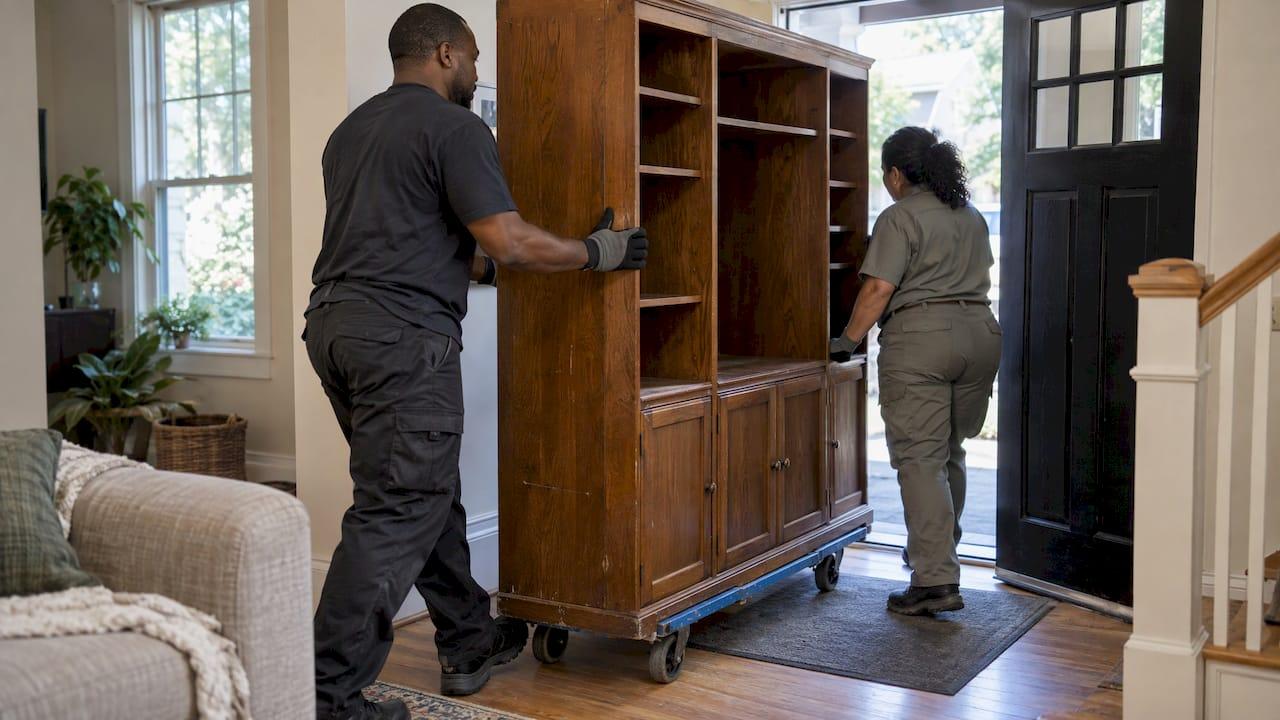
The simplest way to get rid of an entertainment center is to have it hauled out of the house whole, with the TV and electronics handled separately. Curbside pickup works in some towns, but it often needs an appointment, a fee, a limit on items and a unit that is emptied first. A large wall unit is awkward and heavy, and carrying it down stairs is where most injuries and wall damage happen. For homes in Lawrence, Andover, Boston, Lowell and Haverhill, our furniture removal service does the lifting and carries it out the same day when the schedule allows.
This guide covers what to do before the unit leaves, where it can go, what cities charge, and how to deal with the television inside it. It is written for homeowners, families clearing out a parent's home, investors turning over a property and Realtors getting a house ready to list.
TL;DR
- Empty the unit, unplug and label cords, and take off glass doors, loose shelves and drawers before anything moves.
- A usable entertainment center is best donated or reused. A damaged one goes to bulky-item pickup, a drop-off site or a hauler.
- City fees run from about $12 to $30 per item in the examples below, and most towns require an appointment, so check your town's rules before you put it at the curb.
- A TV or other electronics inside the unit usually follow separate rules from the furniture.
- If the unit is large, upstairs, or on a deadline, hiring a crew is faster and safer than moving it yourself.
Table of Contents
- Start by deciding: reuse, bulky pickup or haul-away
- Prepare the entertainment center before it leaves
- Option 1: Donate or sell a usable unit
- Option 2: City or county bulky-item pickup
- What to do with the TV and electronics inside
- Safety: tip-over risk and heavy lifting
- Who this is for: three common situations
- Our point of view
- Have the unit hauled away
- FAQ
- Sources
Start by deciding: reuse, bulky pickup or haul-away
Three questions decide where the unit goes.
Is it in good shape? If it is sturdy, clean and has no water damage or broken frames, it can be reused. The San Francisco Environment Department says that when an item still works or is in good condition, reuse is the fastest and most sustainable option, and it suggests calling ahead to confirm what a charity accepts.
Can you get it out yourself? A solid wood wall unit, or a 3-piece set with a hutch, can weigh well over what two people should carry. If stairs, tight turns or a bad back are involved, that is a job for a crew.
How soon does it have to be gone? Municipal bulk pickup is often scheduled days or weeks out. If you are listing a house, closing on a flip or moving out, waiting for the next collection date can cost more than the pickup fee saves.

Prepare the entertainment center before it leaves
Preparation is the same whether a truck, a charity or the town takes the unit. Public Storage's moving guidance says to remove or secure electronics, shelves, drawers and cords before moving heavy furniture.
- Empty everything. Clear out DVDs, game consoles, cable boxes, speakers and decor. Cities that collect these units at the curb often insist on it. Charlotte, N.C. requires entertainment centers to be empty and asks for an X of tape over any glass. Fayetteville, N.C. also requires bulky items to be emptied, with doors secured or removed.
- Unplug and photograph the cords. If any of the gear is staying, take a quick photo of the back before you disconnect so setup in the new place is easy.
- Remove the TV first. Never try to move a unit with a TV on it. Set the TV flat or upright in its box or a blanket, away from the work area.
- Take out glass, shelves and drawers. Glass doors and shelves are the usual sources of cuts. Tape or wrap them, or set them aside for separate disposal.
- Check for a wall anchor. Many units and TVs are strapped to the wall. One set of manufacturer instructions warns that failing to detach the restraint before moving the furniture may cause injury and damage. Undo the strap or bracket, then patch the screw holes. The CPSC points renters and movers to tips for repairing a wall after removing a furniture anchor.
- Break it down only if it is built to come apart. Modular units usually separate into sections. Solid one-piece cabinets do not, and forcing them apart makes sharp edges and splinters.
If you do carry pieces yourself, use the technique Public Storage describes: stand close to the item, bend your knees, keep your back as straight as possible, lift with your legs, keep the load close, and avoid twisting while carrying. Move slowly and talk to your helper at every step.
On the day, our crew handles the heavy lifting, so for a large unit the preparation that matters most is clearing the contents and the path to the door.
Option 1: Donate or sell a usable unit
A clean, undamaged entertainment center can find a second home. StopWaste advises donating usable furniture to organizations such as Habitat for Humanity ReStore, Goodwill, the Salvation Army or local shelters before disposing of it. The City of Concord, N.C. likewise recommends donating items in good condition to a person in need or a charity before disposal.
A few practical points make donation go smoothly:
- Call first. Charities have limits on size, condition and pickup areas, and many do not take particleboard units with swollen edges.
- Clean it. Wipe down shelves and remove stickers and cable ties.
- Measure the unit. Donation sites and buyers will ask for dimensions.
- Be honest about the weight. A big unit is the reason many offers fall through.
For Boston-area donation, see our guide on furniture donation in Boston. When we haul a unit away, we donate and recycle usable items whenever possible, so a good piece does not have to be a separate errand for you.
Option 2: City or county bulky-item pickup
Most towns collect furniture, but the rules are local and they differ a lot. The pattern is the same everywhere: a limit on items, an appointment, a set-out time and sometimes a fee. These examples show the range.
| Place | What it says about entertainment centers | Cost |
|---|---|---|
| Baltimore County, MD | Listed as accepted furniture. Two scheduled bulk collections a year, up to three items each, set out after 6 p.m. the night before | Included in the program |
| Fayetteville, N.C. | Up to five bulky items at the curb, at least four feet from other objects, emptied with doors secured or removed | No charge |
| Plymouth, MI | Volume-based fee for large items | $12 for an entertainment center |
| Hillsborough County, FL | Broken-down unit; call Solid Waste Customer Service before placing it at the curb | $30 per item |
| Portland, OR | Classed as extra large; pickup within seven days of the request | $29 per item plus an $18 flat pickup fee per trip |
| Newton, MA | Curbside bulky item collection | $20 per item |
These are the published fees for those places. Rates change when cities update their fee schedules, so confirm the current amount on your own town's page before you book.
Two things from this table matter for planning. First, the fee is only part of the cost: you also carry the unit to the curb, and a unit that is not emptied or broken down as required can be left behind. Second, StopWaste notes that large items do not belong in curbside bins or on the street, that improper disposal is illegal dumping, and that fines there can exceed $1,000. Do not leave a unit on the curb without confirming your town's schedule.
The EPA makes the same point from the community side: bulky items need special collection and processing, and a lack of convenient options can lead to illegal dumping. It advises contacting your state environmental agency or local landfill to learn the right course of action.
How to find your own town's rules
Search for your town or city plus "bulky item" on its public works or solid waste page. Then check five things:
- Whether an appointment is required.
- How many items are allowed per pickup and per year.
- Whether there is a fee and how it is paid.
- What time and where the item must be set out.
- Whether the unit must be emptied, broken down or have doors removed.
If you have a larger project, such as a full basement or estate clear-out, a collection limit of a few items will not cover it. A dumpster sizing guide helps you think through volume, though a single entertainment center is a one-item job and a crew is the simpler answer.
What to do with the TV and electronics inside
The cabinet and the electronics inside it are two different waste streams. Many states do not allow consumer electronics in household trash, and a TV often needs its own appointment or drop-off. Smithtown, N.Y., for example, says state law prohibits putting consumer electronics in household garbage, and residents can call for TV pickup or use a free drop-off site.
Where programs exist, they vary:
- Free drop-off. Portland, OR lists free electronics drop-off for TVs, computers, monitors and printers at E-Cycle Oregon locations.
- Monthly curbside collection. Prince George's County, MD offers electronics collection by appointment on the third Monday of each month for residents with county trash service.
- Per-item fees. Newton, MA charges $25 per TV or monitor at its Resource Recovery Center, and Plymouth, MI charges $5 for a TV under 40 inches and $8 for one over 40 inches.
If you live in Massachusetts, read our guide to TV disposal in Massachusetts for where to take one. For computers and other office gear, see computer disposal options.
Before a working TV, game console or computer leaves your home, remove personal data. The San Francisco Environment Department suggests removing personal data from electronics before donating.
Safety: tip-over risk and heavy lifting
Entertainment centers hold heavy TVs, and tip-over is a real hazard in homes with children. The CPSC says that anchoring TVs and furniture to the wall is critical to help prevent tip-over incidents, and that anti-tip kits cost $20 or less at hardware stores or online. If you are replacing your unit with a new one, anchor it on day one.

When a unit is leaving, the risks are different: a tall, top-heavy cabinet can shift on stairs, and glass can break. If you have a heart condition, back problems or are lifting alone, do not try it. Ask a crew, or ask your doctor first if you have any doubt about lifting heavy loads.
Who this is for: three common situations
The homeowner replacing a wall unit. The old unit is usually the last thing to leave. A same-day haul means the new one can go in the same day, with no waiting for a collection date.
The family clearing a parent's home. There are usually many items, not one, and a collection limit of a few pieces will not cover them. A crew can take the entertainment center along with the couches, mattresses and boxes in one visit. Our furniture disposal options guide walks through where each kind of furniture can go.
Investors and Realtors. A vacant property on a deadline needs the unit gone before photos, showings or the closing walk-through. Scheduling a curbside pickup around a listing date is a gamble. For a whole-property cleanout, see our garage, basement and attic cleanout pages.
Our point of view
A entertainment center looks like one item, but it is really three jobs: a heavy, awkward piece of furniture, the electronics inside it, and a wall that may have an anchor in it. Most people only plan for the first one.
We built our service around the heavy lifting. Our crew is insured, we book same-day slots, and we give free quotes, so the homeowner who wants a unit gone this afternoon does not have to wait for a municipal collection window or borrow a pickup truck.
We also think disposal should not mean landfill by default. We donate and recycle usable items whenever possible and work with local charities, so a solid wall unit can end up in someone else's living room instead of a dumpster.
If a town's bulky pickup fits your timing and your item count, it is a fair route for one small piece. When it does not, or when the entertainment center is one of twenty things leaving a house, one visit from one crew is the easier path.
Easy
Have the unit hauled away
If the unit is heavy, upstairs, or has to be gone on a schedule, our furniture removal service is built for exactly that. We serve homes and businesses in Lawrence, Andover, Boston, Lowell and Haverhill, our crew is insured, and quotes are free. For a bigger project, our junk removal service covers the rest of the room.

Tell us what is leaving, where it sits and whether there are stairs. We will take it from there.
FAQ
Will the trash company take my entertainment center?
Often only as a bulky item, not in your regular bin or on a regular pickup day. StopWaste notes that most garbage companies offer scheduled bulky item pickup that may be included in service or cost a small fee. Call your hauler or check your town's public works page for the appointment rules.
Can I throw out the TV with the entertainment center?
Treat them separately. Many states bar TVs from household trash, and cities that collect furniture usually handle televisions through a separate program or drop-off. Take the TV out first and check your town's electronics rules.
How much does it cost to dispose of an entertainment center?
In the city programs listed above, the published fees range from $12 in Plymouth, MI to $30 per item in Hillsborough County, FL, and some places collect a set number of bulky items at no charge. Private hauling is priced by the job. We offer free quotes, so you can compare before you decide.
Can I donate an old entertainment center?
Yes, if it is sturdy, clean and undamaged. Call the charity first to confirm size, condition and pickup rules. If you hire us to haul it, we donate and recycle usable items whenever possible.
Do I need to take the unit apart first?
Only if it was designed to come apart, and some towns require doors removed or the unit emptied before collection. If you hire a crew, you do not have to dismantle it yourself. Just clear the contents and remove the TV.
Sources
- Bulky Items, San Francisco Environment Department
- Bulky Items, StopWaste
- Bulky Waste, City of Concord, NC
- Bulk Item Collection, Baltimore County Government
- Bulky Item Eligibility, City of Charlotte, NC
- Bulky Items, City of Fayetteville, NC
- Bulky Items Quick Start Guide, EPA
- Bulky waste collection rates, Portland.gov
- Special Curbside Pickup for Bulky Items, Hillsborough County
- Large / Oversized Items, City of Plymouth, MI
- Newton, MA bulky item and electronics fees
- Smithtown Refuse and Recycling
- Waste & Recycling, Prince George's County
- CPSC anti-tip-over news release
- How Do You Move Heavy Furniture Safely?, Public Storage
- Furniture restraint instructions (manufacturer PDF)