
The fastest, lowest-risk approach for property managers facing a tenant cleanout is a local, insured junk-removal crew that gives you a scoped quote up front, prioritizes turnover jobs, and hands you timestamped before-and-after photos. That combination cuts vacancy days, keeps you clear of landlord-tenant liability, and gives you the paper trail your HOA board or district office will eventually ask for.
TL;DR:
- Property managers should request a detailed, scoped quote based on photos before scheduling junk removal to lock in prices and avoid surprises.
- Handling tenant belongings legally requires documenting the unit with timestamped photos, notifying tenants in writing, and waiting for the statutory holding period before disposal.
- Disposal fees for refrigerants and hazardous materials add extra costs, so confirm if specific items like freezers or hazardous waste require special handling or additional charges.
- Priority scheduling is essential for eviction cleanouts and HOA violations to prevent fines or court issues, and turnaround times typically range from same-day to five days.
- Insured crews with experience in heavy-lift removal and proper documentation practices protect property managers from liability and support smooth turnover processes.
Table of Contents
- What Junk Removal for Property Managers Actually Covers
- What Items Do Crews Typically Accept?
- How Do You Handle Abandoned Tenant Property Legally?
- What Should You Expect on Scheduling and Price?
- How Do You Prepare a Unit for Pickup?
- What Proof Should You Require From a Vendor?
- How Does EasyScrap Support Property Managers?
- Why a Manager-Focused Vendor Actually Saves You Time
- Get a Scoped Quote Before Your Next Turnover
- Where to Go Next
What Junk Removal for Property Managers Actually Covers
Junk removal for property managers isn't a one-size job. A turnover cleanout, an eviction sweep, and a portfolio-wide appliance swap all call for different crew sizes, timelines, and paperwork. The vendors worth keeping on speed dial cover all three without making you re-explain your account every time.
Here's what a manager-focused service should offer:
- Tenant turnover and eviction cleanouts that clear a full unit in one pass, including mattresses, furniture, and whatever a departing tenant left in closets and under sinks.
- Heavy-lift appliance and furniture removal for couches, washers, dryers, refrigerators, and stoves, handled by crews equipped to navigate stairs and tight hallways.
- Multi-unit and portfolio scheduling, ideally with a single point of contact who understands recurring service instead of a new intake call every time.
- Priority handling for HOA violation cleanups and last-minute eviction turnovers, where a slow response costs you a fine or another lost week of rent.
Providers built around this kind of work often bundle appliance and furniture removal into one visit, which matters when a unit needs both cleared before a walk-through. EasyScrap's service catalog is organized around exactly that combination.
What Items Do Crews Typically Accept?
Most residential junk removal crews take the bulk of what a vacated unit generates without hesitation: couches, mattresses, bed frames, dressers, dining tables, boxed trash, and standard appliances like washers, dryers, refrigerators, and stoves.
- Couches, mattresses, and furniture
- Washers, dryers, refrigerators, and stoves
- General boxed trash and household debris
- Yard waste left behind after a move-out
A few categories need special handling. Refrigerators and freezers contain refrigerants regulated under EPA rules, so proper disposal usually carries an added fee that a reputable crew builds into the quote rather than tacking on at the curb. Electronics recycling, household hazardous waste like paint and solvents, and anything biohazard or sharps related typically fall outside standard hauling and need a licensed specialty contractor instead.
Pro Tip: If a unit turns up needles, chemical containers, or anything that looks biohazard, don't let a general hauling crew touch it. Get the referral in writing and keep it in the tenant file, since that documentation matters if the disposal is ever questioned later.
How Do You Handle Abandoned Tenant Property Legally?
Landlord-tenant law on abandoned property varies significantly by state, and getting the sequence wrong is one of the fastest ways to turn a routine cleanout into a small claims case. The safe order of operations, regardless of jurisdiction, looks like this:
- Document the unit with dated, timestamped photos before anything gets touched or moved.
- Notify the tenant in writing per your state's required method and timeline, giving them a chance to reclaim belongings.
- Store items if the law requires it, for the statutory holding period your state sets, before disposal is legally permitted.
- Dispose only after that period lapses, using a crew that will provide a dated removal invoice as part of the file.
Keep everything: dated photos, the signed or mailed notice, a storage log if items sat in a unit or offsite, and the final removal invoice. That paper trail is what protects you if a former tenant disputes what happened to their belongings months later. For a state-by-state feel of how this plays out in practice, this breakdown on handling tenant belongings left behind walks through common scenarios.
Large estates, anything involving hazardous materials, or a disposal a tenant is actively contesting are the moments to loop in counsel before the truck shows up. A missed statutory window on a high-value cleanout is not worth the risk of skipping that call.
What Should You Expect on Scheduling and Price?
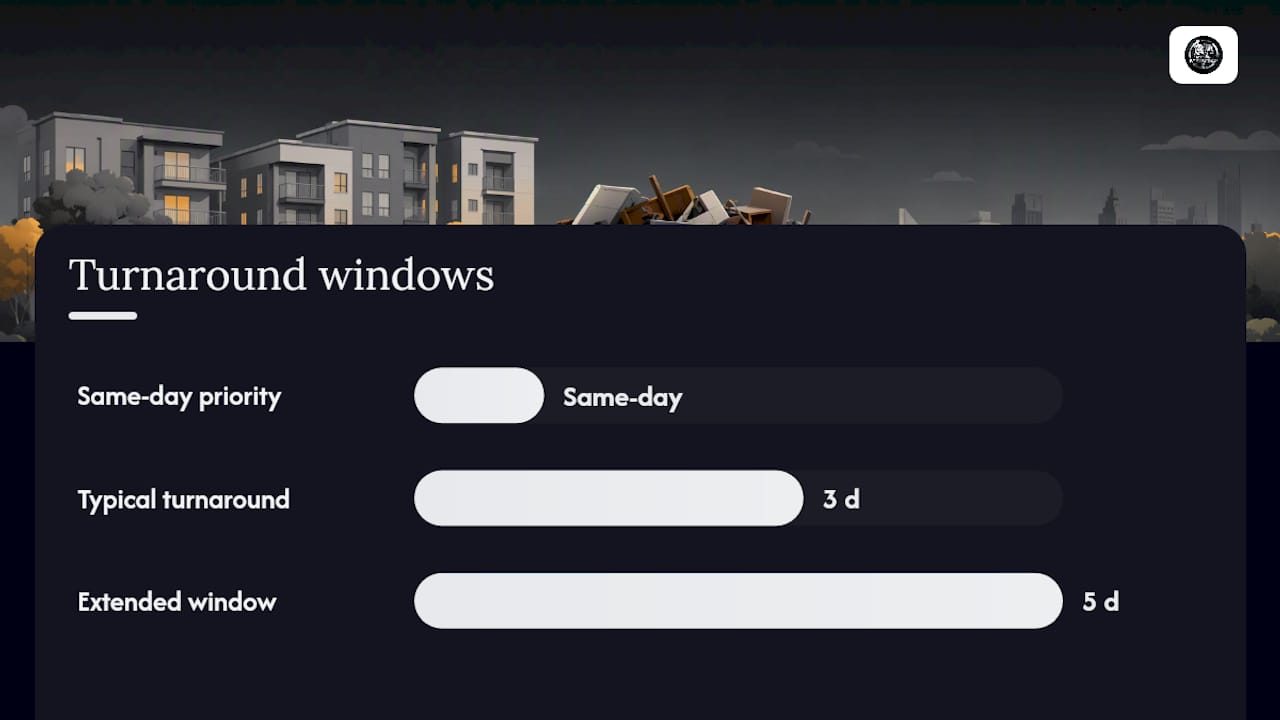
Turnaround windows on property-manager cleanouts commonly run from same-day to 3 to 5 business days, depending on urgency, crew availability, and your local market. Eviction jobs and HOA violation cleanups should always get flagged as priority when you book, since those clocks are usually ticking on a fine or a court date, not just a vacancy calendar.
Price moves on a handful of predictable factors:
- Total volume of items and how many trips or truck loads it takes
- Appliance mix, since refrigerant-containing units often carry added disposal fees
- Access difficulties: stairs, long carries, restricted elevator windows
- Whether same-day service is required, which some crews price at a premium
A scoped quote built from photos rather than a phone description tends to hold up better once the crew arrives, since it locks in price based on what's actually visible instead of a guess. Ask for that written or photo-based scope before you schedule cleaners or inspectors around the job, not after. Property managers running several units at once should expect providers to price minimum job charges into smaller jobs too, since a truck and two-person crew cost the same whether they're hauling one mattress or ten.
How Do You Prepare a Unit for Pickup?
A little prep work before the crew arrives shortens the visit and keeps the invoice matching the quote.
- Submit photos with the work order. A few clear shots of each room gets you a tighter scoped quote and avoids change orders once the crew is on site.
- Set up lockbox or keyless access so the crew doesn't need to coordinate a key handoff around your schedule.
- Flag anything you're legally required to hold under your state's abandoned-property timeline, and pull small valuables out in advance.
- Note access constraints like elevator reservations or narrow stairwells directly in the work order, along with any unusually heavy items.
Coordinating that timing with your cleaning crew and final inspection, including a professional end-of-lease service, is what actually compresses vacancy days. See End of Lease Cleaning – ACT Cleaning by Demand for details on how coordinated cleaning and removal workflows help speed up turnover. A practical pre-job checklist covers the access and photo details in more depth if you're setting this up as a repeatable process across a portfolio.
What Proof Should You Require From a Vendor?
Before you hand a vendor keys to an occupied or recently vacated unit, confirm they carry general liability insurance and ask for either a policy summary or the name of their carrier. This isn't paperwork for its own sake. It's what protects you if a crew damages a hallway or a resident's property during the job.
- Confirm general liability coverage before booking, not after
- Require timestamped before-and-after photos as part of the job
- Get a completion receipt or invoice with itemized charges
- Ask for a donation or recycling receipt when items were diverted rather than landfilled
Pro Tip: Save every before-and-after photo set in the tenant's file, not just your inbox. HOA boards and district managers ask for this proof more often than you'd expect, usually right when you've already moved on to the next unit.
How Does EasyScrap Support Property Managers?
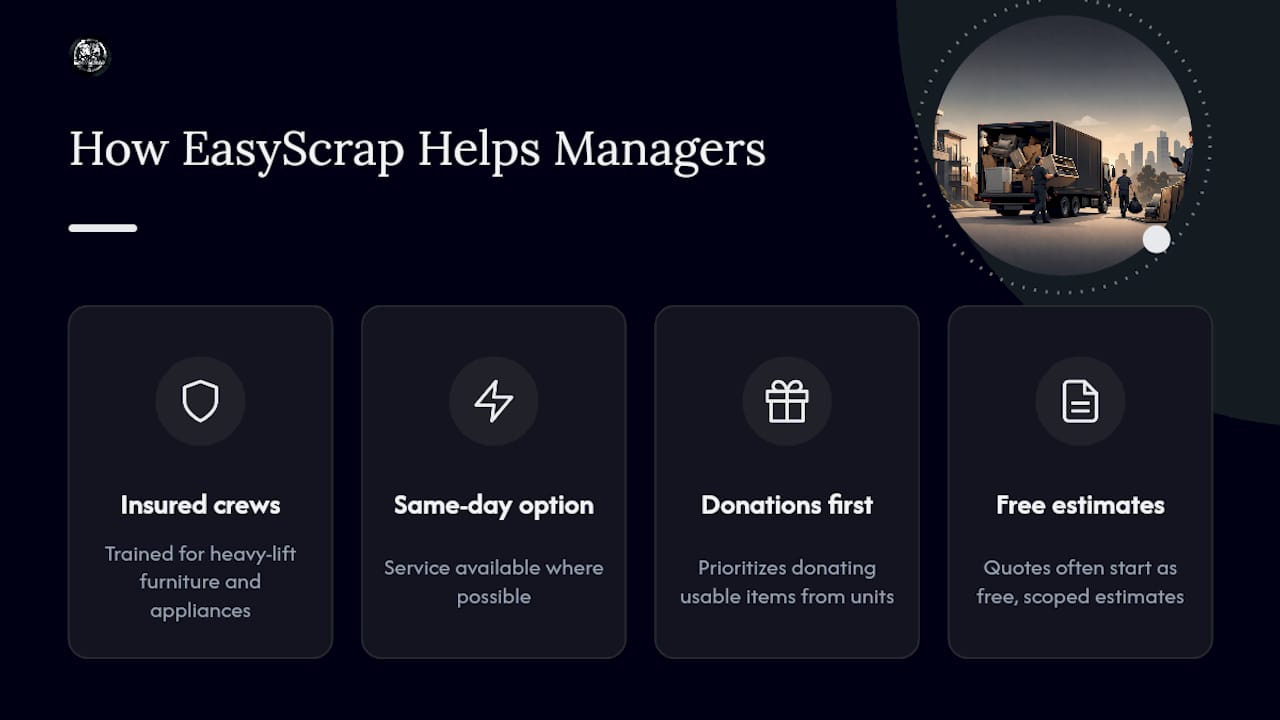
Some local junk removal providers run insured crews trained for heavy-lift furniture and appliance removal, offer same-day service where possible, and prioritize donating usable items pulled from vacated units. EasyScrap's service pages outline the coverage area and job types directly.
Quotes often start as free, scoped estimates, and the prep checklist linked above reflects common guidance given to customers before a crew arrives. That overlap matters: the advice in this article isn't theoretical, it's the operational baseline the company works from on every job.
Why a Manager-Focused Vendor Actually Saves You Time
Most of the friction in property-manager cleanouts doesn't come from the junk itself. It comes from re-explaining your situation to a new vendor every time, chasing down insurance certificates mid-crisis, or discovering a quote didn't include the fridge fee until the truck is already parked outside. A single point of contact who understands portfolio work removes most of that friction before it starts.
If you manage more than a handful of units, don't roll out a new vendor across your whole portfolio on day one. Run one pilot cleanout, check how the quote, the timeline, and the documentation actually hold up, and scale from there. Pair that with a prep checklist your team uses on every work order, and future jobs get faster by default instead of by luck.
— Easy
Get a Scoped Quote Before Your Next Turnover
Skip the guesswork on your next vacated unit. Some junk removal services offer property managers free scoped quotes, insured crews, heavy-lift removal for appliances and furniture that slow down turnover, plus donation and recycling handling for items still usable.
Send photos and access details with your work order and you'll get a locked-in price before the crew ever loads a truck, backed by timestamped before-and-after photos for your file. Whether it's a single eviction cleanout or a recurring account across several buildings, request a quote through EasyScrap's junk removal page and get the next vacancy moving instead of sitting on your calendar.
Where to Go Next
For deeper reading on the topics covered here, EasyScrap's full service catalog lays out appliance and furniture removal options by job type, and this comparison of junk removal versus dumpster rental is worth a look before any high-volume renovation debris job. For a broader industry view on centralized scheduling across multi-location operations, Franchise covers how branded service networks structure account-level support.