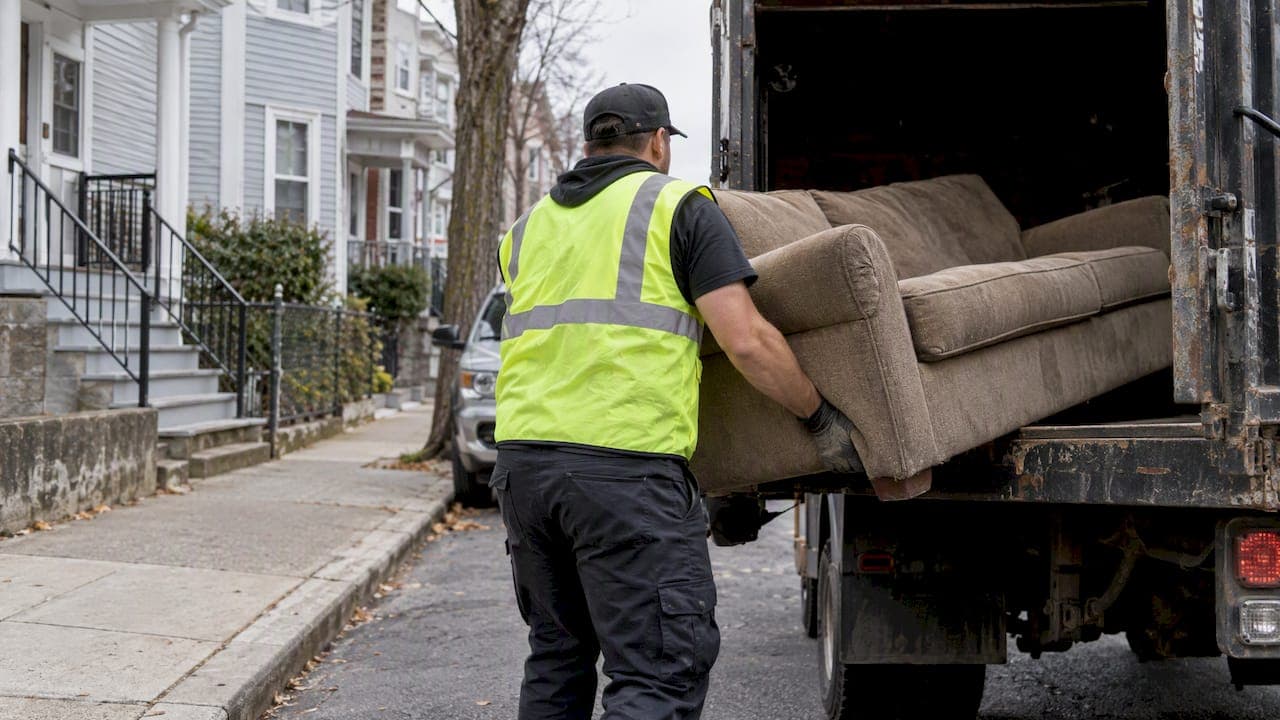
Contactless junk removal is widely available and works best when items are staged outside or in an accessible spot with a clear path for the crew. It covers furniture, mattresses, small appliances, and ordinary household junk without any regulated materials mixed in. Hazardous items or appliances with refrigerant need advance notice or a quick inspection before a provider can confirm a true no-contact job.
TL;DR:
- Request a written quote covering disposal, recycling, labor, and access for your exact load; starting prices often assume the smallest possible pickup.
- Send clear photos of the full load, heavy or fragile items, and access route, and identify the exact staging spot and any parking limits.
- Keep paint, cleaners, batteries, pesticides, refrigerant appliances, and construction debris out of ordinary staged loads; confirm special handling with the provider or local program first.
- For vacant rentals, provide gate or lockbox access and keep the crew’s completion photo or electronic receipt as proof if a dispute arises.
- Contactless pickup suits smaller loads with clear outdoor access, but large indoor pieces, tight stairs, or possible asbestos may require an on site assessment.
Table of Contents
- How contactless pickup works: curbside, staged, and remote-quote models
- What contactless pickup usually costs and how estimates are calculated
- How to prepare your home and items for a contactless pickup
- Items that need special handling or won't qualify for contactless pickup
- Booking, safety protocols, and what to expect on pickup day
- EasyScrap's contactless junk removal: what we do and how to book
- When contactless removal is the best move
- Book EasyScrap for a contactless pickup
- FAQ
- Sources
How contactless pickup works: curbside, staged, and remote-quote models
Contactless removal isn't one single process. Providers generally work from three variations depending on your property and schedule.
- Curbside or outdoor staging: you place items at the curb, driveway, or another agreed outdoor spot before the crew arrives.
- Point-and-go removal: a crew shows up at a set time, confirms the load against photos you sent, and hauls it away without any conversation needed.
- Pre-staged pickup for locked or vacant properties: useful for rentals or vacant homes, where a gate code or lockbox lets the crew in without you present.
Remote estimates usually rely on photos or a short video walkthrough instead of an in-person visit. Some providers price by capped truck-volume (you pay for a fraction of the truck, like a quarter-load or half-load), while others price per item. Either method can work contactlessly as long as the photos clearly show size, quantity, and access.
On the logistics side, most providers give an arrival window rather than an exact time, since prior jobs can run long. When the job is done, crews typically text a confirmation photo of the cleared space or send an electronic receipt, which doubles as proof of completion if a dispute ever comes up. This matters most for landlords and property managers coordinating removals at properties they don't visit daily.
What contactless pickup usually costs and how estimates are calculated
Pricing for a no-contact job depends on the same variables as an in-person job, just estimated remotely instead of on-site.
- Truck space (volume): the more physical space your load takes up, the higher the cost, regardless of item count.
- Item type: heavy appliances or furniture that need two-person lifts typically cost more than light, stackable items.
- Labor: awkward access, stairs, or long carry distances add time and cost even without a crew ever meeting you.
- Disposal and recycling fees: transfer stations often charge based on weight or category, and these fees get passed through.
- Travel and time: distance to the nearest approved disposal or donation site affects the quote.
A written all-in quote for the same staged load and access conditions is worth requesting before you accept any price, according to Angi's junk removal cost data, which notes that professional hauling jobs typically cost several hundred dollars depending on volume, item types, labor, and disposal fees. A "starting at" figure almost never reflects what you'll actually pay since it's usually built around the smallest possible load.
Before booking, it helps to ask a few direct questions:
- Does this quote include disposal and recycling fees, or are those billed separately?
- How is a refrigerator, washer, or other large appliance priced?
- Is the crew insured, and can you confirm that in writing?
- What's the cancellation or rescheduling policy if my situation changes?
Getting these answers in writing before pickup day avoids the most common source of frustration with remote quotes: a price that balloons once the crew sees the actual load.
How to prepare your home and items for a contactless pickup
A smooth contactless job comes down to staging correctly the first time, since there's no crew walkthrough to catch problems on the spot.
- Remove valuables, personal documents, medication, cash, and keys from any furniture or boxes you're setting out, a step EPA guidance on household hazardous waste also recommends as general practice before any pickup.
- Group or label items by type, especially if only part of a pile is meant for removal.
- Place everything at the exact spot you agreed on with the provider, whether that's the curb, driveway, or garage entrance.
- Keep the path to that spot clear of parked cars, hoses, toys, or anything that could slow the crew down.
- Secure pets indoors or in a separate area so the crew can work without interruption or risk.
For heavy or bulky pieces like couches or dressers, break them down if they're designed to disassemble, since this reduces the handling needed and lowers the chance of damage to doorways or stairwells. If a piece can't be broken down, leave it somewhere with a straight, unobstructed path rather than around a tight corner.
When you book, send photos from a few angles: a wide shot of the full pile, a close-up of anything fragile or heavy, and a shot of the access route, including anything that might block a dolly or hand truck. If parking is limited near your home, mention that too, since it affects how close the truck can get; for tips on preparing your home for easy pickups and improvements, see organize your home for back to school.
Pro Tip: If you won't be home, leave a clearly visible note at the staging area with your name, booking confirmation, and scheduled window, so the crew can confirm they're at the right address.
Items that need special handling or won't qualify for contactless pickup
Not everything can be left curbside, and knowing the limits upfront avoids a wasted trip or an awkward reschedule.
- Household hazardous waste, including paints, cleaners, batteries, and pesticides, needs to go through dedicated HHW programs rather than a standard staged pickup, per EPA's household hazardous waste guidance.
- Appliances with refrigerant, along with units containing mercury switches or capacitors, require refrigerant recovery and documentation before final disposal, which EPA's appliance disposal guidance outlines in detail.
- Construction debris and asbestos-containing materials typically fall outside standard contactless service and need separate arrangements with a specialized hauler.
- Bulky items in general often carry size and quantity limits at transfer stations, which is part of why providers may ask for extra details before confirming a price, according to EPA's bulky items guide.
A contactless label never changes the underlying disposal rules for a hazardous item. It reduces person-to-person contact during pickup, but refrigerant recovery, mercury handling, and HHW sorting still have to happen correctly downstream. If you're unsure whether something qualifies, check with your local municipality or HHW program before staging it, since rules and accepted items vary by city, as shown on pages like Providence's bulky items program.
If a refrigerator or similar appliance is part of your load, our guide on avoiding EPA violations with heavy item removal walks through what to check before pickup day.
Booking, safety protocols, and what to expect on pickup day
A good contactless booking request front-loads the details a crew would normally gather in person.
- Photos of the full load from a few angles, plus a shot of the access path and any obstructions.
- Gate codes, lockbox numbers, or parking instructions if the property is locked or has limited access.
- A clear note on staging location, such as "driveway, left of the garage door."
- A flag for any appliances or hazardous materials so the provider can confirm handling before arrival.
Most providers confirm arrival and completion through text updates, a photo of the cleared space, and an electronic receipt. Keep that confirmation photo on file, since it's the easiest way to resolve a dispute if something was missed or damaged.
On the safety side, ask whether the crew carries liability insurance and request details if you're unsure, since this protects you if a walkway or driveway gets damaged during the job. Cancellation and rescheduling policies vary by provider, so confirming the window for a free reschedule before you book saves a headache if your schedule shifts.
EasyScrap's contactless junk removal: what we do and how to book
We handle contactless junk removal for homes and businesses across multiple areas, covering everything from a single couch to a full garage cleanout. Our core services for staged, no-contact pickups include junk removal, appliance removal, and mattress disposal, all bookable with photos instead of an in-person estimate.
Our crew is insured, and we offer same-day availability when possible. We donate and recycle whenever possible, so usable furniture and appliances may go to charity instead of a landfill, and every quote we give is free before you commit to anything.
When you book with us, let us know if your load includes a refrigerator, air conditioner, or anything that might count as hazardous material. We screen for these ahead of time so we can bring the right equipment or flag anything that needs separate handling, keeping your pickup genuinely contactless from start to finish.

When contactless removal is the best move
Contactless staging works well for small to medium loads with clear outdoor access, and it's a smart default when you'd rather limit in-person contact for any reason, including simple convenience. It falls short for large indoor items that need disassembly, tight stairwells, or anything that might contain asbestos, where a trained eye on-site matters more than a photo.
When you're not sure which category your job falls into, say so in your booking note. A short line like "large sectional couch, narrow hallway, not sure if it needs disassembly" gives a provider enough to decide whether contactless will work or whether an in-person visit makes more sense.
— Easy
Book EasyScrap for a contactless pickup
Booking a contactless pickup with us takes a few minutes. Start on our junk removal page or give us a call, upload a few photos of your load, and confirm the staging spot, whether that's a driveway, curb, or garage entrance.
If your load includes an appliance or anything you're unsure about, mention it when you book so we can plan for it ahead of time. Every quote is free, our crew is insured, and we donate or recycle whenever we can instead of defaulting to the landfill.
- Visit our junk removal or appliance removal page to start.
- Send photos of your staged items and access path.
- Confirm your pickup window and staging location with our team.
Once that's set, you're done, and we handle the rest without needing to meet you at the door.
FAQ
What is the minimum cost for junk removal?
Minimum costs vary by provider and local disposal fees, but Angi's cost data shows smaller loads typically fall toward the lower end of the few-hundred-dollar range reported for standard jobs. Ask for a written all-in quote so you know exactly what a small load will run before committing.
How do I get junk removed for free?
Some municipalities run free or low-cost bulky-item pickup or drop-off programs, though availability and accepted items vary widely by city, as seen on pages like Milwaukee's bulky item pickup program. Donation centers may also pick up usable furniture or appliances at no cost if the items are in good condition.
What's included in a $99 junk removal service?
Pricing at that level typically covers a small load, such as a single item or a partial truck-volume fraction, rather than a full truckload. Always confirm in writing whether disposal fees, labor, and appliance handling are included before assuming a flat price covers everything.
What is the average cost of junk removal?
Average costs depend heavily on volume, item type, and local disposal fees, with Angi reporting that typical professional jobs run a few hundred dollars for a standard load. Getting a written all-in quote for your specific load and access conditions is the most reliable way to know your actual cost.
Sources
For official guidance beyond this article, these sources cover hazardous waste rules, appliance disposal, and pricing benchmarks.
- Household Hazardous Waste (HHW) | US EPA
- Bulky items quick start guide | US EPA
- Appliances quick start guide | US EPA
- How Much Does Junk Removal Cost? 2026 Data | Angi
- City of Milwaukee — Bulky item pickup