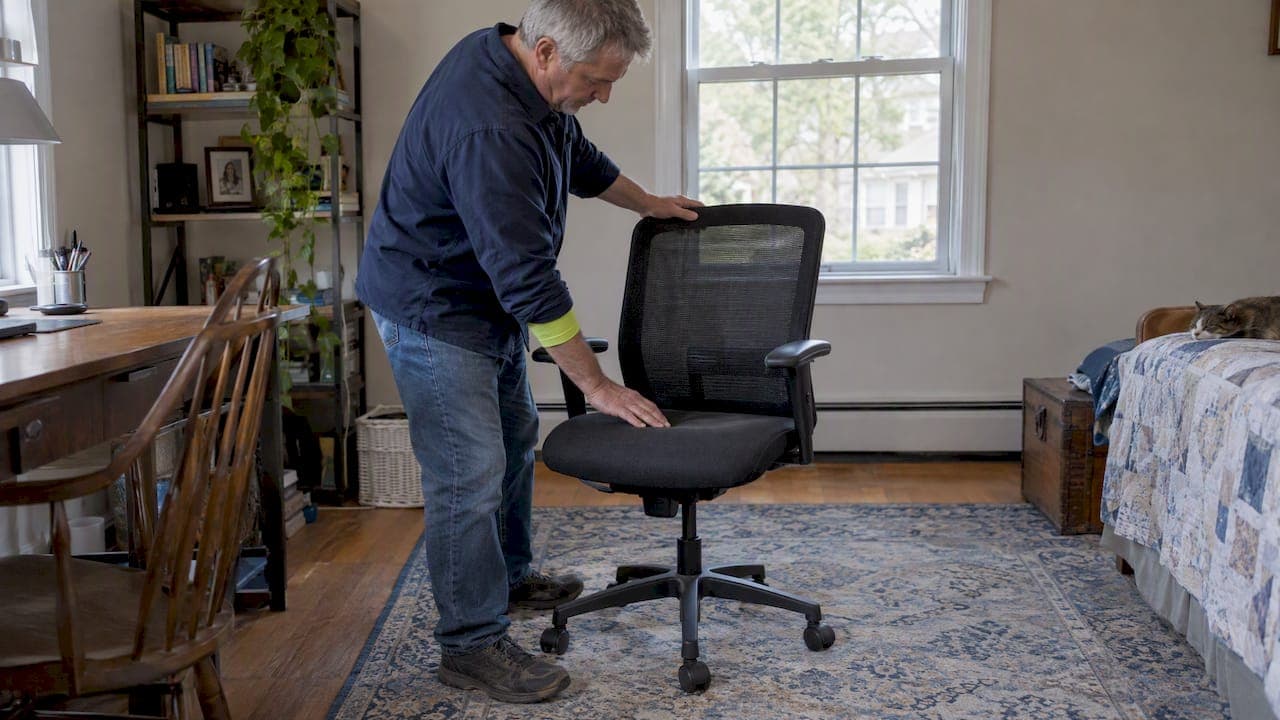
If your chair still works, donate it or sell it. If it's broken, pull the metal parts apart for scrap and leave the pressurized gas lift to a professional if you're unsure how to handle it. If you'd rather skip the work, schedule a bulky-item pickup or hire a junk removal crew to haul it away.
TL;DR:
- Before donating, test every lever, clean the chair, photograph wear, and call ahead because charities may set condition rules or decline single chair pickups.
- For a sale, compare local listings for the same brand and condition, price below the midpoint, and include clear photos, working adjustments, and pickup details.
- Separate steel and aluminum for scrap, check local rules for marked plastics, and send fabric, foam, and glued composites to bulky waste when recycling is unavailable.
- Treat the gas lift as pressurized: if you lack the right tools or feel uncertain, stop and have a professional handle it rather than attempting disassembly.
- Town rules, limits, and fees vary for bulky pickup; removal crews can handle stairs and sorting, while price depends on volume, weight, and access.
Table of Contents
- Where can you donate a working office chair?
- How do you sell or give away a chair that's still usable?
- How do you take an office chair apart safely?
- Where do the different chair materials end up?
- What are your options for bulky pickup, drop-off, and fees?
- When does hiring a local crew make sense?
- How can we remove and responsibly dispose of your office chairs?
- FAQ
- Sources
Where can you donate a working office chair?
A chair that rolls, tilts, and holds a seat height has a second life in it. The EPA recommends donation and reuse for usable furniture, and it advises contacting the organization first because some have condition or type requirements. A quick call can save you a wasted drive.
Good places to ask:
- Charities and nonprofits that furnish offices or help families set up home workspaces.
- Furniture banks and reuse stores that redistribute household and office furniture.
- Schools and community groups that always need extra seating.
- State reuse networks, such as the Mass, which point to organizations that accept furniture for redistribution.
Before you call, wipe down the arms and seat, test every lever, and note the brand and model. Photograph any wear so nobody is surprised at pickup. For stained fabric, these upholstery cleaning tips can help a chair look presentable. Many charities only accept drop-offs, so ask whether they pick up and whether a single chair is worth their trip. If you're in the Boston area, our guide to furniture donation in Boston lists where to give and when to call.
How do you sell or give away a chair that's still usable?
Selling beats donating only if the chair has real resale value, and that usually comes down to the brand and its condition. Ergonomic chairs from well-known makers tend to hold their value, while a generic chair with a cracked seat rarely does. Here is the quickest path:
- Check what comparable chairs of the same brand and condition are listed for locally, then price slightly under the middle of that range.
- Post clear photos from the front, side, and underside, and list every adjustment that works.
- State pickup details up front: address area, times, and whether stairs are involved.
- If nobody bites, relist it as free and stress that the buyer only needs to show up with a car.
- For several chairs, contact an office's facilities team or a school. Institutions often prefer bulk offers, and contracting reuse vendors can lower removal costs compared with dumpster disposal.
If you manage furniture for a workplace, our piece for facility managers on office furniture disposal options goes deeper.
How do you take an office chair apart safely?
A chair that can't be reused can often be sorted into material streams, which makes recycling far easier. The usual parts are the casters, the star base, the gas lift cylinder, the seat and foam, and the metal mechanism under the seat.
- Work with a socket or wrench set, Torx and hex bits, a mallet for stubborn fittings, work gloves, and eye protection.
- Flip the chair, pull the casters out of the base, then separate the base from the cylinder.
- Unscrew the mechanism from the seat, then lift the seat pan away from the frame.
- Keep ferrous and non-ferrous metals apart. Herman Miller's chair recycling instructions recommend specified Torx and hex bits, and note that ferrous metals can be identified with a magnet.
The gas lift is the part to respect. It's a pressurized component. The manufacturer Stabilus describes degassing by carefully drilling or sawing a small hole of about 3 mm, with eye and face protection, and disposing of the waste oil according to regulations. The same guidance says to consult the manufacturer or professionals if you're unsure.
Pro Tip: If the cylinder is sealed, you lack the tools, or you simply feel uneasy, stop and hand the chair to a junk removal crew. Skipping the risk costs far less than an injury.

Where do the different chair materials end up?
Metal is the easy win. Steel and aluminum parts can usually go to a scrap yard, and a magnet tells you which is which. The EPA notes that office furniture is commonly built from steel, aluminum, plastics, and wood composites, and that recovered steel, aluminum, and wood can be reused in new furniture.
Here's what to expect for each stream:
- Steel and aluminum: Separate them and take them to a scrap metal recycler. Smaller pieces like casters' axles can go in with the rest.
- Plastic: Check the base and arms for recycling codes, since many manufacturers mark them. Whether your local program takes them varies.
- Fabric, foam, and glued composites: Hard to recycle. Many transfer stations accept them as bulky items, so plan on that route rather than expecting a recycler.
- Whole chairs: Some manufacturers run take-back programs. Steelcase's Circular program includes a remade service that remanufactures certain chair models to like-new condition. Check your chair's maker before you take it apart.
Separating metal parts may make them easier to recycle, but check with a local recycler about what it accepts.
What are your options for bulky pickup, drop-off, and fees?
If reuse and scrapping aren't practical, you have three realistic routes.
- Municipal bulky-item pickup or transfer station drop-off: Many accept chairs, but they may set size or quantity limits or charge fees. The EPA's bulky items guide notes that bulky waste needs special collection and processing and that furniture often can't be recycled without significant processing. Check your town's rules before loading the car.
- Junk removal service: A crew comes to you, lifts the chair, handles any disassembly, and sorts what can be donated or recycled. A junk removal service may be convenient if you need help with stairs or do not want to handle the chair yourself.
- Institutional removals: Large office clear-outs follow different rules. Mass.gov's waste ban fact sheet says generators are legally responsible for proper waste determination, so contract services that specialize in asset recovery can help with compliance.
Price usually comes down to volume, weight, the number of items, and any special handling, such as degassing a cylinder.
When does hiring a local crew make sense?
In our experience, the line is simple. If you need the chair gone today, there are stairs in the way, or you're staring at a pressurized cylinder you don't trust, call a pro. Ask the company about insurance, donation and recycling options, and quote terms. When you book, tell us whether the chairs need disassembly and mention any other heavy items. Bundling them into one visit is almost always the most efficient way to clear a space.
— Easy
How can we remove and responsibly dispose of your office chairs?

Our furniture removal and junk removal services take the lifting, the sorting, and the hauling off your hands. Ask about crew insurance, scheduling, and whether usable pieces can be donated or recycled. We handle office chair removals and hauling.
When you request a quote, have these details ready:
- How many chairs you have and roughly how big they are.
- Any access limits, such as stairs, narrow halls, or a loading dock.
- Whether you'd like us to handle donation for chairs that still work.
- Any concerns about gas cylinders so we can plan handling.
Ready to clear the space? Request a free quote or schedule your pickup on our furniture removal page.
FAQ
How much does it cost to remove a recliner chair?
Cost depends on the size and weight of the chair, how many items you're removing, and how easy it is to reach. A single chair on the ground floor costs less than several pieces carried down stairs. We give free quotes.
Where can I get free disposal of furniture?
Donation is the main free route, and the EPA advises contacting organizations first because some have condition requirements. You can also list a usable item as free on local marketplaces. Municipal bulky programs may be free or low cost, but rules vary by town.
Can I just throw an old computer in the garbage?
Check your town's rules or ask a local recycler how to dispose of an old office chair.
How can I dispose of an old office chair?
Donate or sell it if it works. If it's broken, separate the metal parts for scrap, and be careful with the gas lift. Otherwise, use a bulky-item pickup or a junk removal service for office chair disposal.
Sources
- What You Can Do | US EPA
- Disassembly and pressure discharge of
- Keyn Chair Recycling Instructions
- Circular by Steelcase