
Pick a completion date today, then work backward. Secure wills, deeds, insurance papers, and jewelry first, before anyone touches a closet. Walk the property, flag safety hazards, and photograph every room for a record before you move a single box. Bring family in for one clear decision meeting, not a dozen scattered phone calls, and if grief or disagreement stalls progress for more than a few days, call in a cleanout crew rather than let the deadline slip.
TL;DR:
- Most estate cleanouts require between 10 and 14 days, with the first week dedicated to family sorting and the last days for crew removal and staging.
- Prioritize high-traffic rooms like the kitchen, entryway, and living spaces for early sorting to ensure quick listing photos and minimize missed items.
- Use a five-category sorting system and set room-by-room targets, pulling valuables immediately and labeling boxes to streamline disposal or donation.
- Hire professional crews when the volume of items exceeds personal capacity, deadlines are tight, or hazards such as mold or biohazards are present.
- Create a detailed photo inventory and coordinate with realtors to ensure timely staging, cleaning, and smooth handoff before listing, avoiding last-minute surprises.
Table of Contents
- Scope and Timeline: How Long a Real Estate Cleanout Actually Takes
- What's the Best Room-by-Room Checklist for a Cleanout?
- Selling, Donating, Recycling, or Hauling: Where Should Each Item Go?
- When Does a Cleanout Turn Into a Safety Issue?
- When Should You Hire Professional Cleanout Help?
- Photo Inventory and the Realtor Cleanout Playbook
- Tips for Organizing and Categorizing Items to Maximize Efficiency
- Coordinating With Buyers and Realtors After the Cleanout
- An Editor's Take: Give Grief a Deadline, Not a Blank Check
- Let EasyScrap Handle the Heavy Lifting
- Sources
- FAQ
Scope and Timeline: How Long a Real Estate Cleanout Actually Takes
Most estate cleanouts fail on timeline, not effort. Families underestimate how long sorting decisions take and overestimate how fast a crew can haul boxes once decisions are made. Start with a walk-through that counts rooms, storage areas, and outbuildings like sheds or garages, since a two-car garage packed floor to ceiling can eat two full days on its own.
Realtor-focused pre-listing playbooks generally recommend a 10 to 14 day window before listing photos, with the first week set aside for family sorting and the final days reserved for crew removal, cleaning, and staging. That buffer matters. Rushing sorting decisions is how heirlooms end up in a dumpster and how family disputes start.
Before anyone lifts a box, settle two things:
- Who has final say on borderline items, and whether that person can override a tie vote among siblings
- A hard deadline for the sorting phase, communicated in writing so that nobody assumes there's more time
- Which rooms get priority if time runs short (kitchens, living rooms, and entryways drive first impressions in listing photos)
- A backup plan if a family member can't make decisions under pressure, including who steps in
Visible rooms deserve first attention if the sale is the priority. Closets, attics, and basements can wait a few extra days without hurting the listing.
What's the Best Room-by-Room Checklist for a Cleanout?
Break the house into daily targets instead of tackling it as one massive project. A single overwhelming task list is where most cleanouts stall out around day three.
1. Set the sorting system before you start. Use five categories: keep, sell, donate, recycle, and dispose. Anything you can't decide on in under ten seconds goes into a "hold" box for a second pass at the end, not a permanent limbo pile.
2. Work high-traffic rooms first. Kitchen and entryway, then living and dining spaces, then bedrooms, then storage zones (garage, attic, basement) last. This order matches how buyers experience the house and gets your best listing photos ready early.
3. Handle one room per session. Empty every drawer and shelf, sort into the five categories, then clear the discard piles before moving to the next room. Don't let sorted boxes for three rooms pile up in the hallway.
4. Pull documents and valuables as you go. Jewelry, cash, deeds, insurance policies, and financial paperwork get pulled the moment you see them, not "later."
5. Label and stage as you finish each room. Boxes going to storage get a room name and contents list on the outside. Rooms that are done get a quick photo for your inventory before you move on.
6. Do a final walkthrough before crew day. Check closets, under beds, and behind doors for anything missed.
Pro Tip: Set a kitchen timer for 45 minutes per room during the sorting phase. When it rings, make a decision on whatever's in your hands right then. Momentum beats perfection in a cleanout.
Selling, Donating, Recycling, or Hauling: Where Should Each Item Go?
Every item in the house needs a destination, and the fastest cleanouts are the ones where that decision gets made once. Ask four questions: Is it worth real money? Is it in usable condition? Does anyone in the family want it for sentimental reasons? Has it been used in the last two years?
- Sell fast, sell narrow. A single weekend yard sale or a focused push on a local online marketplace works better than listing fifty items over three weeks. Price to move, not to maximize.
- Donate for a receipt. Furniture, clothing, and housewares in good condition should go to a charity that provides itemized tax receipts. Routing donations properly can add real value at tax time, particularly for furniture donations that add up quickly when a whole household's worth of goods moves at once.
- Recycle what has a proper channel. Paint, batteries, and electronics need specific drop-off points, and a hazardous waste locator like Earth911 will find the nearest one by zip code.
- Choose your hauling method by volume. A dumpster rental makes sense for pure construction debris or a single massive purge. A junk removal crew works better when you're sorting as you go, since crews handle the loading and disposal sorting for you.
- Store what's undecided. When family members need more time on sentimental items, a short-term unit buys weeks without holding up the listing. Check local storage unit sizes and pricing before committing to a size.
When Does a Cleanout Turn Into a Safety Issue?
Some situations aren't a decluttering problem, they're a safety problem, and pretending otherwise puts people at risk. Stop work and call a specialist if you find visible mold, biohazard material, or anything suggesting drug residue.
- Structural or biological hazards mean the DIY approach ends immediately. Certified remediation crews carry the right equipment; family members without training don't.
- Foreclosure and bank-owned properties carry extra legal weight. Never enter alone, document the property's condition on your first visit, and check your state's rules on abandoned property, since many states require a 15 to 30 day retrieval notice before anything left behind can legally be disposed of.
- Hoarding-level accumulation needs a longer timeline and specialist crews trained in decontamination and heavy-volume removal, not a weekend family effort.
- Basic protection for DIY work still matters even in a normal cleanout: gloves, an N95 mask for dusty attics or basements, and closed-toe shoes for rooms with broken glass or nails.
When Should You Hire Professional Cleanout Help?
Three signals mean it's time to call a crew instead of pushing through alone. A deadline that's closer than the amount of work left, a volume of items too large for a car or two to haul, and a hazard or emotional weight that's stalling the whole family are all valid reasons to stop and hire out.
A professional cleanout typically includes hauling, donation routing to the right charities, a broom-sweep clean of the space, and disposal documentation you can keep for your records. Standard single-family pre-listing jobs often wrap up in one to two days, while foreclosure or bank-owned properties run longer and cost more because of added hazards and paperwork.
Pricing usually follows one of two models: a photo-based quote where you send pictures of the rooms, or truckload and volume pricing based on how much space your items take up in the truck. When comparing quotes, ask the same four questions every time:
- Does the price include labor, hauling, and disposal fees, or are any of those separate?
- What happens to items in good condition? Are they donated, and can you get a receipt?
- Is the crew insured, and what's covered if something in the house gets damaged?
- How fast can they schedule, and does that timeline fit your listing date?
Photo Inventory and the Realtor Cleanout Playbook
A photo inventory protects everyone involved, especially the executor signing off on what happened to the estate's contents. Shoot a wide-angle photo of each room before you touch anything, then three to five close-ups of valuables and paperwork, and save files with a room, date, and item naming pattern backed up to cloud storage.
- Days 1 to 7: family walkthrough and sorting
- Days 8 to 10: crew removal of everything marked for donation, disposal, or haul-away
- Days 11 to 14: cleaning, staging, and final photo prep
Free quotes and fast donation routing shorten this window considerably. For heirs coordinating from out of state, one shared photo and approval thread beats a dozen fragmented calls or texts.
Pro Tip: Screenshot your approval thread messages into the same cloud folder as your inventory photos. If a dispute comes up months later, you'll have a timestamped record of who approved what.
Tips for Organizing and Categorizing Items to Maximize Efficiency
Speed in a cleanout comes from fewer decisions, not faster hands. Set up your five sorting categories physically, in the room you're working, with actual bins or taped-off floor zones rather than trying to remember what goes where mentally. A "keep" bin, a "sell" bin, a "donate" bin, a "recycle" pile, and a "dispose" pile, all visible at once, cut decision time dramatically compared to sorting into vague mental buckets.
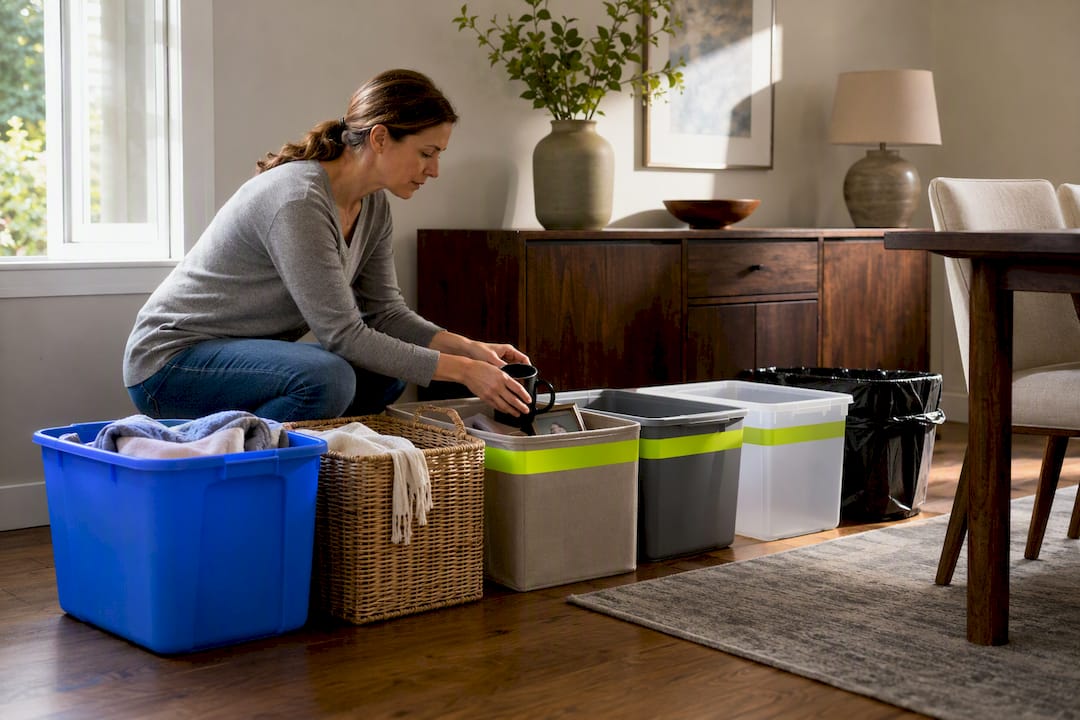
Group similar items across rooms before you finalize decisions. Every kitchen gadget, every set of tools, every stack of linens, gathered in one place, makes it obvious what's duplicated and what's genuinely needed. Households often own three or four of the same tool scattered across a garage, a kitchen drawer, and a basement shelf, and seeing them together makes the "keep one, let the rest go" decision easy.
Label boxes by destination and contents, not just by room. "Garage, tools, donate" tells a crew or a family member exactly what to do with that box without opening it. Color-coded tape or stickers speed this up further: one color for donate, one for storage, one for trash.
Save the sentimental category for last, and cap it. Set a box limit, like two boxes per family member for pure keepsakes, before you start. Without a limit, sentimental piles grow to fill whatever space is available, and that's usually where cleanouts stall for weeks.
Coordinating With Buyers and Realtors After the Cleanout
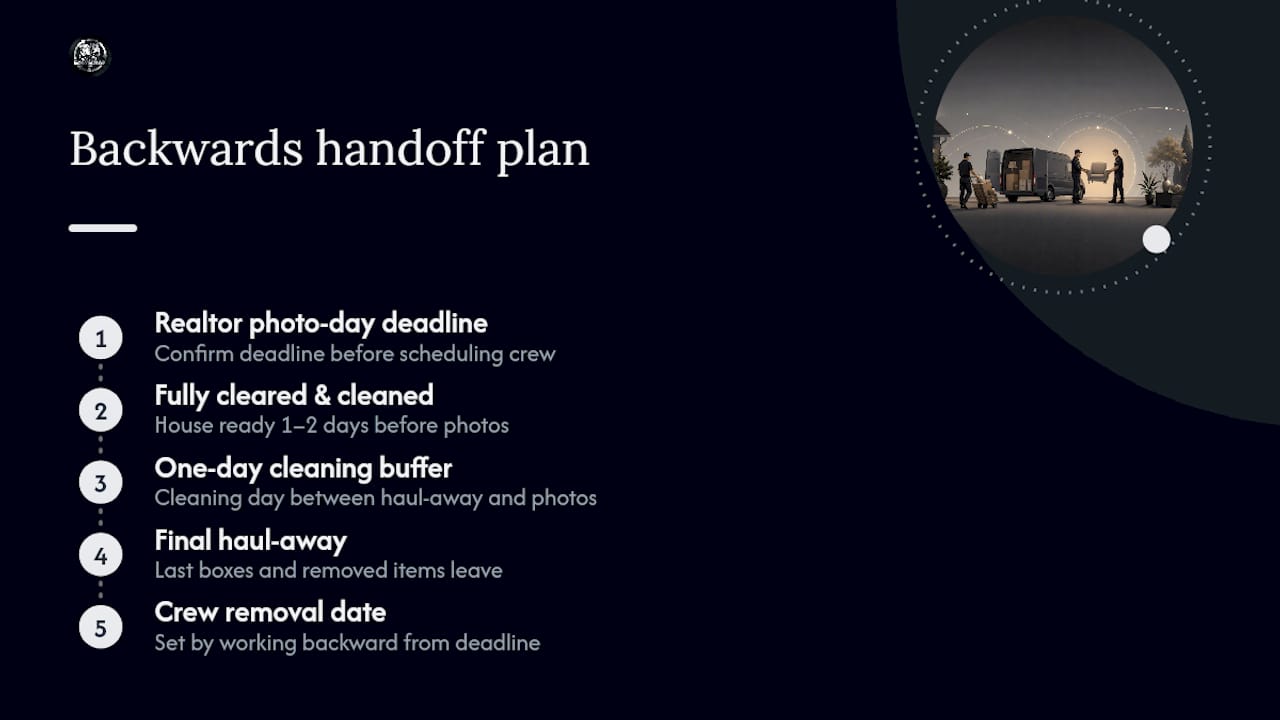
The cleanout isn't finished when the last box leaves. Realtors need lead time to schedule photographers, and most want the house fully cleared and cleaned at least a day or two before that shoot, not the same morning.
Confirm your realtor's photo-day deadline before you finalize the crew removal date, then work backward from there. Building in a one-day cleaning buffer between the last haul-away and the photo shoot avoids the rushed, half-staged look that shows up in listing photos when a cleanout runs right up against the deadline.
Once photos are scheduled, keep a single point of contact between the family, the realtor, and any cleanout crew. Fragmented communication, where the realtor is texting one sibling and the crew is coordinating with another, is how appointments get missed and keys don't show up on time.
If a buyer requests a final walkthrough or an appraisal visit, make sure the property stays in show-ready condition between the cleanout and closing. That means no re-accumulating boxes in the garage "just for now" and no leaving cleaning supplies stacked in a hallway. A clean handoff at closing avoids last-minute disputes over the property's condition.
An Editor's Take: Give Grief a Deadline, Not a Blank Check
Grief doesn't run on a schedule, but a listing date does, and pretending otherwise helps no one. Time-box the sorting phase, name one decision-maker, and photograph everything as you go. When a family is too worn down to keep moving, hiring it out isn't giving up. It's the practical choice.
— Easy
Let EasyScrap Handle the Heavy Lifting
Every checklist above still leaves you with the physical problem: someone has to carry the couch out, load the truck, and figure out where a broken washer legally can and can't go. That's where a local hauling crew comes in, built for exactly this kind of job across several cities in the region.

EasyScrap's insured crews handle furniture removal, appliance removal, and full basement and garage cleanouts, the exact rooms this article flagged as the biggest time sinks. Booking works through a photo quote, and same-day appointments may be available when the listing deadline is tight. Usable furniture and housewares are routed to donation partners whenever possible, which helps keep items out of the landfill and supports tax-receipt strategies. If your estate cleanout has hit the point where hauling is the bottleneck, request a free junk removal quote and get a crew scheduled before your photo day.
Sources
Timeline and pricing figures throughout this guide draw from HomeLight's research on pre-listing value, Opendoor's home preparation guidance, the realtor pre-listing cleanout playbook, and the Titan Group's foreclosure cleanout checklist.
- How to clean out a house to sell and boost its value (HomeLight)
- Foreclosure Property Cleanout Checklist | Titan Group
- Realtors: The Pre-Listing Cleanout Playbook | Grizzly Junk Pros
FAQ
What Is the 5-5-5 Rule for Cleaning Out a House?
The 5-5-5 rule is a decluttering method where you pick five items to keep, five to sell, and five to donate from each room or category before moving on. It works well as a quick-decision tool during an estate cleanout when a family member is stuck staring at a closet full of similar items.
What Should You Never Throw Away When Decluttering an Estate?
Never dispose of legal documents like wills, deeds, and insurance papers, financial records, jewelry, or family photographs without a second review by the decision-maker. These items often get mixed in with everyday clutter and thrown out by mistake when a room is being cleared quickly, so pull them into a separate "hold" box before sorting anything else in that space.
What Is the Best Way to Clean Out an Estate Before Selling?
The most reliable method follows a 10 to 14 day playbook: family sorting in the first week, professional crew removal in the middle days, then cleaning and staging before listing photos. Hiring a junk removal crew like EasyScrap for the haul-away phase frees the family to focus on sentimental decisions instead of lifting furniture.
What Is the 80/20 Rule for House Cleaning?
The majority of visual clutter in a house, usually paperwork, clothing, and kitchen items, causes most of the mess. Focusing sorting effort on those categories first clears the most visual clutter in the least time, which matters most in rooms buyers see first in listing photos.
How Much Does a Professional Estate Cleanout Cost?
Costs vary by volume, hazards, and how many crew hours the job takes, so most companies quote based on photos or a truckload estimate rather than a flat rate. EasyScrap provides free quotes for junk removal and cleanout services across its New Hampshire and Massachusetts service area, with current pricing available directly through a quote request.