
Start with a short walkthrough that names the decision-maker, prioritizes the rooms your photographer will shoot first, and schedules removal backward from the shoot date. If the volume is heavy, the seller lives out of state, or the timeline is under a week, hire a professional crew instead of piecing it together yourself. Local outfits can run the whole job on photo quotes and documented approvals, so you never have to be on site.
TL;DR:
- Professional cleanout crews are recommended for large volumes, tight timelines under a week, or remote decision-makers to ensure timely and efficient property preparation.
- Clear decision-making authority must be established early, with a single person empowered to approve disposals, to prevent delays caused by family disagreements.
- The most impactful rooms for buyer perception are the entry, kitchen, living room, and primary suite, which should be staged to create a positive first impression.
- Donation and recycling efforts can offset costs and provide tax benefits, but must be documented with receipts and detailed records for post-sale transparency.
- Scheduling cleanouts backward from the photo date with a detailed scope and safety assessments minimizes surprises and keeps the process on track.
Table of Contents
- Realtor Cleanout Guide: The Step-by-Step Workflow
- How Far in Advance Should You Schedule the Cleanout?
- Which Rooms Matter Most for Buyer Perception?
- When Should You Bring in a Professional Cleanout Crew?
- What Happens to Donated, Recycled, and Hazardous Items?
- What Does a Cleanout Actually Cost?
- How Do You Coordinate a Cleanout Remotely?
- EasyScrap's Field Experience With Realtor Cleanouts
- What Usually Goes Wrong During a Cleanout
- Staying Safe During a Cleanout: Mold, Pests, and Structural Risks
- Why the Textbook Cleanout Advice Misses the Point
- EasyScrap Services Built for Realtor Timelines
- Sources
- FAQ
Realtor Cleanout Guide: The Step-by-Step Workflow
Every successful pre-listing cleanout follows the same bones, whether it's a downsizing empty nester or a probate property nobody has touched in three years. The order matters more than the speed. Skip the walkthrough and you'll be making decisions about a dead relative's china cabinet the same day the moving truck shows up, which never goes well.
1. Run the walkthrough first. Walk the property with the seller, executor, or listing agent's transaction coordinator before anything gets touched. Confirm who has final say on what stays and what goes. This single step prevents most of the delays that blow up a timeline, because a pre-listing cleanout playbook that skips it usually stalls the moment someone finds a box of old photographs.
2. Set the timeline and the photo date. Work backward from when the photographer is booked, not forward from today. If photos are in 10 days, removal needs to be done by day 8 to leave a buffer for staging and a final clean.
3. Document the scope. Walk every room and note what's furniture, what's trash, and what's questionable. Take photos of anything you're unsure about before it gets moved.
Once the scope is set, sorting is where most agents lose time if they don't have a system. Use four categories, and be ruthless about assigning items fast rather than debating them:
- Keep — items the seller is taking or that stay for staging purposes.
- Donate — usable furniture, clothing, working appliances, and household goods.
- Sell — higher-value items worth listing separately (this can wait until after the closing).
- Dispose — broken, damaged, or unusable items headed to the truck.
Sequence removal by what's visible first. Entryways, living rooms, and kitchens get cleared before basements and garages, because that's what the camera sees first and what buyers judge fastest. A cluttered garage that never makes it into the listing photos matters less on day one than a dining room full of boxes.
On removal day itself, a little logistics planning prevents a lot of chaos:
- Confirm crew arrival time and who will be on site to grant access.
- Clear a parking spot for the truck, especially in tight urban driveways.
- Flag stairs, tight hallways, or anything that will slow down large item removal.
- Walk the property one final time after loadout for a broom sweep, checking closets, under sinks, and behind doors for anything left behind.
Documentation isn't optional busywork. Take before photos of every room, tag anything going to donation with the recipient's name, and keep every receipt in one folder. That paper trail protects you if a seller later asks where a specific item went, and it gives itemizing sellers something concrete for tax purposes.
Pro Tip: Text yourself a quick voice memo walking through each room before removal starts. It takes two minutes and becomes an instant record of condition and contents if anything gets questioned later.
How Far in Advance Should You Schedule the Cleanout?
The standard window is 10 to 14 days before photos, and that window breaks into four phases: a 1 to 2 day walkthrough and decision-making period, 3 to 5 days for the seller to sort personal items, 1 to 2 days for actual removal, and a 2 day buffer before the photographer arrives. That buffer isn't padding. It's what absorbs the inevitable surprise, like a locked storage unit key nobody can find or a donation truck that shows up a day late.
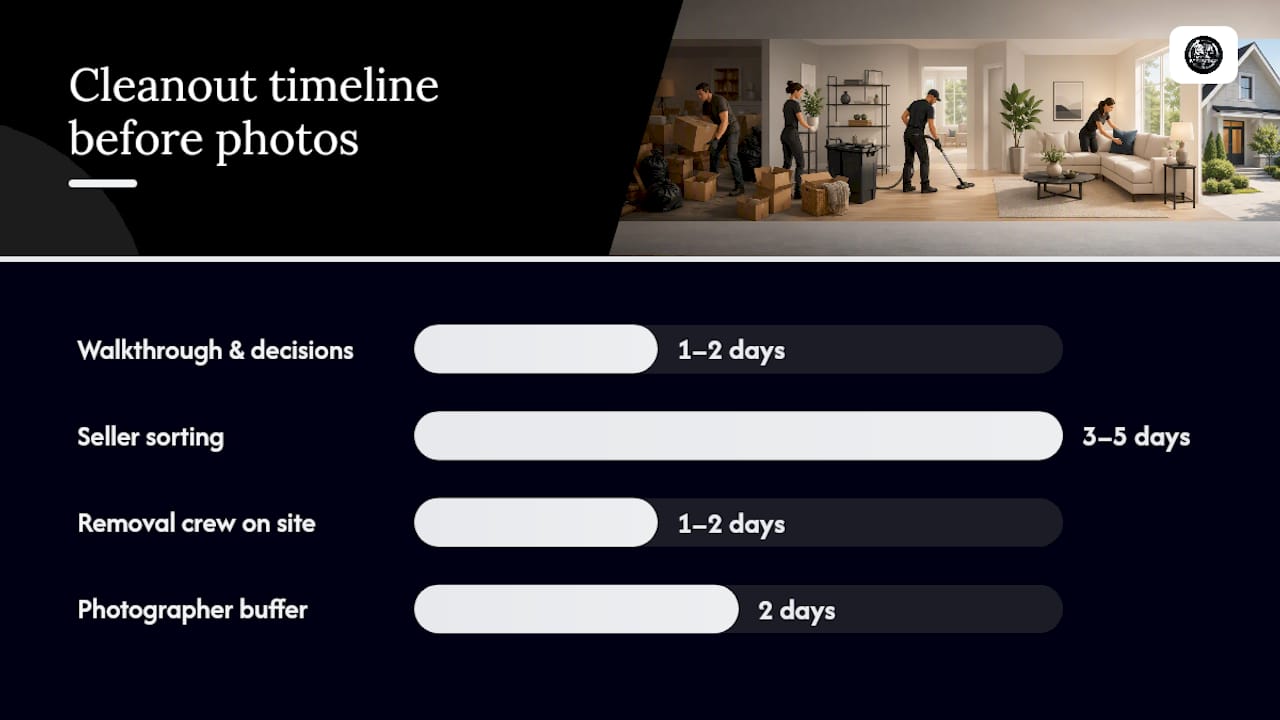
Tighter timelines are common, especially with relocation deadlines or a seller who lists their agent as an afterthought. A 5 to 7 day fast track is workable if you cut the seller-sorting phase short and make keep/donate/dispose calls faster, usually by empowering one decision-maker to act without full family consensus. Below that, a 48 to 72 hour emergency turnaround is possible with a same-day junk removal service, but it usually means staging touches and deep cleaning get compressed or pushed to the day before the shoot.
Book everything backward from the photo date, not forward from today:
- Photo date minus 2 days: final broom sweep and staging touch-ups.
- Photo date minus 4 to 6 days: removal crew on site.
- Photo date minus 8 to 10 days: sorting complete, donation items tagged.
- Photo date minus 10 to 14 days: initial walkthrough and scope agreed.
Agents managing multiple listings a year benefit from setting up a recurring account or preferred-vendor relationship with a local cleanout company. It cuts the quoting back-and-forth to a text message and a handful of photos, which matters when you're juggling three closings in the same month.
Which Rooms Matter Most for Buyer Perception?
Buyers form their opinion of a home in the first four rooms they see in photos: the entry, the living room, the kitchen, and the primary suite. Everything else supports that impression, but those four rooms decide whether a buyer keeps scrolling or clicks away.
The entry sets tone. Clear coats, shoes, mail piles, and anything blocking the sightline into the living space. The kitchen needs clear counters, an empty sink, and nothing on top of the refrigerator. The primary suite and bathrooms should feel like a hotel room, not a lived-in bedroom, which means clothing, personal care products, and anything on nightstands beyond a lamp and a book.
Closets and garages don't need to be empty. They need to look like they could hold more. Clearing closets to roughly 50% capacity and leaving garages with at least half the floor open signals storage potential without making the home look staged or fake. A closet packed floor to ceiling reads as "not enough storage" even in a house with generous square footage.
A few practical calls on what to remove versus what to leave:
- Remove: personal photographs, medications, excess furniture that crowds a room, holiday decor out of season.
- Leave for staging: a few well-placed accent pieces, neutral bedding, a bowl of fruit on the kitchen counter.
- Remove entirely, no exceptions: anything in disrepair, broken furniture, or items that raise safety questions like exposed wiring.
Curb appeal closes the loop. Buyers decide within seconds of pulling up whether they're excited or already looking for reasons to pass. Clear the yard of debris, trim overgrown shrubs, sweep the porch and driveway, and fix anything visibly broken like a loose railing or a cracked walkway light. If yard debris or a stump is part of the picture, a service like Roberto's Stump Grinding can clear it faster than most agents expect, and it's worth the call before photo day rather than after a buyer comments on it in a showing.
When Should You Bring in a Professional Cleanout Crew?
Hire a professional crew when the volume exceeds what a seller can reasonably sort themselves, when the timeline is inside a week, or when the decision-maker lives out of state and can't be on site. Professional cleanout support is specifically recommended for tight timelines, substantial item volume, or remote decision-makers, which covers most estate sales and a good chunk of standard relocations too.
A full professional scope typically includes:
- Photo-based quotes so you get pricing without a site visit.
- Donation routing to local charities with receipts provided back to the seller.
- Multi-truck operations for basement, attic, and garage volume in one visit.
- Broom-sweep finish, so the property is photo-ready the moment the crew leaves.
- Appliance and stair handling for heavy items that would otherwise need two extra people and a dolly.
Billing usually runs by volume or truck-load rather than by the hour, which makes budgeting easier for agents managing several properties. Some companies offer account setups for agents with recurring cleanout needs, which speeds up the quote-to-book cycle considerably.
Before booking, ask four questions: Is the crew insured? Where do donation items go, and do they provide receipts? What items are excluded from the scope, particularly hazardous materials? And how is the job documented, photos, checklist, or otherwise?
Pro Tip: Ask for a photo-based quote even on jobs you think are simple. It forces you to document the space before removal starts, which becomes useful if a seller later disputes what was hauled away.
For basement-heavy jobs, EasyScrap's basement cleanout service handles the multi-trip volume that a single-truck operation can't manage in one visit.
What Happens to Donated, Recycled, and Hazardous Items?
Donation routing does two things at once: it clears the property and it can create real seller value. Furniture and household donations routed through the right channels commonly produce significant documented donation value that can help sellers with tax deductions, which matters to sellers who itemize deductions.

Local charities remain the most reliable outlet for usable goods. Habitat for Humanity ReStore, Goodwill, and The Salvation Army all accept furniture and household items and issue receipts on request. Get the receipt before the truck pulls away. It's much harder to track down afterward.
Electronics need their own lane. Old TVs, computers, and small appliances shouldn't go in a general dumpster load. The EPA maintains specific guidance on electronics donation and recycling because circuit boards and screens contain materials that require separate handling. A computer disposal guide or broader e-waste disposal breakdown can point you to the right drop-off or pickup option depending on the item.
Household hazardous waste is where agents get into trouble if they're not paying attention. Old paint cans, pesticides, and cleaning chemicals need to go to designated household hazardous waste collection programs, not the regular trash pile, and most cleanout crews exclude these items from a standard scope entirely.
If a home built before 1980 has damaged insulation, popcorn ceilings, or old flooring you suspect might contain asbestos, stop removal in that area immediately and bring in an abatement professional rather than letting a general cleanout crew touch it.
That's not caution for caution's sake. The EPA's guidance on asbestos in the home is direct about the risk of disturbing materials that seem stable until they're moved.
Keep every donation receipt and disposal record in one file. It documents the seller's good-faith effort and gives you something concrete to reference if a dispute ever comes up post-closing.
What Does a Cleanout Actually Cost?
Small pre-listing cleanouts, a garage, a spare bedroom, a handful of donation runs, typically run in the low hundreds of dollars. Whole-home cleanouts, especially estate situations with a full basement, attic, and multiple rooms of furniture, climb into the low thousands depending on volume, access difficulty, and how much ends up in disposal versus donation.
The main cost drivers are volume, labor time, and disposal fees, and each one is something you can influence before the crew ever shows up:
- Volume: more truckloads means more labor and disposal cost, so pre-sorting keep items out saves real money.
- Access: third-floor walkups or long driveways add time, which adds cost.
- Disposal mix: a load that's mostly donation costs less than a load that's mostly landfill, since disposal fees hit the latter, not the former.
Staged removal, doing the easy visible rooms first and holding basement or garage volume for a second pass, can also spread cost over two smaller jobs instead of one large one, which sometimes fits a seller's cash flow better.
Billing tends to follow one of three patterns: the seller pays upfront before listing, the agent pays and recoups the cost at closing through the settlement statement, or the vendor invoices directly at closing. Ask which model a company supports before you book, since not every vendor is set up to wait for a closing check.
How Do You Coordinate a Cleanout Remotely?
Out-of-state sellers and executors don't need to be on site if the photo-quote and approval process is handled right. This is standard practice now, and remote coordination through photos and a single text approval thread is the expected norm for out-of-state families managing a property.
1. Take a full photo set before quoting. Cover every room, closets and cabinets open, the garage, the yard, and any access points like a narrow side gate or a steep driveway. Vendors quote off these images, so more angles mean a more accurate number.
2. Send the set through one text thread. Keep every approval, "yes, remove the couch," "no, keep the desk," in that same thread. It becomes your audit trail if anything is questioned later.
3. Take before-and-after photos on removal day. Pair those with donation receipts, and you've got a documented record that protects both you and the seller.
4. Hand off to the next vendor immediately after loadout. Text the stager or photographer that the space is clear so they can schedule without a gap.
Pro Tip: Number your photos in the order you send them and reference those numbers in your approval texts ("okay to remove item in photo 4"). It sounds small, but it eliminates almost all confusion in a remote approval chain.
EasyScrap's Field Experience With Realtor Cleanouts
The advice here is shaped by direct, day-to-day experience running cleanouts for agents in various local areas, rather than theory pulled from a listing checklist template.
A few things that show up consistently on real jobs:
- Same-day junk removal can be the difference between a listing photographer waiting and shooting on schedule.
- Insured crews and documented donation partnerships provide reassurance to sellers.
- Photo-inventory documentation, including before and after shots plus receipts, can help settle post-closing questions about removed items.
For agents who want a deeper reference, the estate cleanout checklist with photo-inventory guidance walks through the documentation process in more detail than fits here, and the eco-friendly junk removal guide covers donation and recycling routing options worth knowing before you quote a job to a seller.
What Usually Goes Wrong During a Cleanout
The most common breakdown isn't logistics. It's decision paralysis. A family disagrees about a dresser, nobody wants to be the one who says "throw it out," and three days evaporate while the crew sits idle waiting on an answer. The fix is the one you set up in the walkthrough: name a single decision-maker up front and give that person authority to make calls without a group vote on every item.
Access problems come in second. A locked storage unit, a key nobody can find, a shed padlocked since a previous owner, these stall a crew mid-job. Walk the full property, including sheds and outbuildings, before removal day so nothing surprises the crew once they're on the clock.
Underestimated volume is another frequent snag. What looks like "a few boxes" on a walkthrough often turns into three truckloads once closets and cabinets get opened. Build in a buffer day rather than assuming the first estimate holds.
Weather and access conflicts with other vendors round out the list. A landscaper's truck blocking the driveway on removal day, or rain turning a dirt side yard into mud right when the crew needs to haul a couch through it, both cost real time. Confirm removal day logistics with any other vendor on site that week, and keep a backup date in mind if the forecast looks bad.
None of these problems are unusual. They're just easier to solve if you expect them going in rather than discovering them the morning of.
Staying Safe During a Cleanout: Mold, Pests, and Structural Risks
Vacant properties, especially estate situations where nobody's lived in the home for months, carry risks a normal move doesn't. Mold is the most common one. A damp basement or a leaking roof that's gone unnoticed can turn a corner into a health hazard, and it's not something a general cleanout crew is equipped to remediate. If you see visible mold growth, especially anything covering more than a small patch, pause removal in that area and bring in a remediation specialist before crews continue.
Pest activity is the second flag. Long-vacant homes attract rodents and insects, and disturbing stored boxes or furniture can expose nests that have been undisturbed for months. A crew that finds signs of infestation, droppings, chewed wiring, nests in insulation, should stop and flag it rather than push through, both for their own safety and to avoid spreading the problem to a truck full of donation items.
Structural risks matter in older or long-neglected properties too. Weak flooring in an attic, an unstable staircase, or a garage roof with visible sagging are all reasons to have a crew assess before loading heavy items across that surface. The same caution that applies to suspected asbestos applies here: if something looks unsafe, stop and get a professional opinion rather than assuming it'll hold.
None of this should scare an agent away from moving quickly. It just means the walkthrough should include a basic safety scan, not just a decluttering checklist, before crews start hauling.
Why the Textbook Cleanout Advice Misses the Point
Most cleanout advice treats the process like a logistics problem: get a truck, get a timeline, get it done. That's backwards. The real bottleneck in almost every cleanout, especially estate and probate situations, is emotional, not logistical. Families stall on decisions, not on scheduling.
The agents who move fastest aren't the ones with the best vendor relationships. They're the ones who nail the walkthrough and get a single decision-maker named on day one. Everything downstream, sorting, scheduling, removal, gets easier once that's settled. Skip it, and even the best crew in town will sit around waiting on a phone call that doesn't come.
The other overlooked piece is donation routing. Most agents treat donation as an afterthought, a nice thing to do with leftover furniture. It's actually a value lever. Documented donations can offset a seller's cost and give them something for a tax return, which matters more to a downsizing retiree than most agents realize going in.
Prioritize the decision-maker conversation first, the timeline second, and the vendor third. Get that order backwards and you'll spend more time managing family friction than managing furniture.
— Easy
EasyScrap Services Built for Realtor Timelines
Realtor cleanouts run on deadlines a normal moving job doesn't have, and that's exactly what EasyScrap is built around. Junk Removal covers the standard pre-listing sweep, general clutter, old furniture, miscellaneous debris, while Appliance Removal and Furniture Removal handle the heavier staging obstacles that slow down a walkthrough.
Turnaround is often same day or next day, which matters when a photographer is already booked and the seller just decided to list. Many cleanout services donate and recycle whenever possible, routing usable furniture and appliances to local charities instead of landfill, providing documentation that can help sellers for tax purposes. For agents handling multiple listings, setting up a recurring relationship with a cleanout company can streamline quoting with just a text and photos instead of a full site visit.
Full scope details, including estate cleanouts and yard waste removal, are listed on the services page. Send over a photo set of the property and request a quote before you lock in your photography date, so the timeline actually holds.
Sources
FAQ
How much does an estate cleanout typically cost?
Small pre-listing cleanouts typically cost several hundred dollars, while full estate cleanouts with basement and attic volume can cost several thousand, depending on access, labor time, and donation versus disposal amounts.
What should be removed from a house before selling?
Remove personal photographs, excess furniture, medications, and anything in disrepair, while clearing closets to about 50% capacity and garages to at least half-open floor space to show storage potential.
How do estate cleanouts actually work?
They start with a walkthrough to name a decision-maker and set the scope, followed by sorting into keep, donate, sell, and dispose categories, then removal sequenced from visible rooms to storage areas, finishing with a documented broom sweep.
What makes a house sell faster?
Clear sightlines in the entry, kitchen, and primary suite paired with strong curb appeal move buyers fastest, since most buying decisions form around those first few rooms and the initial approach to the home.
When should an agent hire a professional cleanout crew instead of doing it themselves?
Bring in a professional crew when item volume is heavy, the timeline is under a week, or decision-makers are out of state, since a documented, photo-quoted job handles all three faster than a DIY effort.