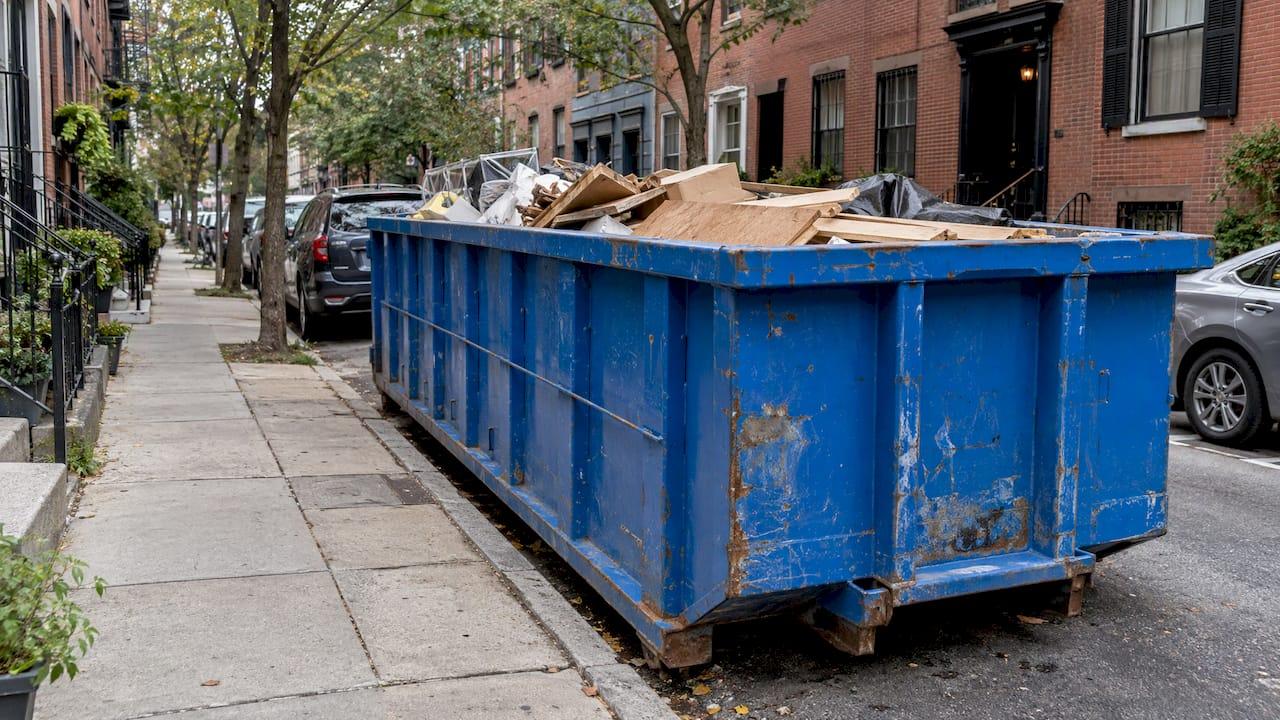
If a dumpster will sit on a Boston street or sidewalk, you need a permit from Boston Public Works before it arrives. A dumpster on a Boston property can also trigger a Site Cleanliness License. A dumpster in your own driveway generally avoids the street permit. The city's dumpster rules still apply to it. If you are in New Hampshire and handling a Boston property, such as an inherited house, a rental or a flip, this guide walks through each permit and what it costs. It also covers how to apply, the fines for skipping it, and a way to avoid the paperwork entirely.
TL;DR
- A dumpster on a public way in Boston (street, sidewalk, alley) needs an occupation permit from Public Works. Boston's regulations say no dumpster may sit in a public way without one.
- The street occupancy permit has a $50 base fee plus space fees, and you should apply online at least seven business days ahead.
- A $50 Site Cleanliness License is required for a dumpster on residential or commercial property in Boston. Contractors and developers do not need one for construction dumpsters.
- Violations carry fines that start at $50 and can climb to $300 or more, so the permit is cheaper than the risk.
- Hauling the junk away with a crew, instead of renting a container, can remove the permit question altogether.
Table of Contents
- When a dumpster in Boston needs a permit
- Street permit versus private property: which one applies to you
- How to apply for a Boston street occupancy permit
- What a Boston dumpster permit costs
- Signs, notice and sidewalk rules
- Rules that apply once the dumpster is in place
- Fines for skipping the permit
- If you live in New Hampshire
- Skip the container: when hauling beats renting
- Let us do the heavy lifting
- Our perspective
- FAQ
- Sources
When a dumpster in Boston needs a permit
Boston's definition is broad. Under Boston Code Section 23-2, a dumpster is a device for storing one cubic yard or more of trash, rubbish or construction debris. The code bars anyone from keeping one on any way, street, alley or other public place in the city. It also bars keeping one on any estate in the city unless it follows Public Works regulations and bears a number issued by the Commissioner of Public Works. The filing fee in the code is $10 plus $2 per dumpster.
Three situations come up most often.
- The dumpster goes on the street or sidewalk. You need a permit for occupation of the way, issued by Public Works. A public way includes a street, sidewalk, alley, parkway, park road, highway or any other way open to public travel, according to Boston.gov.
- The dumpster goes on private property such as a driveway or lot. You do not need a street occupancy permit for space you own. The city's dumpster regulations, though, apply to every dumpster as defined by ordinance, whether it is on private or public property. That covers the owner, the renter, the hauler and anyone else involved.
- You are using a dumpster on a residential or commercial property. Boston's Site Cleanliness License applies. If that dumpster ends up on a public way, the license application also requires a Street Occupancy Permit.
One point is worth knowing before you plan. The code defines a dumpster by volume, one cubic yard or more. A pile of bags at the curb is a different matter, and a few contractor bags are not a dumpster. A roll-off container is, every time.
Street permit versus private property: which one applies to you
Most confusion comes from mixing up the two permits. They are separate, and a job can need one, both or neither.
| Situation | Street Occupancy Permit (Public Works) | Site Cleanliness License |
|---|---|---|
| Dumpster on the street or sidewalk at a home | Yes | Yes, for a dumpster on residential property, and it requires the street permit |
| Dumpster in your own driveway | No | Yes, for a dumpster on residential property |
| Construction dumpster used by a contractor or developer | Yes, if on a public way | Not required for contractors and developers |
| Building with six or more units | Yes, if on a public way | Required through Inspectional Services |
The six-unit rule comes from Boston's code enforcement page: a home with six or more units needs a Site Cleanliness Permit from Inspectional Services. If you are a landlord or investor with a multi-family building, plan for it.
How to apply for a Boston street occupancy permit
The city handles this online. Boston.gov says to apply at least seven business days before you need the space. The steps are as follows.
- Create an account. The application runs through the Public Works online portal. First-time users create an account, choose Street Occupancy Permit as the permit type and enter the work address.
- Pick a work type and describe the job. Say what is being done and why the dumpster is needed.
- Give the dumpster details. For dumpsters, you specify how many there are, their size, and whether you will use a chute or another way to drop materials into them.
- Provide the supporting items. The city asks for the job type and time needed, a traffic plan, and a plan for hiring a Boston police detail if one applies. It also asks for proof of bonding, and the parking meter numbers if you are taking metered spots.
- Handle the bond. The surety bond is $5,000 for occupancy permits. Companies that are not listed in the permittee or contractor lists in the online application send the bond to pwdpermitbranch@boston.gov.
- Submit and wait for approval, then arrange signage before the container arrives.
A homeowner doing one cleanout may find the bond and traffic plan more involved than expected. That is the main reason many people hand the whole thing to a company that already works inside the city's rules, or skip the container.
The refuse contractor requirement
There is a separate condition for outdoor dumpsters. Under Section 23-9 of the code, an application for a permit to maintain an outdoor dumpster must come with evidence that a licensed refuse contractor will provide periodic pickup and removal of refuse. That contractor must also provide cleaning and treatment against rodent or insect infestation at intervals not exceeding one week. You also need evidence that the immediate area is free of rodent and insect infestation. Fail the conditions and the permit is revoked.
What a Boston dumpster permit costs
Here are the published figures. All come from the city.
| Item | Cost | Source |
|---|---|---|
| Street occupancy permit base fee | $50 | Boston.gov |
| Space fee, first 500 sq ft | $0.10 per sq ft per day | same page |
| Space fee, additional space | $0.05 per sq ft per day | same page |
| Signage | $4 each | same page |
| Metered space occupancy | $20 per meter per day | same page |
| Site Cleanliness License | $50 | Boston.gov |
| Dumpster filing fee in code | $10 plus $2 per dumpster | Section 23-2 |
A quick worked example shows how the space fee adds up. A dumpster that takes up about 200 square feet of curb for seven days costs 200 × $0.10 × 7 = $140 in space fees. Add the $50 base fee and a few $4 signs, and you land around $200 before any metered spaces. Each metered spot taken adds $20 per day. These are illustrations of the published rates. Your total depends on the footprint, the number of days and the signs you need.
The Site Cleanliness License is normally approved within a week, sometimes faster, and no inspection is required to receive one, according to the city's license page.
The dumpster regulations also state that every dumpster is registered annually with the Commissioner of Public Works. The Commissioner issues a distinctive two-part number: one part identifies the owner and the other is assigned in sequence for each owner. If you rent a container, that registration normally sits with the company that owns it.
Signs, notice and sidewalk rules
Boston expects you to warn neighbors before a dumpster takes up parking. Boston.gov lays out the timing:
- Residential areas: post signs at least three days before the job, and flyer within a half-block each day for at least two days before work.
- Metered spots: post signs at least two days before, and flyer at least one day before.
- Blocked sidewalk: plan an ADA-compliant pedestrian detour.
- Afterward: clean up debris and remove the signs and fliers.
The signs matter beyond courtesy. They are what keeps other cars out of the space your container needs. Skip the notice period and a delivery truck may find a parked car in the way, which can cost you a scheduled day.
For how long, plan your timeline around the permit window. One guide reports that Boston dumpster permits typically run up to two weeks, but the city page does not state a cap, so confirm the permitted dates when you apply. If a project runs long, do not wait: apply for an extension or new permit before the current one expires.

Rules that apply once the dumpster is in place
A permit is not the end of the obligations. The city's dumpster regulations add operating rules:
- No dumpster may be transported, emptied or serviced between 11:00 P.M. and 7:00 A.M. Mechanical, hydraulic or electrical loaders, compactors, packers and conveyors are barred in those hours too. The Commissioner can allow an exception for good cause.
- No dumpster may be filled to within four inches of the top.
- No dumpster may contain any live rodent, vermin or insect.
The four-inch rule is the one people break by accident. Loading a container until it crowns above the rim is the quickest way to draw a complaint. If you are clearing a whole house, order for volume rather than hoping to stack it higher. Our guide on what dumpster size you actually need helps with that estimate.
Fines for skipping the permit
Boston publishes its penalties, and they vary by section.
- Keeping a dumpster in violation of Section 23-2 carries a $300 fine under Section 23-20. The person doing the act, their employer and every other person concerned may be fined.
- Violations of Sections 23-9 and 23-10, which cover trash outside places of business including overflowing dumpsters, carry $50 fines under the same section.
- Boston's enforcement page describes a $50 fine for a residential dumpster without a permit, capped at $1,000. For a business dumpster without a Public Works permit, it cites $10 plus $2 per dumpster.
- For the Site Cleanliness Ordinance, fines can reach $1,000 per day. If a problem is not fixed in time, the Code Enforcement team can escalate to an administrative hearing and, if needed, Housing Court.
The figures differ because they come from different provisions and enforcement routes, so budget for the higher end rather than the lowest number you see. Enforcement is active: the Code Enforcement Team patrols on foot, bike and car, and you can reach the city at 311 or 617-635-4500. The city also states that inspections can happen outside operating hours, as early as 4 a.m., with yearly site visits on top of those triggered by 311 complaints.
Beyond fines, a dumpster with no permit has no legal claim to the curb, and you also get no No Parking signs, so the space is open to other drivers.
If you live in New Hampshire
New Hampshire readers usually land on this topic for one of three reasons: a parent's home in Boston to clear, a rental or investment property in the city, or a project managed from afar. Three practical points follow.
- The permit follows the property, not your address. If the dumpster sits in Boston, the Boston rules above apply, wherever you live.
- Do not assume Boston's rules apply at home. Towns in New Hampshire set their own rules for containers on streets and for transfer station use. Call your town hall or public works office before any container goes on a public way near you.
- Remote management raises the stakes. The notice, signage and cleanup duties fall on the permit holder. If you cannot be on site, name someone who can.
If the timeline is tight or you are not local to Boston, a full-service hauling crew sidesteps most of this, which brings us to the alternative.
Skip the container: when hauling beats renting
A dumpster rental makes sense for a long renovation with steady debris. For a cleanout of a garage, a basement or an estate, many owners find it is more work than the job itself: permit, bond, signs, a sidewalk detour, and a container sitting for days while you fill it by hand. Our comparison of junk removal versus dumpster rental lays out which one fits which job.

A crew that loads the truck and drives away does not leave a container on a public way. For many one-day cleanouts, that can simplify the permit question. Confirm the details of your particular job with the city when in doubt.
Let us do the heavy lifting
EasyScrap serves Lawrence, Andover, Boston, Lowell and Haverhill with junk removal and hauling for homes and businesses. Our crew is insured. We offer free quotes, and we donate and recycle usable items whenever possible. We take couches, mattresses, refrigerators, washers, dryers and more, and we handle garage cleanouts, basement cleanouts and attic cleanouts. We also handle estate cleanouts and construction debris cleanup, listed on our services page.
If you are weighing a container against a crew, start with a free quote on our junk removal page. Tell us what is on site and when you need it gone. Same-day service is part of how we work.
Our perspective
Most people who search for a dumpster permit are not really after a permit. They want a cleared garage, an empty basement or a house ready to list. The permit is just the cost of one way to get there.
We built EasyScrap around the other way. Our owners are young, local and hardworking, and we show up fast, often the same day, with an insured crew. We do the lifting, load the truck and haul it all off, so you are not posting signs, arranging a bond or watching a container fill.
Where it makes sense, we keep things out of the landfill. We donate usable items and recycle when we can, and we work with local charities in the communities we serve. For realtors and investors on a deadline, and for families clearing a loved one's home, that pairing of speed and care is what we aim to deliver.
If a big, long-running renovation really does call for a roll-off container, the city rules above are the ones to follow. For the cleanouts most homeowners face, we think a crew is the easier path.
Easy
FAQ
Do I need a permit for a dumpster in my own driveway in Boston?
You do not need a street occupancy permit for a driveway, since that permit covers public ways. The city's dumpster regulations still apply to dumpsters on private property, and the Site Cleanliness License applies to dumpsters on residential or commercial property. Check with Boston's Public Works Department if you are unsure about your address.
How long does it take to get a Boston dumpster permit?
Apply for the street occupancy permit at least seven business days before you need the space. The Site Cleanliness License is normally approved within a week, sometimes faster. Build in extra time for the bond and the traffic plan.
Who is responsible if my dumpster rental company does not pull the permit?
The code allows fines against the person performing the act, their employer and every other person concerned, so responsibility can be shared. Confirm in writing who is applying for the permit and who is posting the signs before the container is delivered.
Does the same permit work in New Hampshire?
No. A Boston permit covers only Boston. New Hampshire towns set their own rules, so contact the local town hall or public works department before placing a container on a public way.
Can I avoid a permit by hiring a junk removal crew?
A crew that loads a truck and leaves does not park a container on the street, so the dumpster permit process generally does not come into play. If you have questions about a specific job, confirm with the city.
Sources
- Boston Code, Section 23-2 and 23-9 (Trash outside of places of business)
- Boston Code, Section 23-20 (Violations, penalties, fines)
- City of Boston Public Works Department Dumpster Regulations
- How to get a street occupancy, excavation or driveway permit, Boston.gov
- How to apply for a street occupancy permit, Boston.gov (PDF)
- Site Cleanliness License, Boston.gov
- How code enforcement works in Boston, Boston.gov