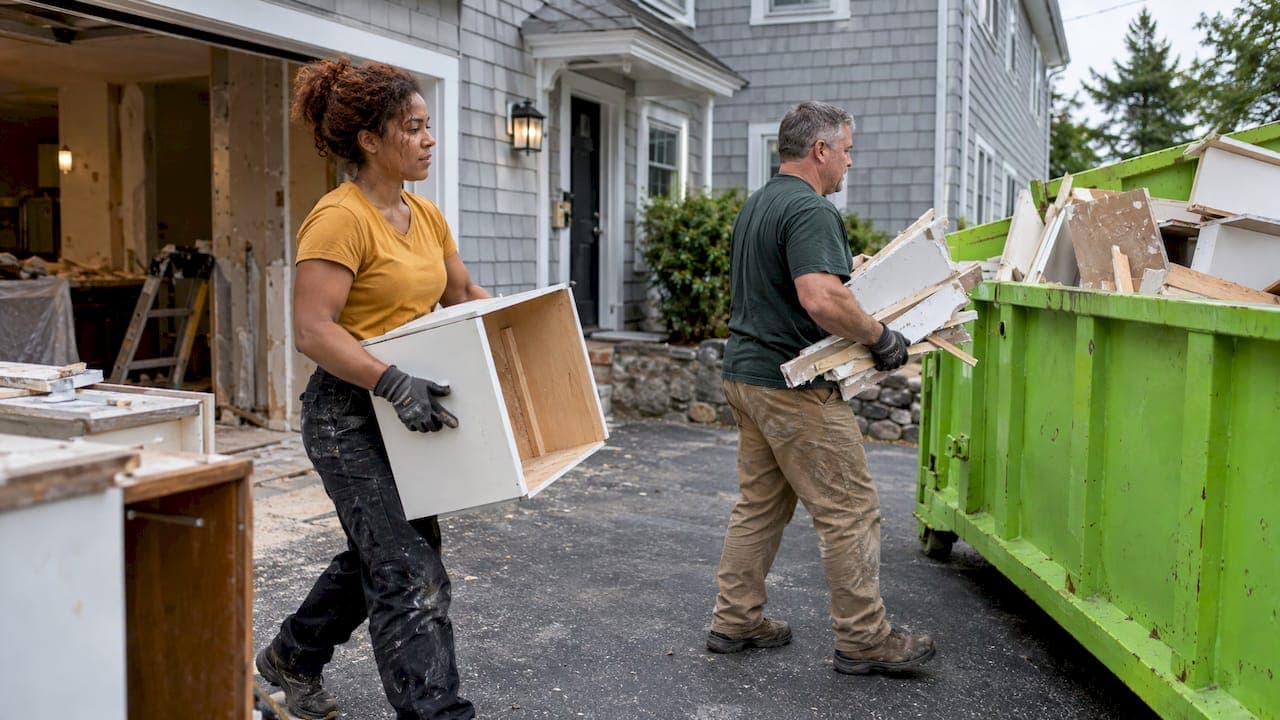
You get rid of renovation debris in three steps. Sort it by material, pick the disposal route that fits the size of the job, and check your state and town rules before anything leaves the driveway. Small loads can go to a transfer station, large mixed piles usually need a roll-off dumpster, and a full-service crew is the fastest option when you do not want to lift, load or haul anything yourself.
This guide walks through each route, what the rules say for Massachusetts and the surrounding area, how to handle wood waste, and what to do with the debris left after a basement flood.
TL;DR
- Sort first: clean wood, metal, concrete and drywall go to different places, and mixed loads cost more and recycle less.
- Match the route to the job: drop-off for a few bags and boards, a dumpster for a gut renovation, hauling for speed and zero heavy lifting.
- In Massachusetts, wood, metal, brick, concrete, asphalt and clean gypsum wallboard are banned from landfills, and open burning of construction debris is illegal.
- Paint, solvents, treated wood and anything that may hold asbestos or lead paint need special handling, not the regular debris pile.
- After a flood, photograph everything before you throw it out, and discard what cannot be cleaned and dried within 24 to 48 hours.
Table of Contents
- Sort the Pile Before You Choose a Route
- Wood Waste and Wood Debris: What Goes Where
- Three Ways to Get Rid of Renovation Debris
- What Renovation Debris Disposal Costs
- Massachusetts and New Hampshire Rules to Check First
- Basement Flood Debris: Throw Out the Right Things Safely
- Our Perspective
- Let Us Haul the Debris
- FAQ
- Sources
Sort the Pile Before You Choose a Route
The single best move you can make is sorting. EPA guidance on renovation waste explains that metals, lumber, asphalt and concrete can be reused or recycled, but only when they are kept apart from contaminants such as trash, nails and broken glass. A pile that is clean and separated has more options and often costs less to move.
A practical sort for most home projects looks like this:
- Reusable items: cabinets, doors, windows, fixtures and appliances that still work. EPA recommends deconstruction, the selective disassembly of buildings, so these pieces can be reused. Pull them out intact rather than smashing them.
- Clean wood: framing, trim and plywood without paint or treatment.
- Metal: pipes, ductwork, flashing, wiring and fasteners. The Steel Recycling Institute estimates the recycling rate for construction steel at about 85 percent, so metal is rarely a problem to place.
- Masonry: concrete, brick, tile and asphalt.
- Drywall and mixed debris: the bulk of most interior jobs.
- Special handling: paint, solvents, adhesives, treated wood, mercury products and anything that could contain asbestos or lead-based paint.
That last group matters most. EPA's RCRA guidance on construction and renovation lists paints, solvents, adhesives, treated wood, asbestos-containing items and lead-based paint among wastes that may be hazardous or excluded from some states' definition of ordinary construction debris. If your house predates the late 1970s, treat old paint and old insulation or flooring as suspect until a qualified inspector says otherwise.
Wood Waste and Wood Debris: What Goes Where
Wood is usually the largest single material in a remodel, so it deserves its own plan. The Wisconsin Department of Natural Resources has a clear fact sheet on wood waste disposal. Its order of preference is to separate clean lumber from other debris, reuse it first or use it for heating, and chip it into mulch if neither is possible.
The same fact sheet gives the rule that applies everywhere: do not burn treated or painted wood, or construction materials that contain plastic, rubber or asphalt. Treated and painted wood belongs at a licensed, approved solid waste facility.

In Massachusetts, burning is not even a gray area. The state says open burning of construction or demolition debris is illegal. Do not plan on a backyard fire for old studs or deck boards.
A simple way to handle wood on a typical job:
- Pull nails and screws where you can, and set aside anything painted or pressure treated.
- Stack clean offcuts and framing separately from drywall and flooring.
- Offer usable lumber to neighbors, a salvage yard or a charity before you pay to dispose of it.
- Send the rest to a transfer station that accepts wood, or have it hauled with the rest of the load.
EPA also notes that transfer stations are a common collection route for wood, metals, textiles and electronics, though local acceptance varies. Call your town's facility before you load the truck.
Three Ways to Get Rid of Renovation Debris
U.S. homeowners generally choose among three models: self-hauling to a drop-off site, renting a roll-off dumpster, or hiring a junk removal crew. One industry comparison describes dumpster rental, junk removal and contractor hauling as the three main service models, each with different labor and cost implications depending on project size and site access. EPA's own guidance says the right choice depends on the project type, space available for sorting, local markets, cost, schedule and contractor experience.
| Factor | Drop-off at a transfer station | Roll-off dumpster | Junk removal crew |
|---|---|---|---|
| Best for | A few bags, boards or a pickup load | Gut renovations and roofing, weeks of work | One-time cleanups, finished phases, tight schedules |
| Who loads | You | You or your contractor | The crew |
| Driveway space | None needed | Needs room for the container, and possibly a permit | None beyond truck access |
| Speed | Depends on your trips | Sits on site until full | Often same day |
| Sorting | You sort at the site | You decide what goes in | Crew sorts and diverts reusable items |
When drop-off makes sense
If you have a modest amount of clean material and a truck, a transfer station is the lowest-effort way to dispose of it. Expect weighing, a per-ton or per-load fee, and rules about what each bin accepts. It becomes a poor fit when you have drywall, heavy fixtures or a hot tub-sized item to move, because every trip costs a day and your back.
When a dumpster makes sense
A dumpster is practical when work will run for weeks and debris builds up daily, such as a kitchen gut or a full roof tear-off. The container sits on your property, so check town rules on placement and permits. Keep it dry and keep prohibited items out, because overfill and banned materials are what generate surprise charges. If you are not sure whether a dumpster or a crew fits better, our comparison of junk removal vs dumpster rental walks through the decision.
Budget-minded remodelers also plan disposal alongside materials. A breakdown of an affordable bathroom remodel shows how much of a small project goes to materials, which is a useful reminder to set aside a line for debris from the start.

When hauling makes sense
A crew is the right call when the work is done and you want the mess gone, when debris is spread across rooms, or when the material is heavy, awkward or numerous. It also fits projects with no space for a container, such as condos and tight city lots. Our guide to three renovation cleanup options covers DIY, specialty dust-control pros and same-day hauling side by side. Contractors weighing volume and salvage can read how to choose junk removal for contractors.
What Renovation Debris Disposal Costs
There is no single price, because volume, weight, material type and access all move the number. As a reference range, This Old House reports that dumpster rentals typically cost $294 to $479 and junk removal usually costs $133 to $372, depending on size, volume and location. Those are national figures from June 2026 reporting, so treat them as a starting point, not a quote.
The cheapest advertised price is not always the cheapest outcome. A rental that fills faster than expected, a permit you did not budget for, or a second trip to the transfer station can erase the savings. The honest way to price a job is to count what you have:
- Roughly how many pickup-truck loads is it?
- Is any of it heavy material such as tile, concrete or plaster?
- Can the truck get to the debris, or is it up stairs or in a basement?
- Do you need it gone by a deadline, such as a listing date or an inspection?
We publish a plain-language guide to what to budget for construction debris removal and an explainer on how on-site junk removal quotes work. We do not publish fixed prices for renovation cleanups, because the load decides the cost. We offer free quotes.
Massachusetts and New Hampshire Rules to Check First
At the federal level, construction and demolition debris is generally not regulated as hazardous waste under RCRA, and states set their own definitions and disposal standards. That means the rules you live under are local.
Massachusetts. The state's waste ban list covers asphalt pavement, brick, concrete, metal, wood and clean gypsum wallboard as of the June 2020 regulatory update. In practice, those materials must be diverted to recycling or processing rather than dumped with ordinary trash. Any hauler you hire should be sorting them accordingly. If you are weighing cleanup against the cost of fees tied to a covered loss, this explainer on disposal fees in insurance claims is worth a look.
New Hampshire. Towns run their own transfer stations and set their own hours, resident stickers, fees and accepted materials. Call the station or check the town website before you load up, and ask whether construction debris is accepted at all or must go to a separate facility.
Everywhere:
- Ask your town whether a dumpster on the street or driveway needs a permit.
- Keep paint, solvents and adhesives out of the regular pile. Dry out liquid building materials and never rinse them into storm drains, a rule cities such as Oceanside, California spell out in their clean water guidance.
- If a material might contain asbestos or lead paint, stop and have it tested or handled by a licensed professional before you disturb it.
- Mattresses, appliances and textiles can have their own state rules. See our notes on the Massachusetts mattress ban, appliance recycling options in Massachusetts and textile recycling rules.
For a wider look at where each material can go, see where U.S. homeowners and contractors can take construction debris.
Basement Flood Debris: Throw Out the Right Things Safely
Flood cleanup is where speed and caution collide. Mold starts quickly, but so do bad decisions. FEMA's guidance is specific: wear protective equipment, keep children out of the area, and discard items that cannot be cleaned and dried within 24 to 48 hours.
A sensible order of operations:
- Photograph first. FEMA recommends documenting damage with photos and keeping samples of items like carpet and upholstery, because they may affect an insurance claim. Do this before anything goes to the curb.
- Protect yourself. Gloves, boots, eye protection and a respirator rated for mold are the baseline. Floodwater can carry contamination.
- Sort salvageable from not. Hard, nonporous items can often be cleaned. Carpet, padding, upholstered furniture, particleboard and soaked drywall usually cannot be dried in time.
- Mind the fans. FEMA warns that if mold has already started growing, using fans can spread mold spores.
- Remove the debris. A flooded basement means heavy, wet, awkward material carried up stairs, which is exactly where hiring a crew pays off.
One point owners often miss: FEMA says building owners are responsible for documenting and mitigating mold, and that NFIP flood policies do not cover mold damage. Speed matters, and so does your paper trail. If your basement has flooded, our basement cleanout service is built for this kind of heavy, stair-bound load.
Our Perspective
We started EasyScrap because renovation debris is the part of a project nobody plans for. The tile is chosen, the contractor is booked, and then a pile of drywall, old cabinets and torn-up flooring is sitting in the garage with nowhere to go.
Here is how we see it. Disposal is not one decision, it is a sorting decision followed by a logistics decision. When the pile is sorted and the load is manageable, nearly any route works. When the pile is big, heavy, spread across floors or due to leave by a deadline, the route that removes the most uncertainty is usually the best one. A crew that arrives when scheduled, loads everything and takes it away the same day saves you the trips, the lifting and the guesswork about what a transfer station will accept.
We also care where it ends up. Our team donates usable furniture, fixtures and household items and recycles what can be recycled, working with local charities, instead of sending everything to a landfill. That fits the direction of both EPA guidance and Massachusetts rules, and it keeps good materials in circulation in the communities we serve.
We are a young, local, insured crew serving Lawrence, Andover, Boston, Lowell and Haverhill. Whether you are a homeowner finishing a basement, a grandparent clearing a house, or a Realtor or investor getting a property ready to list, our goal is simple: show up on time, treat your home with respect and leave it clean.
Easy
Let Us Haul the Debris
When your renovation is done, or even mid-project, we can remove it. EasyScrap handles construction debris cleanup, furniture, appliances, flooring and drywall scraps, plus garage, basement and attic cleanouts, for homes and businesses across northeastern Massachusetts and the Boston area. Our insured crew offers flexible scheduling and same-day service when available, and we donate and recycle whenever possible.
Tell us what you have, and we give you a free quote. Start at our junk removal page or visit EasyScrap to book.
FAQ
How do you get rid of renovation debris?
Sort it by material, then choose self-hauling, a dumpster or professional junk removal based on how much you have and how easily a truck can reach it. Check local rules first, especially for paint, treated wood and anything that may contain asbestos or lead. Reuse and recycle what you can.
Can I burn leftover wood from a renovation?
Not treated or painted wood, and not construction materials containing plastic, rubber or asphalt. In Massachusetts, open burning of construction or demolition debris is illegal. Clean, untreated lumber is better reused, chipped for mulch or sent to a facility that accepts wood.
Do I need a dumpster or a junk removal service?
A dumpster suits multi-week projects where debris builds daily and you have space and permission for the container. Junk removal suits finished jobs, tight access and tight schedules, since the crew does the loading and hauling. Many homeowners use a dumpster during demolition and a crew for the final cleanup.
What should I throw away after a basement flood?
Discard items that cannot be cleaned and dried within 24 to 48 hours, which typically includes carpet, padding, soaked drywall and upholstered furniture. Photograph everything before disposal and keep samples of items such as carpet for your insurance claim. Wear protective gear, and keep children out of the area.
Is renovation debris considered hazardous waste?
Most of it is not. Federal rules generally do not classify construction and demolition debris as hazardous, but paints, solvents, treated wood, asbestos and lead-based paint can be. Those items need handling under federal or state requirements, so ask your town or state environmental agency before disposing of them.
Sources
- Debris Disposal 101: A Guide To Managing Renovation Waste, This Old House
- Building Savings Strategies for Waste Reduction of Construction and Demolition Debris, EPA
- RCRA in Focus: Construction, Demolition, and Renovation, EPA (2004)
- RCRA in Focus: Construction, Demolition, and Renovation, EPA (hazardous constituents)
- Characterization of Building-Related Construction and Demolition Debris, EPA
- Burning and Disposal of Wood Wastes, Wisconsin DNR
- Open Burning Safety, Mass.gov
- Construction and Demolition Materials Waste Ban FAQ, MassDEP
- Standardized Terms for Materials Accepted by Municipal Recycling Programs, EPA
- Dumpster vs. Junk Removal vs. Contractor Hauling, HomeMending
- City of Oceanside Clean Water Program building tips, EPA
- Returning to flooded buildings, FEMA
- Returning Home After a Flood, FEMA
- Mold and Mildew, FEMA
- How to Document Damages After Severe Weather Events, FEMA
- Affordable Bathroom Remodel: What $5,000 Buys
- Using the gap log to recover disposal fees on insurance claims