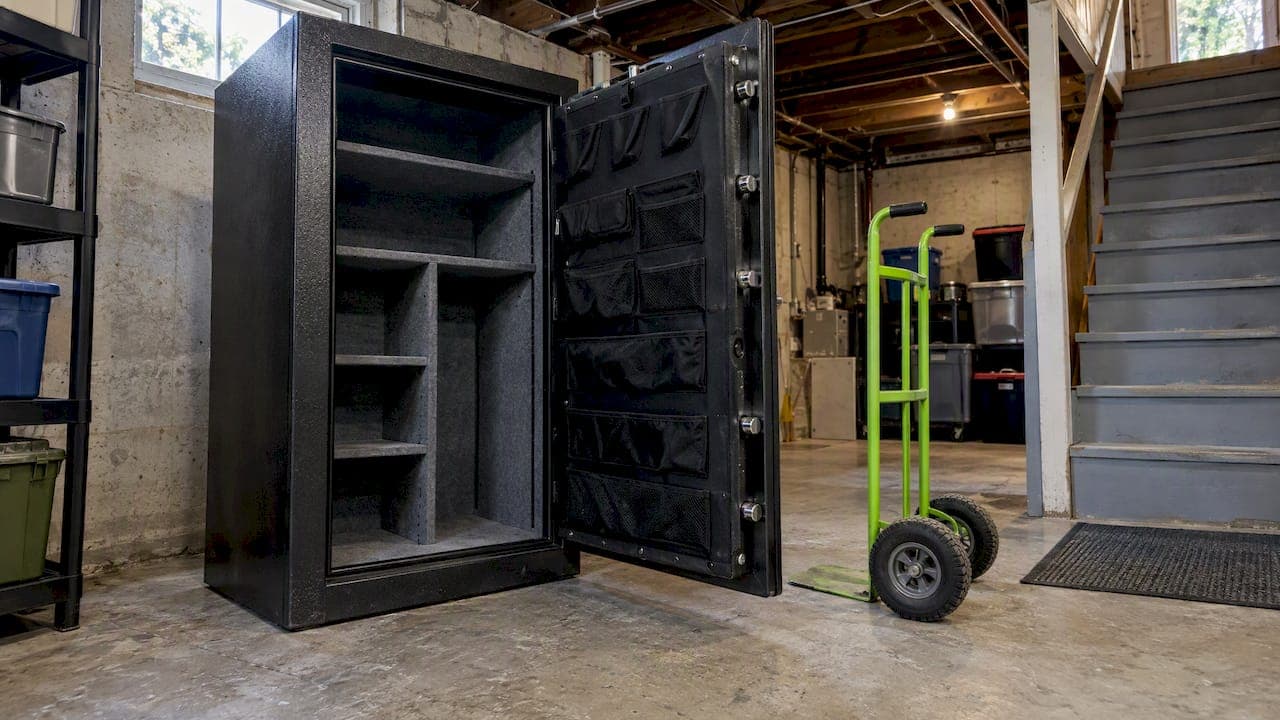
The safest way to dispose of a gun safe is to empty it completely, deal with the firearms and ammunition separately, and then hand the empty steel box to someone equipped for its weight: a buyer, a scrap-metal recycler, a transfer station that accepts it, or a hauling crew. Most safes weigh several hundred pounds, so the lifting is usually the hardest part. The contents and the lock are the parts that can go wrong.
This guide walks through the order that works: what to do before anyone touches the safe, where an empty one can go, what to know about stairs and basements, and when to hire help. We serve Lawrence, Andover, Boston, Lowell, Haverhill and nearby towns in Massachusetts and New Hampshire, so local examples come from there where we can.
TL;DR
- Empty the safe first. Firearms and ammunition never go in the trash, a dump or a scrap load, and they need their own plan.
- If the safe is locked and you cannot open it, call the manufacturer or a licensed locksmith. Do not cut it open yourself.
- A working safe can be sold or given away. A broken metal one may go to a scrap-metal recycler or a landfill or transfer station that accepts it. Rules differ by town and county, so call first.
- A safe is heavy enough that stairs, tight turns and basements are the real risk. Use proper equipment and at least two strong helpers, or hire a crew.
- We haul away heavy items from homes in Massachusetts and New Hampshire. Tell us about the safe when you ask for a free quote.
Table of Contents
- Start with what is inside
- Decide what the safe is: reuse, recycle or landfill
- Moving a heavy safe without getting hurt
- Where the safe turns up in a bigger cleanout
- What does gun safe removal cost?
- How we can help
- Our perspective
- FAQ
- Sources
Start with what is inside
Before you think about hauling, make sure nothing is left in the safe. That means firearms, ammunition, magazines, cash, documents, jewelry and the small items that slide into the door pockets and the bottom corners. Check the shelves, the door organizer and any dehumidifier rod or battery-powered light.
U-Haul's moving guide recommends removing belongings and securing firearms and other contents separately before you shift the safe at all. Emptying it also cuts the weight, which matters when you start moving it.
Firearms
A firearm is not junk, and a junk removal company is not the right place for one. Police departments take unwanted firearms in many places. San Diego's police department, for example, says residents can request a firearm pickup, keep the firearm unloaded in a locked, secure location until instructed, and that surrendered firearms are crushed and recycled. San Ramon, California, police ask that firearms be unloaded before transport, and tell people who cannot safely unload one to call non-emergency dispatch for collection.
Those are California examples, and each department sets its own process. In Massachusetts or New Hampshire, call your local police department's non-emergency line, say you have a firearm to surrender, and follow their instructions on how to hand it over. Do not carry it around town to find someone who will take it.

If the firearms belonged to a relative who has died, or you are clearing a home as an executor, the same rule applies: leave the firearms where they are, locked, and call the police or a licensed dealer to arrange the transfer. A cleanout crew can start on the rest of the house.
Ammunition
Ammunition does not belong in household trash, and landfills turn it away. Loudoun County, Virginia, for instance, does not accept ammunition at its landfill and refers residents to the Fire Marshal's Office. Larimer County, Colorado, routes ammunition to its household hazardous waste facility.
For Massachusetts, the state's household hazardous products guide says ammunition should be kept dry and away from heat, and suggests asking local rod-and-gun clubs or police departments whether they can use or store it, or arranging a hazardous-waste transporter for specialized disposal. Do that before the safe moves, so loose rounds are not rattling around in a safe on a dolly.
When you cannot open it
Inherited safes, old combination locks and dead electronic keypads are common. If the safe will not open, contact the manufacturer or a licensed locksmith. DumpMapper's guide says the same, and adds that you should not try to cut the safe open yourself. Sparks, flying metal and a locked box of unknown contents are a poor combination.
A safe that is still locked is not ready for disposal. Any reputable crew or recycler will want to know it is empty.
Decide what the safe is: reuse, recycle or landfill
Once it is empty, the question is what condition it is in. Liberty Safe's guide suggests identifying the type of safe, the lock, how it is anchored, its dimensions, the route out and the contents before choosing a removal method. That list is a good checklist for a quote too.
| Situation | Best route | What to know |
|---|---|---|
| Safe works and the lock opens | Sell or give it away | Local buy-and-sell groups and safe dealers see steady demand for used safes |
| Safe is damaged but repairable | Locksmith repair, then sell | A locksmith can often fix lock or bolt problems |
| Safe is metal and beyond repair | Scrap-metal recycler | Ask whether they take safes and whether non-metal parts must come out |
| Safe is insulated or fire-lined | Transfer station or landfill that accepts it, or a hauler | Some drop-offs exclude insulated safes |
| Safe is anchored or in a tight space | Hauling crew | Plan the route and unbolting before the move |
Sell or give it away
Hennepin County, Minnesota, tells residents to prioritize reuse: sell or give away a working safe, or repair a broken one at a locksmith. York County Solid Waste Authority in Pennsylvania likewise says reusable safes may be donated or resold. A used safe has real value to a buyer who would otherwise pay for a new one, so a listing with clear photos, the dimensions and the make is worth a few days of patience.
Keep in mind the buyer will have to move it. Say whether the safe is in a basement, how many steps there are, and whether you will help with loading.
Scrap metal
A steel safe is a lot of metal. Hennepin County says a metal safe may be accepted by a scrap-metal recycler, and that it should be checked with the recycler first, since non-metal parts may need to come out. The county accepts metal safes at its own drop-off facilities for no charge but excludes insulated safes. That is one county's rule, and yours may differ.
Fire-rated safes complicate this. The fireproofing material between the steel layers is not metal, and not every yard wants to deal with it. Ask the recycler directly: "Do you accept a fire-lined safe, and does the door need to come off?" Our guide to scrap metal disposal for homeowners and businesses covers what yards typically ask for.

Landfill or transfer station
Some safes can go to a landfill. York County Solid Waste Authority says safes larger than document size generally belong at a landfill rather than in regular trash. Hennepin County notes that safes may go in the garbage but advises checking with your waste hauler or local landfills and transfer stations.
Do not leave a safe at the curb with your regular trash. Municipal collection crews will not lift it, and it will be left behind with a tag. DumpMapper points out that accepted materials, unloading requirements, fees and fire-lining rules vary by city and county, so a call to your town's transfer station or public works office comes before any trip with a truck.
Moving a heavy safe without getting hurt
A home safe commonly weighs hundreds of pounds, and the injuries happen on stairs. The usual equipment is a rated appliance dolly, ramps and straps, plus at least two strong helpers. The person who guides the load should never stand on the downhill side of a staircase. DumpMapper advises that basement or stair moves usually call for hiring movers, and we agree.
A few practical points before the move:
- Measure the route. Check doorways, turns, step counts and the vehicle opening. A safe that fits in is not guaranteed to fit out, especially if it was installed before a wall or door was added.
- Look for anchors. Many safes are bolted to the floor through the base. Unbolt them before anyone pulls. A safe that suddenly releases can tip.
- Protect the floors. U-Haul suggests furniture sliders suited to your floor type and moving pads with mover's wrap. Wood, tile and carpet all need different treatment.
- Do not tilt it on its own. Tipping a safe over on its edge to get a dolly under it puts a lot of weight in the wrong place. Use a dolly rated for the weight.
- Do not rush. Plan every stop on the route. Safes do not forgive a slip.
The same logic applies if you are keeping the safe and just relocating it. Winchester's owner manual says to place the safe where the floor is sure to support its weight, to use a dolly substantial enough for the safe's size and weight, and to anchor it to prevent tipping. It also recommends the lowest elevation in the home for fire protection, and warns that homes with pier-and-beam floors need placement where the floor will bear the load.
Where the safe turns up in a bigger cleanout
A lot of the safes we hear about are not a single-item job. They are in a basement, a garage or a bedroom closet that is part of a larger cleanup: an estate, a rental turnover, a move. In those jobs the safe is the one item that cannot be dragged to a pile. If the property has also accumulated years of belongings, the decision on how to approach the whole house matters. This piece on whether to clear a hoarder house or sell it as-is shows how owners weigh cleanout against selling in poor condition, which is a useful frame when the safe is only one of many items to deal with.
The order we suggest for these jobs:
- Locate and secure firearms, ammunition, documents and valuables first, with the family or the executor present.
- Open and empty the safe, or get a locksmith or the manufacturer to do it.
- Decide what leaves the house and how: sale, recycling, donation or haul away.
- Then bring in a crew for the heavy lifting and the rest of the junk.
What does gun safe removal cost?
We do not publish a flat price for safes, because the price depends on the job and not the item. The factors that move a quote are:
- Weight and size. A small cabinet safe is a different job from a full-size floor safe.
- Location. Ground-floor garage versus basement with a staircase is the biggest swing.
- Anchoring. A bolted base takes time.
- Everything else you want gone. A safe on a truck with a full load of other items is usually cheaper per item than a lone pickup.
- Disposal fees. Landfills and transfer stations may charge, and some recyclers pay or take scrap for free depending on the metal and market.
Specialist safe movers price differently from junk haulers, and a mover who will relocate a safe to your new house is a different service from one who will take it away and dispose of it. When you compare quotes, ask each provider whether the price includes the carry-out, the disposal fee and any stair charge.
How we can help
If the safe is empty, accessible and you do not want to rent a dolly and call in favors, we can take it from there. We offer junk removal and heavy appliance and furniture hauling across Lawrence, Andover, Boston, Lowell and Haverhill, plus nearby New Hampshire towns. Our crew is insured, quotes are free, and we offer same-day service when the schedule allows.
We also work in basement cleanouts and garage cleanouts, which is where most safes live. When you ask for a quote, tell us the approximate size, where the safe sits, how many steps are between it and the truck, and whether it is bolted down. Request a free quote and we will confirm what we can take and how.
Our perspective
Most of the time, a gun safe is not the problem. The problem is the three things around it: what is still inside, a lock nobody can open, and a staircase with a heavy load on it. Handle those in the right order and the actual removal is straightforward.
We think the best outcome is the one that keeps steel out of the landfill. That is why we donate and recycle whenever possible, and why we like to ask about the safe's condition before we show up. A working safe has a second life. A scrapped one can become metal again.
We are a young, local crew, and we know that people call us during stressful moments: a parent's estate, a house sale deadline, a basement that has not been touched in years. We aim to be reliable, friendly and clear about what we can haul, so you are not left guessing. Firearms and ammunition always go through the police or a licensed channel, and we will tell you that up front.
Easy
FAQ
Can I put a gun safe in the trash?
Usually not at the curb. Municipal crews do not collect safes, and a safe of this size generally belongs at a landfill or transfer station rather than regular trash, as York County Solid Waste Authority explains. Call your town's public works office or transfer station to confirm whether it accepts safes and what it charges.
What do I do with the guns and ammunition in the safe?
Remove them first and keep them unloaded and locked until you have a plan. Call your local police department's non-emergency line about surrendering firearms. For ammunition, Massachusetts' hazardous products guide suggests asking police or rod-and-gun clubs or using a hazardous-waste transporter.
Can a gun safe be recycled?
Often yes. A metal safe may be accepted by a scrap-metal recycler, sometimes after non-metal parts are removed, according to Hennepin County. Fire-lined or insulated safes can be excluded, so ask the recycler before you bring it.
Can two people move a 400-pound safe?
On flat ground with a rated dolly and straps, two strong people can sometimes do it, but stairs change the answer. Basement and stair moves usually call for hired help, as DumpMapper advises. If there is any doubt, hire a crew.
Sources
- Safes | Hennepin County
- Safes - York County Solid Waste Authority
- Firearms | City of San Diego
- Property & Evidence | City of San Ramon
- Guide to Safely Managing Hazardous Household Products | Mass.gov
- Loudoun County Landfill Accepted and Unaccepted Wastes
- Disposal A to Z | Larimer County
- How to Move a Gun Safe | U-Haul
- Decommissioning Old Safes | Liberty Safe
- How to Dispose of a Gun Safe or Heavy Safe | DumpMapper
- Winchester Safes owner's manual