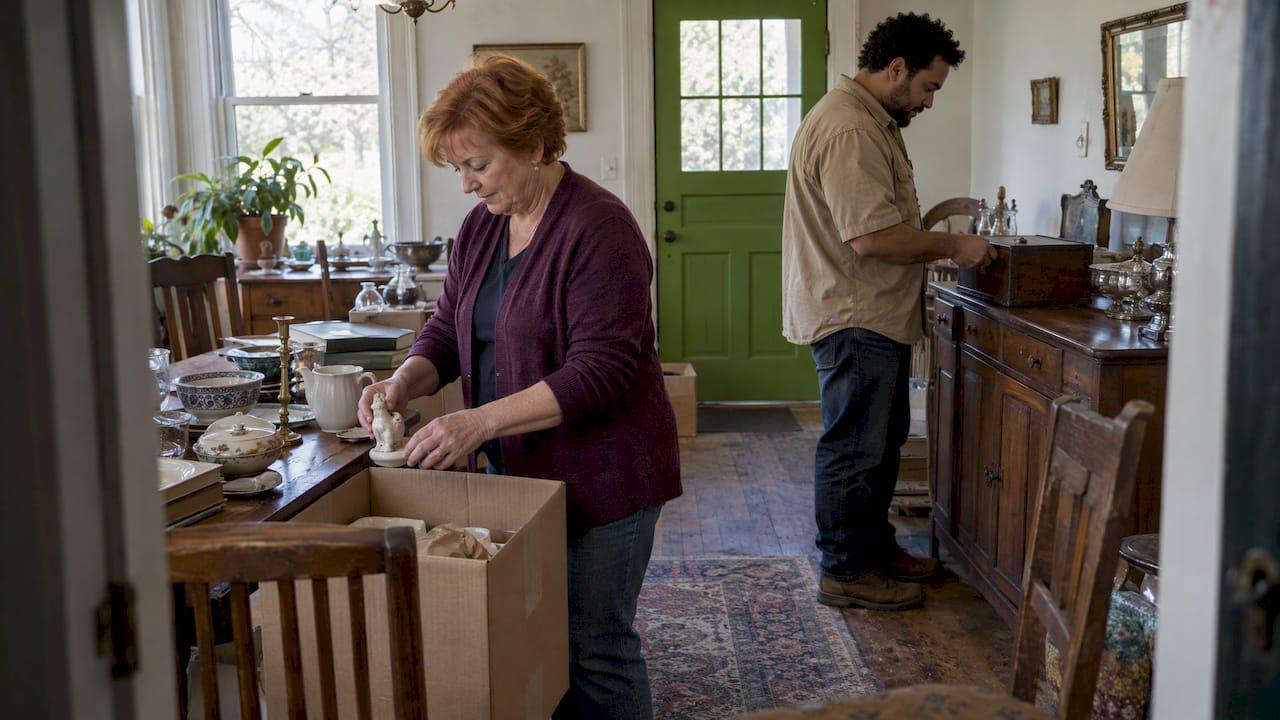
When an estate sale ends, there is almost always something left: furniture nobody wanted, boxes of kitchenware, a basement of tools, a mattress. You have four ways to clear it. You can donate what is usable, sell what has value through another channel, keep what matters to the family, and pay a crew to haul the rest. Sort first, then match each pile to the right exit. Do it in that order and you finish faster, spend less and avoid regrets.
This guide is for executors, adult children, Realtors and investors who are looking at a full house after the last shopper leaves. It covers what usually happens to leftovers, how to sort them, what charities refuse, what to confirm with the sale company, and when to call a hauler.
TL;DR
- Leftovers usually go one of five ways: donation, online or bulk sale, return to the family, removal by a cleanout crew, or disposal.
- Sort into three piles before anyone hauls anything: keep, donate, junk. Pull papers, photos and jewelry first.
- Charities often turn away mattresses, stained upholstery and broken items, so plan a hauling route for those.
- Get the handling of unsold items, removal costs and an itemized list of what sold in writing before the sale starts.
- A one-visit cleanout crew can clear the remainder, donate what is usable and leave the house ready to list.
Table of Contents
- What usually happens to estate sale leftovers
- Step 1: Pull out anything you cannot replace
- Step 2: Sort what remains into three piles
- Step 3: Donate what charities will actually take
- Step 4: Sell what still has a market
- Step 5: What to confirm with the estate sale company
- Step 6: Clear the rest, and do it once
- Perspective: why we say clear it in one visit
- Getting the property ready after the cleanout
- Need the leftovers gone? Call EasyScrap
- A simple timeline for the week after the sale
- FAQ
- Sources
What usually happens to estate sale leftovers
There is no single rule, because the outcome depends on the contract and on what the family wants. According to a summary of common practice from an estate sale company, leftovers are typically donated, sent to a secondary auction with proceeds returned to the estate, hauled away for a fee, or bought by the company at an agreed rate and credited to the estate.
Another estate sale firm lists a wider menu: private offers, an online auction, a bulk buyout, donation, consignment, recycling or disposal, with the family free to keep selected belongings. In a traditional sale, prices are set before the doors open and often drop as the sale goes on, so what remains at the end has already been discounted once. That matters: if a lamp did not sell at half price, it is unlikely to sell next weekend at the same table.
Here is how the main exits compare.
| Exit | Best for | Watch out for |
|---|---|---|
| Donation | Clean, complete, working household goods | Charities refuse many items; pickup windows can be tight |
| Online or auction sale | Collectibles, tools, art, jewelry, anything with a real market | Takes weeks and effort; fees and shipping |
| Bulk buyout by a buyer | Large lots of mixed goods when speed matters | Lowest price per item |
| Family keeps | Photos, letters, heirlooms, documents | Storage space and decision fatigue |
| Cleanout and haul-away | Furniture, appliances, mattresses, broken items, anything left | Cost depends on volume and access |
| Landfill or recycling | Truly unusable goods | Hazardous materials need special handling |
Step 1: Pull out anything you cannot replace
Before a donation truck or a hauling crew touches anything, do one slow walk-through for the items that cannot be undone. One auction house suggests you not throw anything away until you know what you have: costume jewelry boxes sometimes hold fine jewelry, closets can hide designer pieces, and stacks of old papers may include signed documents, vintage stock certificates or first editions.
Check these places on your walk-through:
- Desk drawers, coat pockets, and books (cash, letters and bonds turn up between pages)
- Kitchen canisters, freezers and shoeboxes
- Photo albums, military records, handmade items and anything with a name written on it
- Workshop and garage shelves, where tool sets and collectibles hide behind paint cans
Family photographs, letters, documents and heirlooms are normally set aside for the family during sorting, before anything goes to sale, donation or cleanout. If you are the executor, document what you set aside. Our guide to a photo inventory before an estate cleanout shows how to photograph rooms and contents so every sibling sees the same record.
Keep sentimental items, but keep them on purpose
Sentiment is not the same as value, and it is not the same as space. One national charity retailer notes that carefully chosen keepsakes can honor the person's legacy when stored properly or worked into your own home, and it cautions against holding on to too much. A practical rule: each family member picks a small number of items, and anything nobody claims moves to the donate or haul pile. Our plan for cleaning out your parents' house walks through how to run that conversation.
Step 2: Sort what remains into three piles
A simple method keeps a crew from guessing. One industry guide recommends three categories: keep or personal, donate, and junk, with the donate pile boxed and labeled and the junk pile grouped together. You can do the same with painter's tape and a marker.
- Keep: photos, documents, jewelry, heirlooms. Move them off-site or into one locked room.
- Donate: clean, complete, working, safe items. Box small goods and label the boxes.
- Junk: broken furniture, stained or ripped items, worn carpet, old mattresses, anything unsafe.
If you are stuck on a borderline piece, use the quick checks in our article on three on-site tests to decide what to donate or trash.
Step 3: Donate what charities will actually take
Donation is the most common exit, and a good one, but charities choose what they accept. Check that items are clean, complete, safe and usable. Organizations may decline mattresses, large entertainment units, recalled products, medical equipment, chemicals, weapons, opened consumables or upholstered furniture. Policies vary by organization and location, so call before you schedule.
Practical points that save a second trip:
- Group donations by room so a pickup crew can load quickly.
- Put small items in boxes, with fragile goods wrapped.
- Keep donation items away from the damp basement pile.
- Ask about pickup limits: most charities will not carry heavy appliances or sleeper sofas from a third-floor walk-up.
We built our process around exactly this problem. See how donations are accepted in one junk removal visit, and read about our donation program.
Donation and taxes
If the estate may claim a charitable deduction, the personal representative should ask the estate's tax professional what documentation, valuation or acknowledgment is required. The IRS explains the relevant rules in Publication 526 and Publication 561, as outlined here. Keep the charity's receipt and your photos. For homeowners, we also explain when junk removal can be tax deductible.
Step 4: Sell what still has a market
If an item might bring real money, a second channel can pay off. Options that sale professionals describe include private offers, an online estate auction that reaches a broader buyer pool, or a bulk buyout. Auctions let competitive bidding set the price, and they give executors and heirs a public, market-based record that items were offered fairly.
A few other tactics, from a regional auction house: list items online or donate locally, mark items best offer during the sale, or hold a follow-up clean-up sale with discounts and bundles.
Be realistic. A second sale costs time and a second round of strangers walking through the house. Sell only what is worth that effort, such as tools, jewelry, art, vintage electronics and collectible glass. Everything else belongs in the donate or haul pile.

Step 5: What to confirm with the estate sale company
Most leftover disputes start before the sale does. Removal of unsold goods is usually a separate service, and companies differ widely: some clear the house as part of a package, some bill hauling by the hour or load, and some return the keys with everything still in place. Ask which one you are getting.
Put these items in the written contract:
- Unsold items: who decides, and whether they are donated, disposed of, returned or sold later. Contract guidance lists this among the key clauses in estate sale agreements.
- Removal costs: one contract template says the estate bears removal or disposal costs unless otherwise agreed.
- Payment timing and records: the Minnesota Attorney General advises that the contract specify payment timing, require an itemized list with the actual price collected, and bar the company from using the estate's share before payment. The same office advises asking for a subtotal of proceeds at the end of each sale day and requiring express consent before the company buys sale items.
- Buyouts of leftovers: one hiring guide points out a conflict of interest when the company keeps or buys leftovers at a discount, since it priced the items itself. If a buyout is on the table, ask for the price in writing.
Oversight is thin in many places. One estate sale owner notes that companies are largely unregulated in most U.S. states, so itemized documentation of what was left is your protection. Rules differ by state, so if the estate is in probate, ask the estate attorney before you sign. Our photo-first probate cleanout guide covers how documentation helps avoid heir disputes.
Step 6: Clear the rest, and do it once
Whatever is left after donation, keepsakes and any second sale is the haul-away pile. That usually means:
- Couches, mattresses, box springs and bulky dressers
- Refrigerators, washers, dryers and other appliances
- Broken or stained items and worn carpet
- Garage, basement and attic contents nobody claimed
- Yard debris, old paint and miscellaneous bulk
Ask the person doing the work about hazardous materials. Tires, batteries, paint, chemicals, propane tanks and older CRT monitors need identifying and separate handling. In Massachusetts, paint has its own rules, which we explain in our guide to legal paint disposal options in Massachusetts.
Which space is the problem?
Most leftovers pile up in the same places. If yours is the garage, see our garage cleanouts; for a damp lower level, basement cleanouts; for stairs full of boxes, attic cleanouts. For a few large pieces, furniture removal or appliance removal is faster than coordinating a charity.
Perspective: why we say clear it in one visit
We see the same pattern in the houses we clear in Lawrence, Andover, Boston, Lowell and Haverhill. The sale ends on Sunday, the family is exhausted, and the house is still listed, tied up or waiting for out-of-town siblings to decide. Every extra week of leftovers is another week of utilities, insurance and stress.
Our view: do the sorting yourself or with family, then let one crew take the rest in a single visit. We are a young, local team, our crew is insured, and we donate and recycle whenever possible, so usable furniture and household goods have a chance to go somewhere useful instead of straight to the dump.
We also think the executor should never be rushed. Photograph the rooms, pull the papers and photos, and tell us what stays. We do the heavy lifting and you keep control of the decisions.
Easy
Getting the property ready after the cleanout
Once the house is empty, you are choosing between selling, renting or handing it to a family member. If you plan to list it, use a home staging checklist so the empty rooms show well. A thorough clean helps too, and a move-out cleaning is the usual last step before photos or a handover.
For Realtors and investors working to a closing date, our executor timeline for a 10 to 14 day cleanout and two-week estate cleanout process lay out the order of work.
Need the leftovers gone? Call EasyScrap
We handle junk removal, furniture and appliance removal, and estate, garage, basement and attic cleanouts for homes and businesses in Lawrence, Andover, Boston, Lowell and Haverhill. We offer free quotes, flexible scheduling and same-day service, and our crew is insured. Tell us what is staying, what is going and what could be donated, and we will handle the rest.
Start with our junk removal service or see everything we clear on our services page. You can also reach us from easyscrapofficial.com.
A simple timeline for the week after the sale
A calendar keeps the cleanup from drifting. Adjust it to your situation.
- Day 1: Walk every room and closet. Remove papers, photos, jewelry and cash. Photograph each room.
- Day 2: Ask family which items they want. Set a deadline for claims.
- Days 3 to 4: Pack and label donation boxes. Identify hazardous goods such as paint and batteries.
- Day 5: Confirm the sale company's itemized list and final payment terms in writing.
- Days 6 to 7: Book the haul-away crew, and a donation pickup if your charity offers one. Walk the house a last time.
- After: Clean the house, then stage or hand over.
If closing is close, book removal earlier, and consider handling donation and hauling in the same visit so you do not wait on two schedules.
FAQ
Who gets the leftover items after an estate sale?
That depends on the contract. Leftovers may be returned to the family, donated, auctioned, bought by the company or removed by a cleanout service, depending on the agreement and the family's goals. Settle it in writing before the sale so nobody is surprised afterward.
Can I donate a mattress or old couch left over from the sale?
Often not. Many organizations decline mattresses and upholstered furniture, as donation guidance for estate items notes. Call first, and plan on hauling anything a charity refuses.
Should I keep anything before the cleanout crew arrives?
Yes. Pull photos, letters, documents, jewelry and anything with family meaning, and check pockets, books and boxes. Once these are set aside and photographed, the crew can clear everything else without worry.
Does the estate pay to remove unsold items?
Usually, unless the contract says otherwise. One standard template says the estate bears removal or disposal costs unless otherwise agreed. Ask the sale company whether removal is included, and get any hauling quote in writing.
Sources
- Estate Sale Leftovers: Is Someone Profiting Without You?
- What Happens to Unsold Belongings?
- What Happens to Unsold Estate Items?
- Estate Cleanouts: What to Keep, Sell, or Donate
- What Happens to Estate Leftovers & What to Do With Them
- Your Guide to Junk Removal For Estate Sales
- Unsold Estate Items
- What Usually Happens To Items Not Sold At An Estate Sale?
- Plan for the leftovers before your estate sale ends
- Estate Sale Contracts: Key Terms and Best Practices
- Estate Sale Contract Template
- Avoid Estate Sale Scams (Minnesota Attorney General)
- 14 Questions To Ask When Hiring An Estate Sale Company
- What Happens After the Estate Sale
- Home Staging Checklist: Room-by-Room Guide for Sellers
- Move-In & Move-Out Cleaning