
Expect to pay a range for a light studio or 1BR cleanout, a higher range for a standard 2BR unit, and significantly more for hoarder-level jobs with heavy debris. The single biggest lever on your total loss isn't the cleanout invoice. It's speed: every extra day a unit sits empty costs you rent, so document everything immediately and book removal fast once you have legal possession.
TL;DR:
- Eviction cleanout costs depend heavily on volume, with regional factors increasing prices by up to 40 percent in metro areas due to labor and disposal fees.
- Heavy or bulky items, appliances with refrigerants, hazardous materials, and difficult access significantly raise the final quote beyond simple volume estimates.
- Legal requirements mandate confirming possession, sending notices, and documenting everything before removal to avoid liability and support cost recovery.
- Speed is more critical than cost, as vacancy expenses often surpass cleanout invoices once units sit vacant for more than a few days.
- Establishing a predictable, written agreement with a trusted vendor and maintaining thorough documentation reduces costs and legal risks during eviction cleanouts.
Table of Contents
- How Much Does an Eviction Cleanout Cost by Unit Size?
- What Drives Eviction Cleanout Costs Up?
- What Legal Steps Come Before Removing Tenant Property?
- How Do You Calculate Vacancy Cost During a Cleanout?
- How Can You Reduce Eviction Cleanout Expenses?
- What's the Step-by-Step Eviction Cleanout Process?
- Can You Recover Eviction Cleanout Costs From the Tenant?
- What Should You Ask Before Hiring a Cleanout Vendor?
- What Does a Real Eviction Cleanout Look Like in Practice?
- The Priority Order That Actually Matters
- Get Your Unit Turnover Ready Without the Runaround
- Sources
- FAQ
How Much Does an Eviction Cleanout Cost by Unit Size?
Cost scales with volume, not square footage. A one-bedroom apartment with a mattress, a couch, and some boxes runs very differently than a three-bedroom house the tenant abandoned mid-move with furniture stacked to the ceiling.
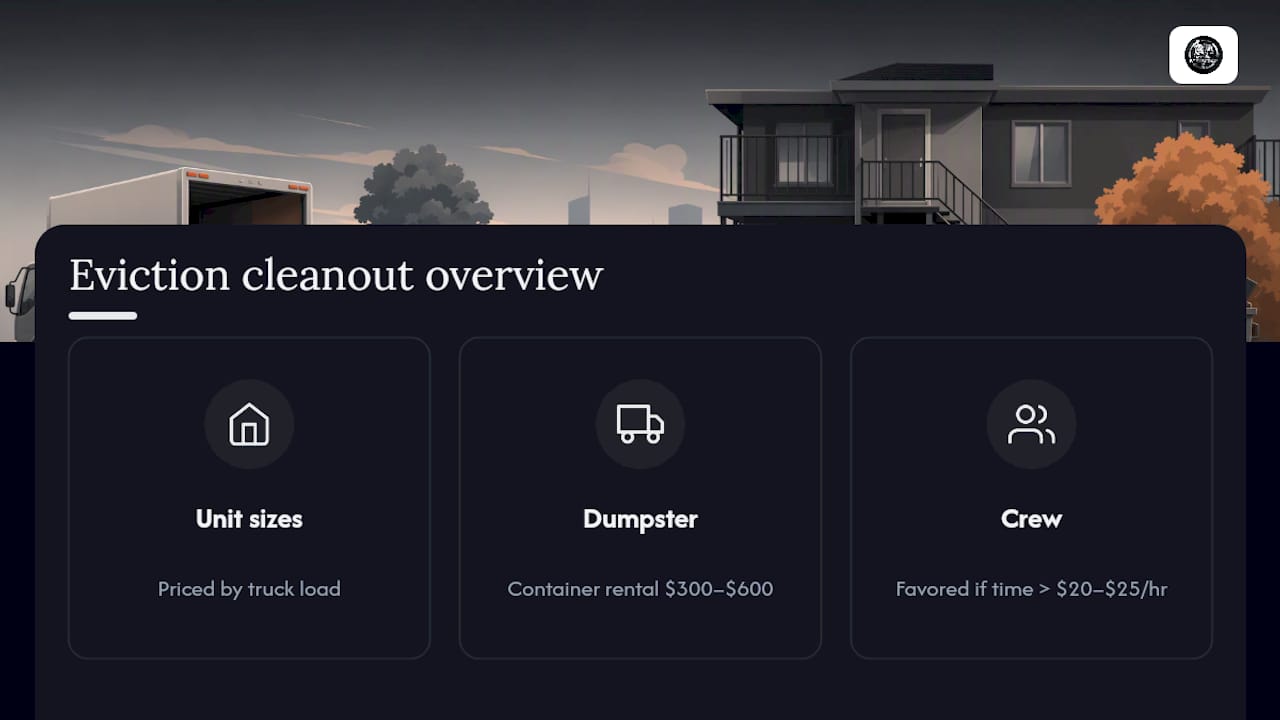
Most crews price by truck load, so it helps to think in those terms when you're comparing quotes:
Typical pricing includes ranges for studio/1BR, 2BR, and 3BR+ or full house units, with hoarder-level or severe neglect jobs costing substantially more due to factors such as volume and specialized labor.
These bands align with the ranges NARPM publishes for industry benchmarking. However, your actual number depends heavily on region. Coastal and metro markets generally incur higher costs than these baselines because of labor rates and disposal fees.
Renting a dumpster yourself looks cheaper on paper, often $300 to $600 for a week's rental. But that number only covers the container. It doesn't include your own labor hauling items to the curb, the days that unit sits vacant while you do it, or the risk of tossing something you legally needed to inventory first. For a side-by-side breakdown of when dumpster rental actually saves money versus a staffed crew, the math usually favors a crew once your time is worth more than $20 or $25 an hour.
What Drives Eviction Cleanout Costs Up?
Volume is the baseline driver, but several factors push a quote higher than you'd expect from square footage alone.
- Heavy or bulky items like sectional couches, pianos, or gym equipment often add flat surcharges of $50 to $150 each.
- Appliances with refrigerants (refrigerators, freezers, some AC units) require certified handling, which typically adds $25 to $75 per unit.
- Hazardous materials, including paint, solvents, batteries, and propane tanks, can't go in a standard load. The EPA classifies these as household hazardous waste requiring separate disposal through dedicated HHW programs, which usually means a second trip and a separate fee.
- Access issues, like third-floor walkups with no elevator, commonly add 10% to 25% to labor costs.
- Distance and mileage matter if the property sits outside a crew's normal service radius.
- After-hours or emergency scheduling can carry a rush surcharge, especially if a court order sets a tight deadline.
Statistic Callout: Metro-area eviction cleanouts run 15% to 40% higher than baseline national estimates, according to NARPM's industry benchmarking, largely driven by regional labor and landfill tipping fees.
Ask every vendor for a written, itemized quote before the crew shows up. A vague "flat rate" that balloons once the truck is half full is the most common surprise landlords report.
What Legal Steps Come Before Removing Tenant Property?
You can't just show up with a truck the day the judge signs the order. Most states require you to confirm legal possession first, then follow a specific sequence for handling anything the tenant left behind.
The general pattern looks like this, though exact rules vary by state and sometimes by city:
- Confirm the eviction judgment and legal possession date with the court or sheriff.
- Send any required post-eviction notice about abandoned property, if your jurisdiction mandates one.
- Photograph and inventory everything left in the unit before you touch it.
- Check your state's storage and sale rules. Some jurisdictions require you to store items for a set number of days, or auction anything above a certain value, before disposal.
- Keep every receipt, notice, and photo in one file.
Nolo's overview of abandoned property rules makes clear that skipping notice or storage requirements can expose you to a tenant's claim, even after a lawful eviction. Timelines matter here as much as the paperwork itself: a property worth more than your state's threshold often triggers a mandatory storage or auction period, which delays your cleanout and stretches your vacancy. If you want a walkthrough of what documentation actually holds up, our guide on handling property tenants leave behind covers the practical side of this.
How Do You Calculate Vacancy Cost During a Cleanout?
Divide monthly rent by 30 to get your daily vacancy cost, then multiply by however many days the unit sits empty during cleanout and turnover prep. A $1,800/month unit costs you $60 a day in lost rent, separate from the cleanout bill itself.
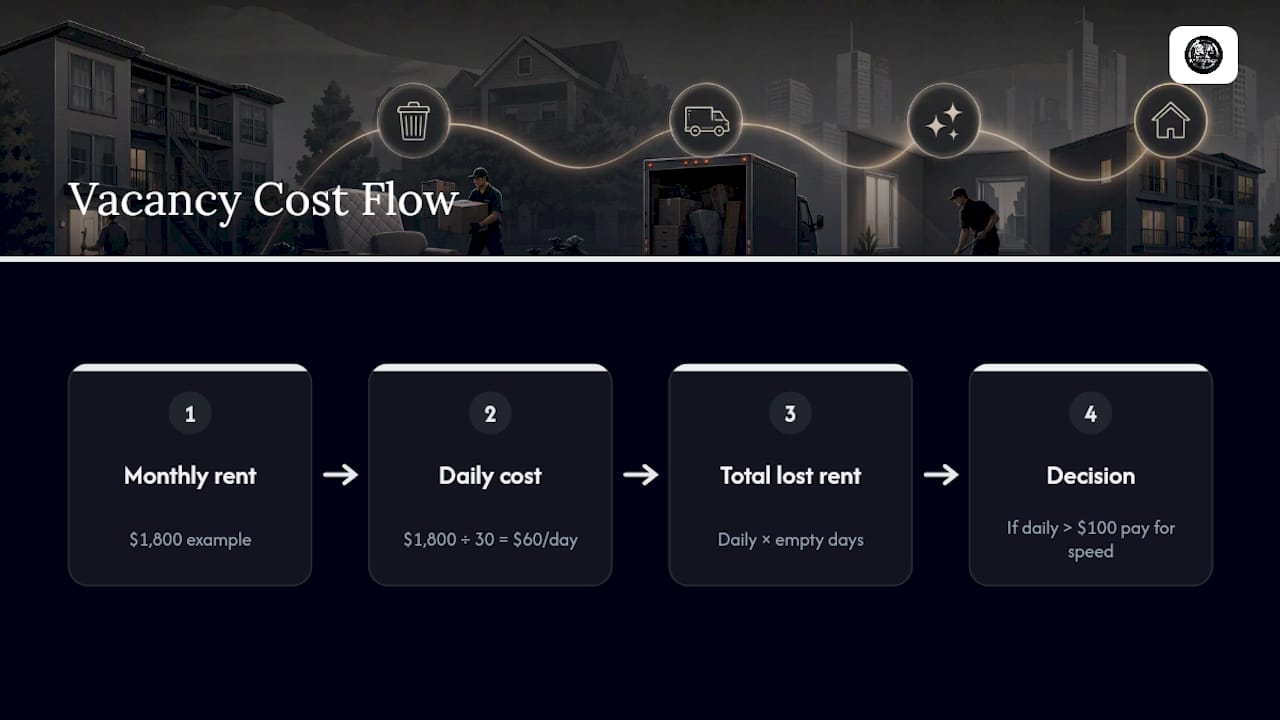
The math usually favors speed once you run the numbers side by side:
Once your daily rent exceeds roughly $100, paying for speed almost always beats saving on the cleanout invoice.
How Can You Reduce Eviction Cleanout Expenses?
Cost control here is mostly about timing decisions and paperwork, not finding the absolute cheapest vendor.
- Bundle jobs. If you manage multiple units, negotiate a flat-rate agreement with one crew for recurring turnovers instead of shopping every job separately.
- Pre-inspect and photograph before you call anyone. A vendor working from photos quotes tighter than one estimating blind, and you avoid disputes later.
- Route usable items to donation or resale. Furniture and appliances in decent shape can offset part of your bill, and a reputable crew will handle that logistics for you.
- Match the method to the load. Light jobs might only need a dumpster; heavy or hazardous loads need a full crew.
- Schedule during normal business hours when possible. Rush fees for weekend or evening jobs add up fast across multiple units.
Pro Tip: A documented flat-rate agreement for recurring cleanouts locks in your per-unit cost and speeds up scheduling, since the crew already knows your properties and access points.
What's the Step-by-Step Eviction Cleanout Process?
Running the same checklist every time keeps you legally covered and keeps your team from improvising under pressure.
- Confirm possession. Verify the judgment and possession date with the court before doing anything physical.
- Send required notices and inventory the unit. Photograph every room before removal starts.
- Triage on-site. Separate items worth storing, donating, or reselling from clear trash and debris.
- Secure utilities and safety gear. Confirm power and water status, and have the crew use proper PPE for dust, mold, or biohazard risk.
- Handle appliances and hazardous items separately. Refrigerants and HHW items go through certified channels, per EPA guidance.
- Collect disposal receipts and donation logs the moment the job wraps.
- Reconcile against the deposit and file everything for potential deductions or claims.
Preparing the unit before the crew arrives cuts hours off the job. This prep checklist covers what to clear and flag ahead of time.
Can You Recover Eviction Cleanout Costs From the Tenant?
Often, yes, but only with paperwork to back it up. Security deposits cover documented cleanout costs in most states, provided you can show an itemized invoice, dated photos, and disposal receipts tied to the specific unit and date.
- Deduct documented costs from the deposit first; courts and tenants both respond better to itemized proof than round numbers.
- If the deposit doesn't cover the full cost, small-claims court is usually the next step for the balance.
- Sale or auction of abandoned property, where your state allows it, can offset costs directly, but only if you followed the storage and notice rules first.
- Keep receipts, before/after photos, and disposal manifests in one file. This single habit determines whether a claim succeeds.
Nolo's eviction procedure guide lays out how the legal timeline affects when you can legally act and what documentation courts expect.
What Should You Ask Before Hiring a Cleanout Vendor?
A cheap quote that turns into a higher final bill isn't actually cheap. Before you sign anything, confirm these points in writing.
- Ask for proof of insurance and a certificate you can keep on file.
- Get an itemized written quote, not a verbal ballpark.
- Confirm how they handle HHW and refrigerant-containing appliances.
- Ask about stair, elevator, or multi-floor access fees upfront.
- Request disposal receipts and documentation as standard, not an add-on.
- Clarify cancellation fees before you book.
Comparing flat-fee against per-item pricing only works if you're comparing the same scope. Ask each vendor to quote the identical load so the numbers are actually apples-to-apples, and check tenant and landlord feedback through resources like DWELR when vetting a property's history before you even schedule the job.
What Does a Real Eviction Cleanout Look Like in Practice?
A New Hampshire property manager working with Easyscrapofficial had a two-bedroom unit left with a full bedroom set, a broken refrigerator, and scattered debris after a contested eviction. The crew completed a same-day removal, handled the refrigerant-containing appliance separately, and had the unit broom-clean within hours instead of the multi-day timeline a DIY approach would have required.
- Photo documentation and an itemized disposal receipt were delivered same day.
- Usable furniture went to donation, with a log provided for the manager's records.
- The manager used that documentation to support a deposit deduction without dispute.
Fast turnaround plus paperwork in hand is what actually protects the bottom line here.
The Priority Order That Actually Matters
Most advice on eviction cleanouts buries the real lesson under pricing charts. Here it is plainly: speed and documentation beat cheap, almost every time, because vacancy cost quietly outpaces the cleanout invoice on any unit renting above roughly $1,000 a month. Landlords who chase the lowest quote often lose more in vacant days than they saved on the job itself.
If you manage more than a handful of units, the smartest move is locking in one reliable vendor relationship rather than rebidding every cleanout from scratch. Consistency in documentation matters more than shaving a hundred dollars off a single invoice.
— Easy
Get Your Unit Turnover Ready Without the Runaround
This local junk removal company handles eviction cleanouts the way this article describes them: fast, documented, and insured. Their crews provide same-day service across multiple metro areas, and every job comes with disposal receipts and donation logs so you have the paperwork ready for deposit deductions or court.

Whether it's a single studio or a multi-unit portfolio needing a standing arrangement, the crews handle furniture, appliances, and hazardous items with proper certified handling, not guesswork. Get a free quote for your eviction cleanout and find out how fast your unit can be rent-ready.
Sources
FAQ
How Much Should You Charge for a Cleanout?
Pricing typically follows truck load and labor time, running $150 to $800 for light loads and up to $3,000 or more for hoarder-level jobs; most crews quote by volume rather than a flat per-hour rate.
What's Included in a Low-Cost Junk Removal Quote?
Budget quotes usually cover loading, hauling, and standard disposal, but often exclude hazardous material handling, appliance refrigerant removal, and stair or access fees, so always ask what's excluded before booking.
Are Move-Out Cleaning Services Worth the Cost?
For most landlords, yes, since professional crews turn units around in hours instead of days and provide documentation that supports deposit deductions, which usually offsets the added cost through reduced vacancy loss.
How Long Does a Full Eviction Cleanout Take?
A standard 1BR or 2BR unit typically takes a few hours with a professional crew, while hoarder-level or multi-room jobs can take a full day or more depending on volume and hazardous material handling.