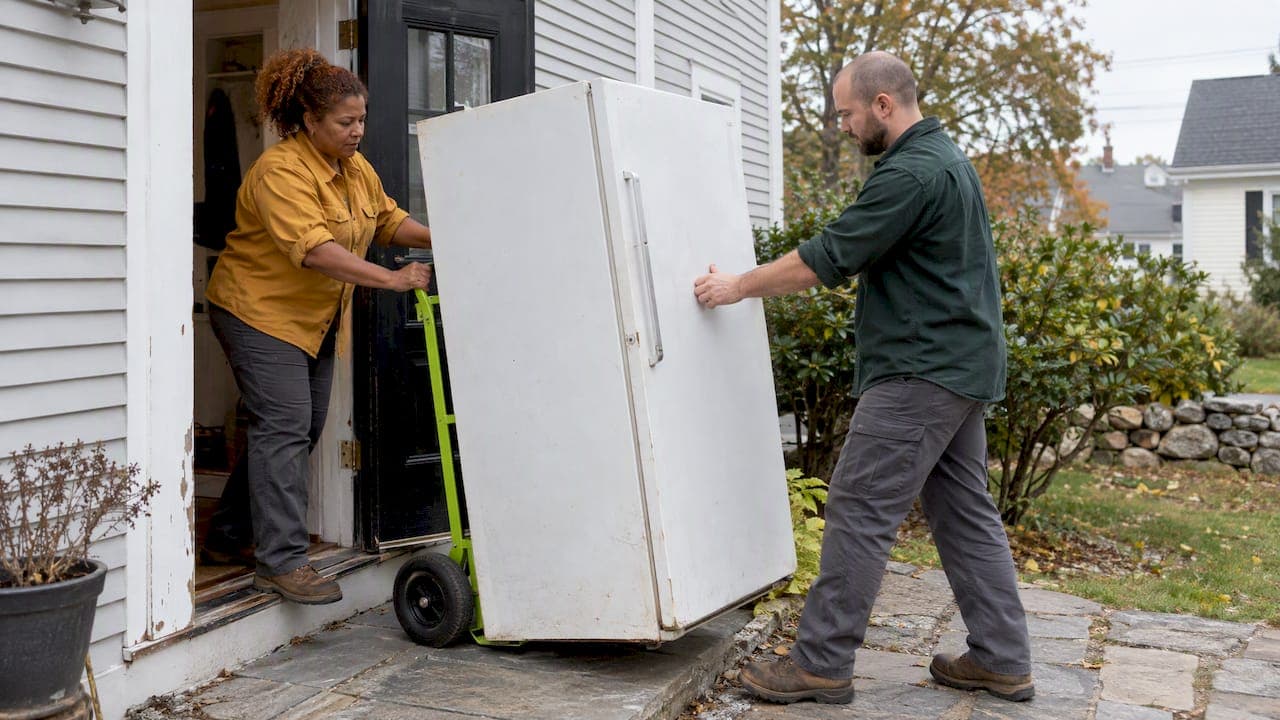
You can get rid of an old freezer through a utility pickup program, a municipal bulky-item collection or transfer station, a retailer haul-away with a new purchase, a scrap recycler, a donation, or a paid junk removal crew. Which one fits depends on whether the freezer still works, how far you can move it, and how soon it has to be gone. What you cannot do, especially in Massachusetts, is set it out with the regular trash.
This guide walks through each route, what it costs you in time and effort, and the questions to ask before anyone touches the unit. It is written for homeowners, families clearing out a relative's house, landlords, investors and Realtors working against a closing or turnover date.
TL;DR
- A freezer holds refrigerant that must be recovered before the metal is scrapped, so it is never an ordinary trash or curbside recycling item.
- If the freezer works and is old and inefficient, a Mass Save pickup in Massachusetts can be free and come with a $75 rebate. Check eligibility first.
- Retailer haul-away usually requires you to buy and receive a replacement. Transfer stations and scrap yards vary, so call before you load anything.
- If the freezer is heavy, stuck in a basement, or on a deadline, a paid, insured removal crew is the fastest route. Ask who recovers the refrigerant and where the unit goes.
- Empty it, unplug it and defrost it a day or two ahead, whichever route you choose.
Table of Contents
- Why a freezer is not regular trash
- Local rules in Massachusetts and New Hampshire
- Six freezer disposal options compared
- Option 1: Utility rebate or pickup program
- Option 2: Town pickup or a transfer station
- Option 3: Retailer haul-away
- Option 4: Scrap yards and recyclers
- Option 5: Donate or give it away
- Option 6: Hire a paid, insured removal crew
- Chest freezer vs. upright: what changes
- How to prepare your freezer for pickup
- Our perspective: what we see on freezer jobs
- Need the freezer gone? We can remove it
- Special situations
- FAQ
- Sources
Why a freezer is not regular trash
A freezer is a sealed system. ENERGY STAR explains that refrigerators and freezers contain refrigerants, oils and other compounds that must be removed and recovered under federal law before final disposal. Only then can the steel and other metals be recycled.
The rules follow the unit through the whole chain. Under EPA's safe disposal requirements, the last party in the chain, such as a scrap recycler, has to make sure refrigerant was recovered before the appliance is finally disposed of. That is why a yard may turn away a freezer that arrives without paperwork or without recovery.
Two practical consequences:
- Do not vent or puncture anything. Cutting a line or drilling into the cabinet to see what happens is both illegal and unsafe. Leave the sealed system alone.
- Do not trust a homemade sticker. EPA says it does not require or accept a sticker as proof that refrigerant was removed. Ask the hauler or the receiving facility who performs recovery and what documentation they keep.
The material is worth the trouble. ENERGY STAR notes that an average refrigerator aged 10 years or older holds more than 120 pounds of recyclable steel, and freezers are built the same way.
Local rules in Massachusetts and New Hampshire
Massachusetts
The Massachusetts waste-ban fact sheet classifies refrigerators and freezers as white goods and restricts them from disposal at solid-waste facilities in the state. In plain terms, a freezer cannot go into a dumpster, a trash pickup or a mixed load headed to a transfer station for disposal. It has to go through an appliance recycling route.
This matters for landlords, property managers and Realtors in Lawrence, Andover, Lowell, Haverhill and Boston. A freezer left in a unit or a dumpster can mean a rejected load, a surprise fee or a failed pickup right before a showing or move-out.
New Hampshire
The NH Department of Environmental Services lists freezers among the white goods that can be recycled as scrap metal. It also states that refrigerant-containing appliances must be drained by a certified technician before scrap recycling. For disposal it points you to your local transfer station or scrap metal yard, or to your hauler if you have curbside service.

Town rules differ. Some transfer stations take freezers for a fee, some require a sticker or proof of recovery, and some do not take them at all. A two-minute call to your town's transfer station saves a wasted trip with a 150-pound appliance.
Six freezer disposal options compared
| Option | Best for | Cost to you | Effort | Watch out for |
|---|---|---|---|---|
| Utility pickup program | Working, older, inefficient freezers | Often free, sometimes with a rebate | Medium: schedule, empty, clear access | Eligibility rules, wait times |
| Town pickup or transfer station | Budget-minded, can haul it yourself | Varies by town | High if you move it | Appointments, fees, refrigerant requirements |
| Retailer haul-away | Buying a replacement | Varies, often tied to the purchase | Low | Delivery-day only, like-for-like conditions |
| Scrap recycler | Dead units you can transport | Varies | High | May refuse freezers without recovery |
| Donation | Clean, working, newer units | Free | Medium | Charities pick what they can resell |
| Paid junk removal | Heavy, hard-to-reach or deadline jobs | Quoted per job | Low | Ask about recovery and destination |
Option 1: Utility rebate or pickup program
If your freezer still runs, start here. EPA's appliance disposal guidance lists an electric-utility rebate or bounty as the first of four practical routes, and notes that programs may require working condition, a minimum age or minimum size.
In Massachusetts, Mass Save offers a no-cost pickup and a $75 rebate for an inefficient, working refrigerator or freezer. It is open to customers of its sponsor utilities, including Eversource, National Grid, Unitil and Cape Light Compact. You schedule online or by phone with your electric account number handy, and the rebate takes 6 to 8 weeks to process after pickup. Read the current eligibility list on the program page before you book, since a unit that does not run or is too small may not qualify.
We break down how this works for fridges in our Massachusetts appliance recycling guide, and the same logic applies to a freezer.
The trade-off: you work to the program's calendar. If you need the freezer gone by Friday, a utility appointment weeks out will not help.
Option 2: Town pickup or a transfer station
Municipal bulky-item collection is the second route EPA lists. Some cities schedule appliance pickups by appointment, often free or at a modest fee. Others only accept freezers at the transfer station.
Before you book or load, ask:
- Do you accept freezers and chest freezers specifically?
- Is there a fee, and is it per item?
- Does the freezer need a refrigerant-recovery tag or paperwork?
- Do I need a resident sticker or proof of address?
- Are there lifting limits, or must I bring help?
Our Lawrence readers can see how this plays out in our Lawrence refrigerator disposal guide, which covers the city pickup and EPA rules. Freezers follow the same appliance rules.
Option 3: Retailer haul-away
Many stores will take your old unit when they deliver the new one. ENERGY STAR says many retailers offer haul-away with the purchase of a replacement appliance. EPA adds that some retailers charge, some offer no-cost drop-off and some give a voucher.
There is no nationwide rule that a big-box store takes any old freezer for free. Confirm these points at checkout:
- Is haul-away included or an add-on fee?
- Does the old unit have to match the new one (chest for chest, upright for upright)?
- Is removal only on delivery day?
- Will the crew disconnect and carry it from the basement, or must it be at the door?
If you are shopping for the replacement anyway, a small chest freezer buying guide can help you size the new unit. A smaller, newer model often does the same job for much less electricity than a 20-year-old chest.
ENERGY STAR's 2024 factsheet estimates that replacing an old freezer with an ENERGY STAR certified one can save about $300 and cut lifetime greenhouse gas emissions by 4,200 pounds, and that utilities may offer rebates for the new unit as well as for recycling the old one. Those are lifetime estimates, not a guaranteed payment.
Option 4: Scrap yards and recyclers
A scrap yard is the classic answer for a dead freezer, but acceptance is not automatic. Wisconsin's DNR large appliance recycling guide makes the point that refrigerant-containing appliances need special treatment, and many yards will not take them. The lesson applies in any state.
Call first and ask whether they:
- Accept freezers at all.
- Recover refrigerant on site or require it to be done already.
- Charge a fee or pay by weight.
- Need the doors or lid removed or latched.
If you have a pickup truck, a dolly, a helper and a cooperative yard, this is a workable low-cost route. If any of those is missing, it turns into an afternoon of risk. A chest freezer can weigh well over 100 pounds and has an awkward center of gravity on stairs.
Option 5: Donate or give it away
A clean, working freezer that is not too old can be useful to a neighbor, a church pantry or a community group. Reuse is a fair choice if the unit holds temperature, the seals are intact and there is no odor. A few cautions:
- ENERGY STAR points out that old refrigerated appliances can be less energy efficient, so passing along a 25-year-old energy hog just moves the electric bill to someone else. Recycling is often the better outcome.
- Confirm that the charity will actually collect it. Many accept only items they can resell and will not carry from a basement.
- A freezer that broke after a power outage and spoiled its contents should be recycled, not donated.
Option 6: Hire a paid, insured removal crew
This is the convenience option. It makes sense when the freezer is heavy, buried in a basement or garage, upstairs, or tied to a deadline: a closing, a tenant turnover, an estate cleanout, or a house listed this weekend. The crew carries it out, protects floors and walls, and takes it to the right downstream recycler so you do not have to figure out the chain yourself.
The key questions for any provider:
- Who handles refrigerant recovery? The person who hauls it is not necessarily the one who recovers the refrigerant. Ask for a plain answer.
- Where does the freezer go? EPA notes that the normal recycling chain recovers refrigerant and compressor oil, removes hazardous components, shreds the unit and separates the metals. Some foam, plastics and glass may still reach a landfill, so ask about responsible practices rather than accepting a general eco-friendly label.
- Are you insured? A crew working in your home should carry insurance.
- Is the quote written and all-in? Stairs, access and additional items change the price. Get it in writing.
Our Homeowners' heavy item removal guide covers how to avoid EPA violations when you hire out the job.
Chest freezer vs. upright: what changes
The disposal rules are the same. The logistics are not.
Chest freezers are deep and heavy, with a lid that must be secured, and they often sit in garages and basements where the path out has turns or steps. Chest freezers are the ones people most often underestimate when they try to move one alone.

Uprights are taller and top-heavy. They tip on stairs and scrape door frames. Remove shelves and baskets, and tape or tie the door shut so it does not swing during the move.
For either type, measure the doorway and the path out before you book. If the unit cannot fit, tell the crew in advance.
How to prepare your freezer for pickup
This is the same checklist whether the unit goes to a program, a yard or our truck. It follows the practical steps EPA and the other sources describe.
- Photograph the unit and note whether it works. If you are a landlord, investor or estate representative, this record helps with your files.
- Empty it. Move food into coolers or another freezer. Throw out anything spoiled.
- Unplug it and defrost it for 24 to 48 hours. Put towels and a shallow pan down to catch water.
- Remove shelves, baskets and loose parts. Latch or tape the door or lid shut.
- Clear the path. Move boxes, shelves and rugs. Prop doors open.
- Disconnect water lines or hardwiring only through a qualified professional or your property team. Do not improvise.
- Confirm the route with the program or provider: appointment window, fees and what they need from you.
Our perspective: what we see on freezer jobs
Most freezers we are called about are not the problem people expect. The unit itself is fine to remove. The problems are the stairs, the garage that has not been cleared in years, a lid that will not stay shut, and a deadline that arrived faster than the utility program could schedule.
We tell customers the same thing each time: the cheapest-looking path is not always the cheapest one. A freezer that gets rejected at a transfer station, or a free pickup that lands three weeks after a closing, costs more than a quoted job done on time. If the freezer works and you have time, check the utility rebate first. It is a good program and we say so. If you do not have time, or cannot move it, that is where we come in.
We donate and recycle whenever possible, and we will tell you plainly where an appliance is headed before we take it. Ask any hauler the same, including us.
— Easy
Need the freezer gone? We can remove it
EasyScrap serves Lawrence, Andover, Boston, Lowell and Haverhill, and Windham, NH. We remove freezers and other large appliances from basements, garages, attics and curbside, with an insured crew and free quotes. If you are also clearing a garage or basement, we can take the freezer along with everything else in one visit.
See our appliance removal service or our refrigerator removal page to request a quote. Same-day service may be available depending on the schedule.
Special situations
Landlords and property managers
A freezer abandoned in a unit is a turnover delay. Photograph it, note the condition, and book removal before the next tenant or inspection. In Massachusetts, do not put it in the building dumpster, because white goods are restricted from solid-waste disposal.
Realtors and sellers
A basement chest freezer is a common holdover on a listing. If it stays with the house, say so in writing. If it goes, schedule removal before photos and showings. For a longer cleanup, our junk removal service can clear the whole space.
Estate cleanouts
Families often find a freezer full of decades-old food. Wear gloves, bag the contents, and let it defrost fully before anyone moves it. If the power has been off for a long time and there is a smell, tell the removal crew in advance so they can plan.
Freezer is full and the power is out
If the unit failed and the food is thawing, the first job is the food, not the freezer. Once it is empty and cleaned out, pick the disposal route that fits your timeline.
FAQ
How do I dispose of a freezer that does not work?
A dead freezer will usually not qualify for a utility rebate program, so the routes are a town transfer station or bulky pickup, a scrap recycler that handles refrigerant, retailer haul-away with a replacement purchase, or a paid removal crew. Call first and ask about refrigerant recovery. In Massachusetts it cannot go out with regular trash.
Can I put a chest freezer out with the trash?
No. Massachusetts restricts freezers from solid-waste disposal as white goods, and New Hampshire directs you to a transfer station or scrap yard because the refrigerant must be recovered. Even where your town allows bulky pickup, confirm it before the freezer goes to the curb.
Does Home Depot take an old freezer for free?
Not as a standalone service that is guaranteed anywhere. Retailers commonly offer haul-away when you buy and receive a replacement, and terms vary by store and by program. Ask about fees, whether the old unit must match the new one, and whether removal happens only on delivery day.
Can I remove the Freon from a freezer myself?
You should not. EPA allows removal for small appliances under specific recovery equipment standards, but the sealed system should never be vented or punctured. Use a qualified recovery service or a receiving facility that does it for you.
How much does freezer removal cost?
It depends on the route. Utility programs can be free and sometimes pay a rebate, while paid removal is quoted per job based on access, stairs, size and any other items. We give free quotes, so you will know the price for your freezer before we come.
Sources
- EPA: Appliance Disposal
- EPA: Stationary Refrigeration Safe Disposal Requirements
- ENERGY STAR: Find a Fridge or Freezer Recycling Program
- ENERGY STAR: Flip Your Fridge factsheet (2024)
- MassDEP: Your Business and the Waste Bans
- Mass Save: Refrigerator and Freezer Recycling
- NH DES: Appliances
- Wisconsin DNR: Large Appliance Recycling Guide