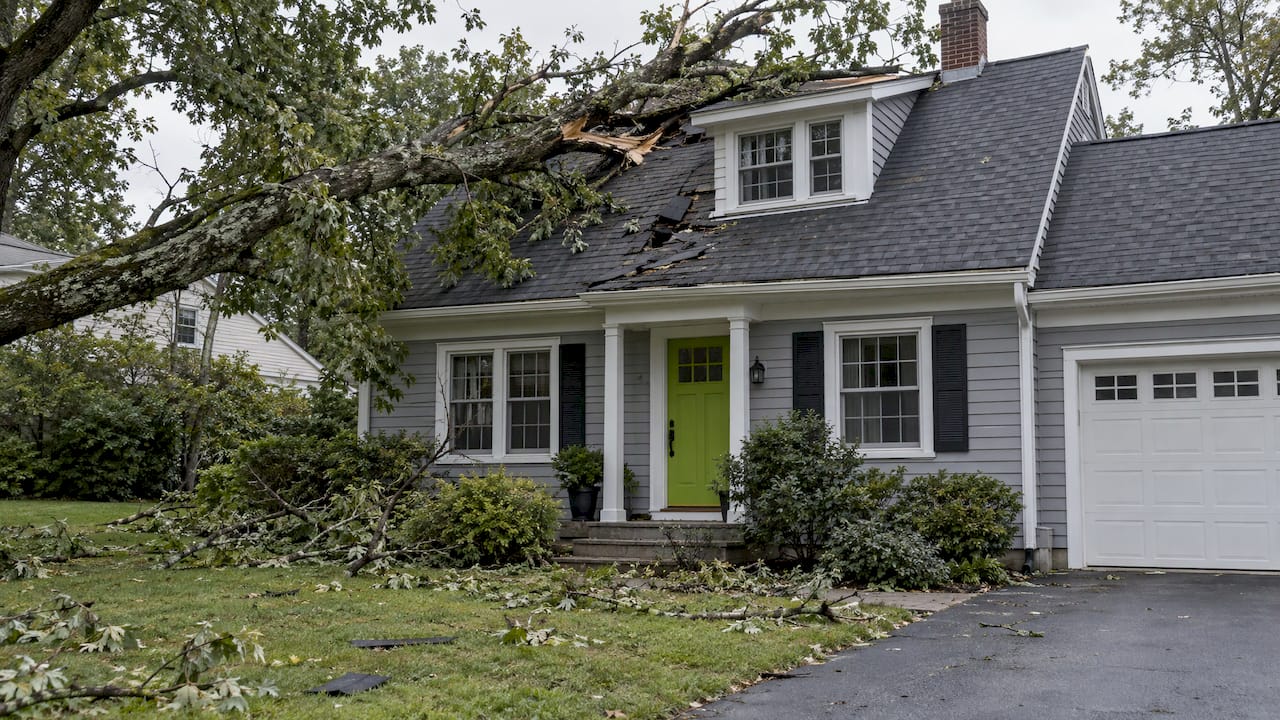
Homeowners insurance pays for junk removal only when the junk is debris from a covered loss, such as a fire, a windstorm or a tree that falls on your house. It does not pay to haul away old furniture, a full garage, an unused appliance or years of accumulated clutter. For that kind of job, you pay the hauler directly, and the most useful thing your policy does is protect you while the crew is at your property.
That split answers most of the questions homeowners, grandparents clearing a family house, investors and Realtors ask us. Below you will find what the debris removal clause actually says, the limit that usually applies, how to document a claim before anything leaves the house, and what to check when a crew comes to work on your property.
TL;DR
- Homeowners insurance covers debris removal only after a covered loss (fire, wind, falling tree). It does not cover routine junk, cleanouts or hoarding cleanup.
- When it applies, debris removal is usually part of the claim for repairing the home. If costs exceed your dwelling limit, many policies add up to 5% of that limit.
- Photograph and list items before they are hauled, and get your insurer's written go-ahead for removal.
- Your policy's personal liability and medical payments coverage can respond if someone is hurt on your property, but a hauler should carry its own insurance.
- Read your own policy or call your agent: wording and limits differ by company and state.
Table of Contents
- When homeowners insurance pays for debris removal
- The 5% rule and other limits
- Trees and yard debris
- What your policy will not pay for
- Before you haul anything away after a covered loss
- Liability when a crew works at your home
- Why it helps to know which bucket you are in
- Get the job done
- FAQ
- Sources
When homeowners insurance pays for debris removal
Most standard homeowners policies include a debris removal clause. It is an "additional coverage," meaning it sits inside the policy automatically rather than being something you buy separately. The Washington Insurance Commissioner explains that it helps pay to clear, haul away and dispose of debris after a covered event, and that it applies when a covered structure is damaged by a peril your policy insures against.
The key word is covered. A kitchen fire, a windstorm that tears off shingles or a tree that comes down in a covered storm all start a claim, and the cleanup becomes part of that claim. Debris from causes the policy excludes generally is not paid. The same Washington page notes, for example, that debris from flooding or earth movement generally needs a separate policy, such as flood insurance, and that under flood policies debris removal applies only to flood-caused debris, typically inside the insured structure.
The Oklahoma Insurance Department adds two practical points. Debris removal is automatically part of a standard homeowners policy and is included in the cost of rebuilding the structure. And if volunteers, a charity or local government do the removal, you are not compensated for it, because you did not incur the expense.
That last point matters in New Hampshire and Massachusetts after a big storm, when towns sometimes organize curbside collection. Ask your insurer how a town program interacts with your claim before you hire anyone privately.
The 5% rule and other limits
Debris removal usually counts toward your dwelling limit, the "Coverage A" figure on your declarations page. That creates a trap: if a total loss uses up the entire dwelling limit, nothing is left for cleanup.
To address this, the California Department of Insurance fact sheet on debris removal explains that the most common homeowners form adds debris removal coverage of 5% of the Coverage A limit once that limit is exhausted by rebuilding costs. Some policies add 5% for Coverage B (other structures) and Coverage C (personal property) as well. The Washington commissioner describes the same pattern: up to an additional 5%, available only when the dwelling limit has been used up.
A worked example
Say your dwelling limit is $400,000 and a fire causes $380,000 in damage to the structure plus $30,000 in debris hauling and disposal. Together that is $410,000, which is $10,000 over your limit. A policy with the common 5% extension would make up to an additional $20,000 available for debris, so the extra $10,000 would be paid. This is only an illustration. Your own policy may use a different percentage or none, so check the wording.

Hazardous material and contamination
Policies often handle hazardous debris differently. The Washington page says homeowners policies cover testing and removal of pollutants or hazardous materials such as ash, leaked chemicals, fuel-soaked soil or asbestos when they result from a covered loss. Some policy forms are narrower: the Farmers policy filed with the Oklahoma department, for instance, excludes expenses to remediate contamination of land, water, air, buildings or personal property. Wording varies by insurer, so read the section titled "Debris Removal" in your own policy.
Trees and yard debris
Trees are the most common debris claim in New England, and the rules are narrow. The North Carolina Department of Insurance states that the debris removal coverage pays up to $500 to remove trees felled by a covered peril when they damage a covered structure or block a driveway or an accessible entry. The California Department of Insurance claims guide says trees, shrubs and plants are insured on a limited basis, generally 5% of the dwelling limit in total with a $500 (sometimes $250) cap for any one tree, shrub or plant.
In plain terms, a tree that falls on your roof is usually a claim. A tree that falls in your yard and hits nothing generally is not, and you pay to clear it. The Farmers policy mentioned above excludes tree removal unless the tree first damaged covered property. If you need cutting and stump work on a large fallen tree, a tree services contractor can handle the felling, and a hauler can take away the brush and household items afterward.
What your policy will not pay for
The debris removal clause pays for debris caused by or resulting from a covered loss. That wording rules out most of what people call junk:
- Old furniture, mattresses and appliances you simply want gone.
- Garage, basement and attic cleanouts, including after a move or downsizing.
- Estate cleanouts after a family member passes or moves to care.
- Renovation debris from a project you chose to do.
- Accumulated clutter and hoarding cleanup.
On that last item, the Farmers policy excludes loss caused by neglect, lack of maintenance or failure to make repairs, so a pile built up over years is not a sudden covered event. The Wisconsin Office of the Commissioner of Insurance, in its consumer's guide to homeowners insurance, advises keeping the house clear of accumulated trash, oily rags and combustible materials as a loss-prevention step. Clutter is treated as a fire and safety risk, not as insured property.
If you are planning a cleanup of that kind, you are budgeting for a paid job. Our hoarder house cleanup guide covers cost, process and safety, and our guide to how junk removal works explains why an on-site quote avoids surprises.
Before you haul anything away after a covered loss
If your loss is covered, the order of operations protects your claim. Once debris is gone, you cannot prove what it was.
- Notify your insurer promptly. The Texas FAIR Plan policy, a residual-market form, requires prompt written notice, protecting the property from further damage and keeping records of repair expenses. Most policies have similar duties after a loss.
- Photograph and list what you see. United Policyholders advises photographing recognizable items in the debris before removal.
- Get the insurer's written okay. The same organization suggests asking for written confirmation that the insurer has fully inspected the loss location and agrees debris removal can proceed.
- If cleanup cannot wait, document it. When debris must be removed for health and safety or to prevent further damage, the New York Department of Financial Services Circular Letter No. 8 (2012) directs insurers there to accept photographs, videos, samples and inventories prepared by the policyholder as proof of loss. That is New York guidance, so ask your own insurer what it accepts in Massachusetts or New Hampshire.
- Keep every invoice. Ask the hauler for an itemized receipt showing the date, the address and what was removed.
Our storm debris removal guide walks through what to do in the first hours after a storm.
Disaster programs and your claim
After a widespread disaster, a city or county may run a coordinated cleanup program. United Policyholders notes that you may be asked to complete paperwork and coordinate payment with your insurer, and that if program costs come in under your debris removal limit, leftover benefits may go toward repairs or rebuilding. It also cautions against spending debris benefits on repairs until you know your cost share, since agencies may bill years later. In California wildfire programs, per the state fact sheet, homeowners who sign a Right of Entry form get the program's work free of charge, and insured owners authorize their debris benefits to be paid to the county up to the specified amount.
Liability when a crew works at your home
There is a second way homeowners insurance touches junk removal, and it applies to ordinary, paid jobs. When a crew carries a couch down your stairs, someone could be hurt or something could be damaged.
The Wisconsin commissioner's guide explains that homeowners policies include personal liability coverage for non-auto accidents caused by you, a family member or a pet, with a basic limit usually of $100,000 per occurrence and no deductible. Medical payments coverage generally pays up to $1,000 per person for someone outside your family who is injured at your home, regardless of fault. Virginia's administrative code goes further in that state, requiring medical payments coverage to extend to a residence employee injured in the course of employment. Limits differ by policy and state, so confirm yours.

These protections are a backstop, not a substitute for the hauler's own coverage. Business insurance guidance from MoneyGeek says general liability covers costs when a crew damages a client's property, and that workers' compensation is required by law once a business hires employees. A crew that carries both means a scratched floor or an injured worker is handled by the company's insurance, not by a claim on your own policy that could affect your premium.
What to confirm before you book
- The company is insured, and will say so in writing if you ask.
- The quote is for your specific items and access (stairs, tight hallways, attics).
- Donation and recycling practices, if you care where usable items go.
- Who removes hazardous items such as paint, chemicals and certain appliances.
For investors, landlords and property managers, our five-step guide to verifying insured junk removal lays out how to confirm coverage before a crew enters a rental.
Why it helps to know which bucket you are in
Realtors and investors tend to run into this at closing. A seller clearing a house before listing, an investor taking over a property with a full basement and a family dealing with an estate are all in the same position: none of those cleanouts is a covered loss. Budget for them as a normal expense. Our post on whether junk removal can be tax deductible for U.S. homeowners covers the situations where that expense may matter at tax time, and a tax professional can confirm how it applies to you.
For appliances, note that a dryer or refrigerator you are replacing is your cost, while one destroyed in a covered fire falls into the claim process above. Keep the unit in place for the adjuster until your insurer says it can go. A refrigerator that is simply old can be picked up through our appliance removal service.
Our view
We get this call often: a homeowner has a flooded basement or a storm-damaged garage and asks whether insurance will pay us. Sometimes it will, and when it does we are glad to give you a clear, itemized record to send your insurer. More often the job is a cleanout with no claim attached, and we want you to know that before you plan your budget.
Our crew is insured, and we offer free quotes, so you can see what a job costs before you commit. We also donate and recycle whenever possible, which keeps usable furniture and appliances out of the landfill.
For a covered loss, document first, haul second. For everything else, book a crew that shows up on time and does the heavy lifting.
Easy
Get the job done
If your insurer has cleared the debris for removal, or you are facing a cleanout that insurance will never pay for, we can help. EasyScrap serves homes and businesses in Lawrence, Andover, Boston, Lowell and Haverhill, with free quotes, an insured crew and same-day junk removal. We take furniture, appliances, garage, basement and attic contents, yard waste, construction debris and estate cleanouts, and we donate and recycle usable items whenever possible.
Start with our junk removal service, or see the full list of services to find the one that fits your property.
FAQ
Does homeowners insurance cover junk removal?
Only when the junk is debris from a covered loss, like fire or wind damage. Debris removal is normally part of the claim to repair the home. Routine junk, cleanouts and unwanted items are your own expense.
How much will my policy pay for debris removal?
Usually it is included in your dwelling limit, and many policies add up to 5% of that limit if the limit is used up. Policies vary, so check the debris removal section of yours or ask your agent. Trees typically carry small per-tree caps, often $500.
Will insurance pay for hoarding cleanup?
Generally no. Standard debris removal pays for debris resulting from a sudden covered event, and policies exclude loss caused by neglect or lack of maintenance. Plan to pay for the cleanup directly, and see a guide to the process and safety steps before you start.
Does my homeowners policy cover someone hurt during a cleanout?
Personal liability and medical payments coverage may respond if a visitor is injured at your home, commonly up to $100,000 per occurrence for liability and $1,000 per person for medical payments. Confirm the limits on your declarations page, and book a company that carries its own insurance.
What should I do before debris is hauled away after a claim?
Report the loss, photograph the debris and any recognizable items, and ask your insurer for written approval to remove it. Keep itemized receipts from the hauler for your claim file.
Sources
- Debris removal insurance coverage, Washington Office of the Insurance Commissioner
- Debris Removal Insurance Fact Sheet, California Department of Insurance
- After the Disaster, Oklahoma Insurance Department
- Farmers Next Generation Homeowners Policy, Oklahoma edition
- Consumer's Guide to Homeowners Insurance, Wisconsin OCI
- Homeowner's Insurance guide, North Carolina Department of Insurance
- Residential Property Claims Guide, California Department of Insurance
- Debris Removal After a Disaster, United Policyholders
- Insurance Circular Letter No. 8 (2012), New York DFS
- 14VAC5-342-100 Medical payments coverage, Virginia Administrative Code
- Junk Removal Business Insurance Requirements, MoneyGeek
- Tree services