
The fastest way to get a junk volume estimate is to measure the pile (length × width × height in feet, divided by 27) or use truck-fraction anchors like "half a pickup bed" or "a quarter of a 15-yard truck." Round your number up slightly, since air gaps and hidden items almost always add volume. Once you have a rough cubic-yard figure, snap three photos and send them for a photo-quote instead of waiting on a full on-site visit.
TL;DR:
- Estimating volume using simple measurements or visual anchors helps determine whether the debris will fit into a standard truck or dumpster, with full loads starting around 15 cubic yards.
- The cubic yard calculation involves multiplying length, width, and height in feet then dividing by 27; round up estimates to account for gaps or hidden items.
- Weighing the debris is crucial, as material density varies greatly; heavy loads like concrete can cost much more to dispose of than lighter items of the same volume.
- Sending three photos from different angles, including close-ups of surcharge items, usually suffices for a free remote quote, especially for visible, unobstructed loads.
- Seasonal and regional factors affect volume estimates, with spring and storm debris increasing load sizes, and older neighborhoods or estate cleanouts tending to produce larger amounts of junk.
Table of Contents
- Quick Visual Anchors for Everyday Items and Rooms
- Turning Measurements Into Cubic Yards, Step by Step
- Matching Your Volume to a Truck, Dumpster, or Expected Weight
- What to Send for a Photo-Quote (and What Changes the Price)
- How Season and Location Change Your Estimate
- Full-Service Removal or a Dumpster Rental: How to Choose
- Ready to Book? Here's What EasyScrap Needs From You
- Sources
- FAQ
Quick Visual Anchors for Everyday Items and Rooms
You don't need a tape measure to get in the ballpark. Most people can size up a job just by picturing how furniture and clutter stack up against a few known reference points.
A 3-seater couch runs about 2 cubic yards, and a queen mattress with a box spring lands in the same range. A full-size refrigerator comes in smaller, around 1.5 cubic yards, while a filled 33-gallon trash bag holds roughly 0.15 cubic yards. Line up ten of those bags and you've matched one mattress.
Truck-fraction anchors work the same way haulers think about a job:
- 1/8 truck (about 2 yd³): a single mattress or a few boxes
- 1/4 truck (about 4 yd³): a small bedroom's worth of furniture
- 1/2 truck (about 7 to 8 yd³): a one-car garage with moderate clutter
- 3/4 truck (about 10 to 12 yd³): a cluttered garage or a full basement
- Full truck (about 15 yd³): a whole-house cleanout or heavy renovation debris
Another way to picture it: a standard pickup bed holds roughly a quarter of a typical junk truck, so two truckloads of stuff piled in your driveway is already halfway to a full load. Room by room, light loads (a decluttered closet, a few boxes) usually land under 2 yd³, medium loads (a bedroom clear out, half a garage) run 3 to 8 yd³, and heavy loads (a hoarding situation, a flooded basement) can push past 10 yd³ without much effort.
Turning Measurements Into Cubic Yards, Step by Step
When eyeballing a load isn't precise enough, the math takes two minutes. Cubic yards are the standard unit for pricing debris removal, and the formula is the same one dumpster companies use to size containers: length in feet × width in feet × height in feet, divided by 27. Twenty-seven is just the number of cubic feet in one cubic yard, since a yard is 3 feet on each side (3 × 3 × 3).
Here's a worked example. Say you've got a pile of old furniture and boxes stacked in a garage, measuring 12 feet long, 6 feet wide, and 4 feet high.
- Multiply length by width by height: 12 × 6 × 4 = 288 cubic feet.
- Divide by 27: 288 ÷ 27 = 10.7 cubic yards.
- Round up to a practical number, like 11 or 12 cubic yards, to account for gaps between items.
For irregular piles, measure the maximum envelope, meaning the tallest, widest, and longest points, even if the middle of the pile is hollow or uneven. That overestimate is intentional. It's far cheaper to round up on paper than to get hit with a second trip fee because the actual load didn't fit.
Pro Tip: *Measure what you can see first, then walk the property and ask yourself what's hiding.
Matching Your Volume to a Truck, Dumpster, or Expected Weight
Once you've got a cubic-yard number, the next question is what container or crew size actually handles it. Roll-off dumpsters typically run 10 to 20 cubic yards, junk trailers land around 12 to 16 cubic yards, and a standard junk removal truck holds close to 15 cubic yards. If your estimate lands at 6 or 7 cubic yards, you're looking at less than half a standard truck. If it hits 14 or more, you're near a full load, and it's worth mentioning that upfront so the crew comes prepared.
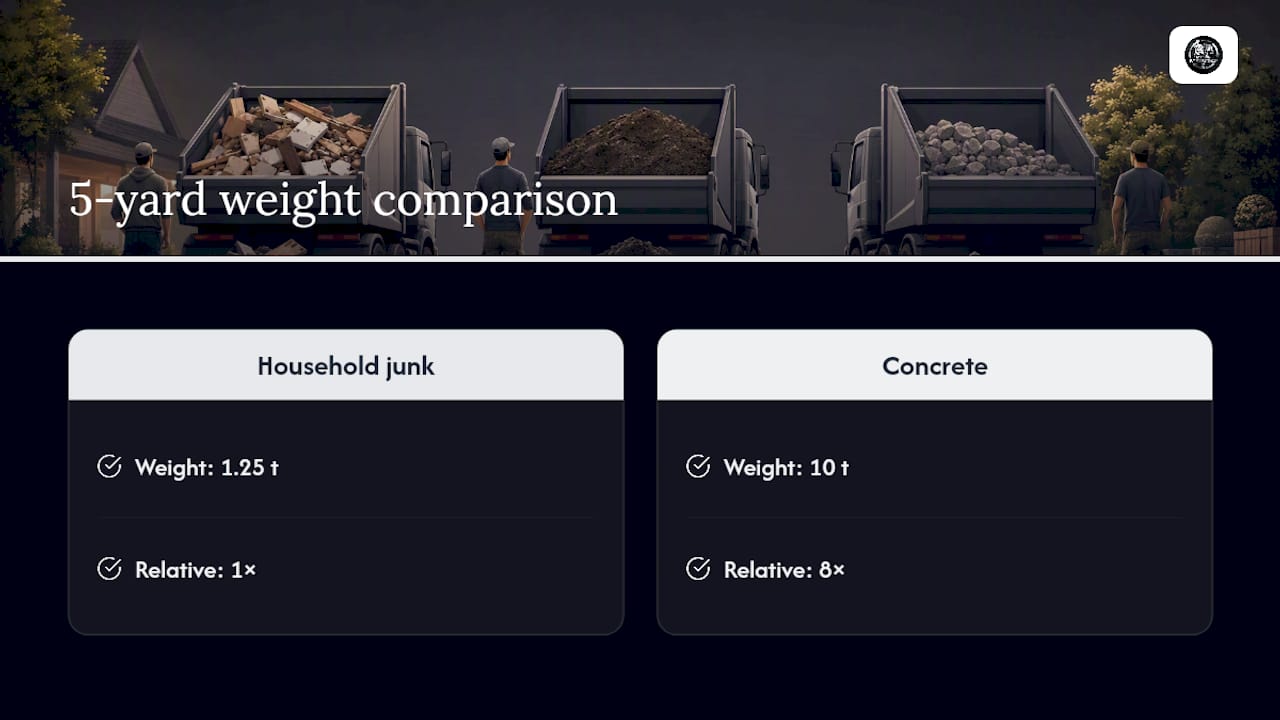
Volume only tells half the story, though. Weight is what actually drives disposal fees, and different materials pack very differently into the same cubic yard.
The math behind that last column is simple: cubic yards × average pounds per cubic yard, divided by 2,000, gives you tons. A 5-yard load of household junk weighs about 1.25 tons, but the same 5 yards of concrete weighs 10 tons, eight times heavier. That's why a small pile of tile, dirt, or concrete can sometimes cost more than a much larger pile of furniture. Haulers price around weight limits and disposal fees, not just how much space something takes up in the truck.
If you're planning a renovation-heavy job with mixed debris, matching your estimate to the right dumpster size before calling anyone avoids paying for capacity you don't need, or worse, underestimating and needing a second container mid-project.
What to Send for a Photo-Quote (and What Changes the Price)
Getting an accurate remote quote comes down to what you show a hauler, not just what you tell them. Professional estimators typically walk the perimeter, count flat-rate items, pick a truck-fraction anchor, then photograph the load from three angles before finalizing a number. You can shortcut that process yourself by sending the right photos upfront.
Three shots cover most jobs:
- Wide shot: the full site or room, so the crew understands access and context.
- Mid shot: the actual pile or load area, showing how items are stacked.
- Close-up: anything that might trigger a surcharge, like a mattress, a hot tub, or a stack of tires. Include a tape measure or a common object like a broom for scale if you can.
Photo quotes work well for driveway piles, garage cleanouts, and anything visible in daylight. When the load is ambiguous, buried, or part of a hoarding situation, an on-site visit is the safer call, since photos can't show what's underneath or behind a pile.
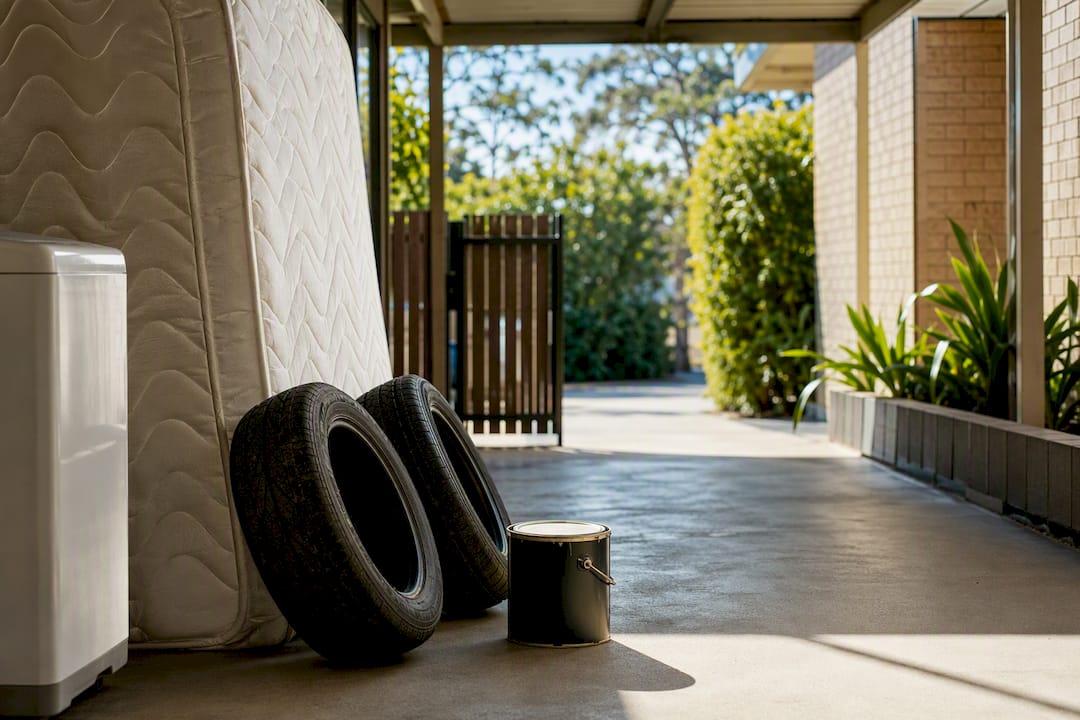
Disclose access issues too: stairs, narrow gates, long carries from the curb, or furniture that needs disassembly all affect labor time. And flag surcharge items separately rather than folding them into a general volume guess. Mattresses, tires, refrigerators, paint cans, and other freon-containing appliances typically carry flat fees regardless of how much space they take up, since they require special handling or disposal fees haulers pay per item.
The company offers free quotes based on photos, access notes, and any heavy or regulated items called out ahead of time. The company runs insured crews and routes usable items to donation whenever possible instead of the landfill by default.
Pro Tip: If you're not sure whether something counts as a surcharge item, mention it anyway. It's a lot easier for a crew to say "that's included" than for you to get a higher bill on move day.
How Season and Location Change Your Estimate
Spring and early summer bring the highest volume of cleanout requests almost everywhere, driven by spring cleaning, moving season, and estate cleanouts tied to home sales. That demand spike doesn't just affect scheduling. It also means garages and basements tend to be fuller by the time people finally call for a quote, since clutter accumulates over winter and gets tackled all at once.
Weather plays a direct role in volume, too. After a hard winter or a wet spring, yard waste and storm debris (broken branches, water-damaged items pulled from a flooded basement) can add several cubic yards to a job that would otherwise be a straightforward furniture pickup. If you're estimating volume right after a storm, add extra room for saturated materials, since wet wood, drywall, and insulation weigh far more per cubic yard than their dry equivalents.
Regional housing patterns matter as well. In markets with a lot of older housing stock, basement and attic cleanouts tend to run larger than average, simply because those spaces have had more years to fill up. Areas with a high share of rental turnover see more end-of-lease cleanouts, which cluster around the first of the month and often involve full apartments rather than single rooms. Estate cleanouts, meanwhile, don't follow a season at all. They show up year round and almost always run larger than the family expects, since they typically involve decades of accumulated belongings across an entire house.
Full-Service Removal or a Dumpster Rental: How to Choose
The decision usually comes down to the shape of the job. One-off heavy items, a garage full of mismatched clutter, or a cleanout you need gone by the weekend point toward full-service removal, since a crew shows up, does the lifting, and hauls everything away the same day. Steady debris from an ongoing renovation, where trash accumulates over days or weeks, fits a rented dumpster better.
Factor in labor realistically. If the job means carrying a couch down three flights or across a long yard, that's exactly the kind of work a full-service crew handles that a dumpster rental doesn't. Speed matters too. Same-day service exists for a reason: most people don't want a dumpster sitting in the driveway for two weeks when the job could be done in an afternoon.
— Easy
Ready to Book? Here's What EasyScrap Needs From You
Once you've got a cubic-yard number and a sense of what's in the pile, booking is the easy part. Easyscrapofficial handles the full range of jobs those estimates usually point to: furniture removal, appliance removal, garage and basement cleanouts, estate cleanouts, and everything in between, without the multi-day wait that comes with renting your own container.

Send three photos (wide, mid, and close-up), mention anything heavy like a hot tub or a stack of concrete, and flag access issues like stairs or a narrow gate. That's genuinely all it takes for a free quote back, no guesswork, no in-person visit required for most jobs. EasyScrap's crews are insured, and usable items get routed to donation or recycling instead of a landfill whenever that's an option. If your estimate landed in garage or basement territory specifically, the garage cleanout and basement cleanout pages spell out exactly what's included.
Ready to turn your estimate into a booked job? Head to the junk removal page, send your photos, and get same-day service on the calendar.
Sources
A few outside resources are worth bookmarking if you want to sanity-check your own math before requesting a quote.
- Dumpsters
- Estimating cubic yards / The Glove Box | Guy With a Truck
- Visual estimation techniques — GetJunkQ
For renovation-scale debris specifically, Y&CO Build's renovation cost guide offers a useful outside look at matching container sizes to project waste, even though its pricing reflects a different market.
FAQ
How Many Cubic Yards Is a Couch?
A standard 3-seater couch takes up about 2 cubic yards, roughly the same footprint as a queen mattress and box spring set. Sectionals and larger sofas can run higher, especially with an attached chaise.
How Do I Estimate Junk Volume Without Measuring Anything?
Use truck-fraction anchors: picture how much of a pickup bed, half a truck, or a full 15-yard truck your pile would fill. Most single-room cleanouts land between 1/4 and 1/2 truck, while whole-garage or basement jobs often reach 3/4 to a full load.
What's the Average Cost for Junk Removal Based on Volume?
Pricing generally scales with both volume and weight, so a small pile of dense material like concrete can cost more than a larger pile of furniture. Easyscrapofficial provides free, no-obligation quotes based on photos and item details, with current pricing available directly on the junk removal page.
Should I Round Up or Down When Estimating Volume?
Always round up.
What Items Typically Add Surcharges Regardless of Volume?
Mattresses, tires, refrigerators and other freon-containing appliances, paint, and hot tubs commonly carry flat fees due to special disposal handling. Flagging these items when requesting a quote, rather than folding them into a general volume estimate, helps avoid surprise charges on move day.