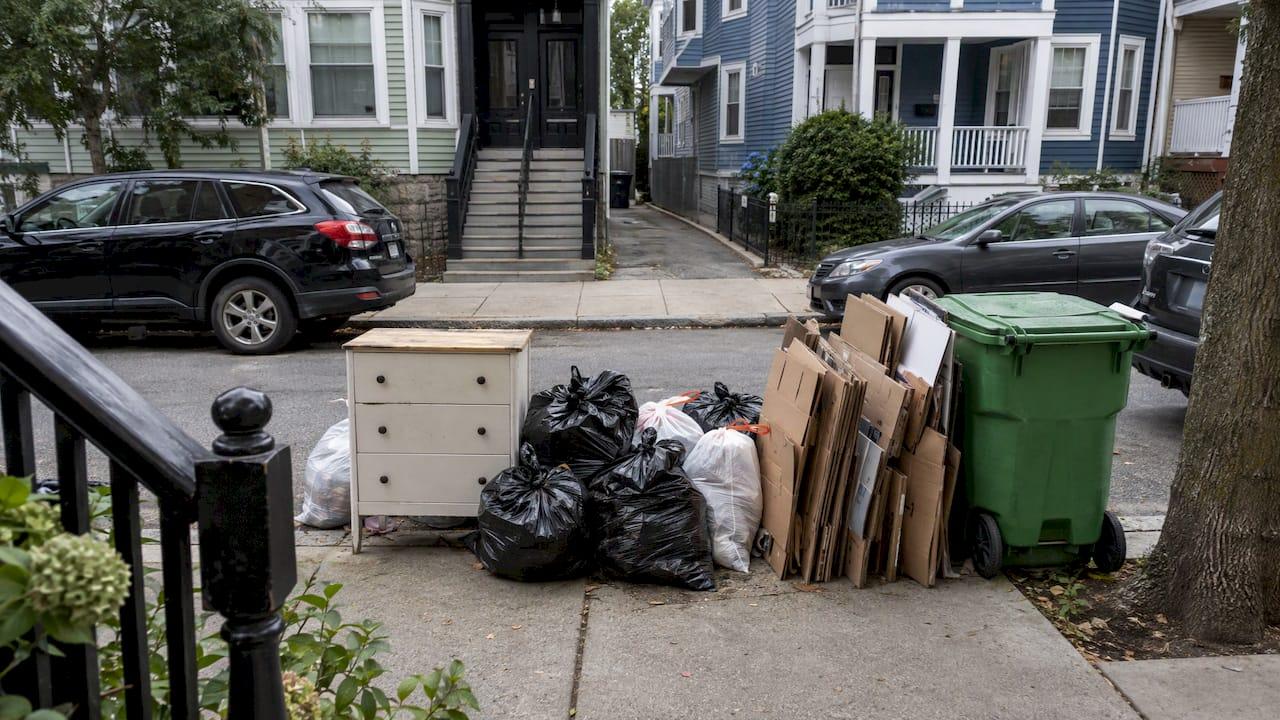
On Boston Moving Day, September 1, your trash has to follow the city's schedule, not yours. Set-out times are strict, bulky items need their own pickup, and a pile on the sidewalk can bring a fine to you or your landlord. The fastest way to avoid all of it is to sort early, use the city's free programs for what they cover, and book a licensed, insured crew for the rest. We do that work every day for homes and properties in Boston, Lawrence, Andover, Lowell and Haverhill.
TL;DR
- Put regular trash and recycling out by 6:00 a.m. on your collection day, or after 5:00 p.m. the night before. Earlier than that is a $25 fine.
- Mattresses and box springs need a free scheduled city pickup. TVs, air conditioners and refrigerators need a special pickup booked through 311.
- The city does not collect construction debris, plumbing fixtures, fences or water heaters. Those need a private hauler.
- Usable furniture and household goods should be donated, not dumped. Spread your set-out over several weeks instead of the last day.
- For a whole unit, garage or basement cleared in one visit, book same-day junk removal with a crew that donates and recycles.
Table of Contents
- Why Moving Day creates so much trash
- When you can put trash out
- What the city takes and what it doesn't
- Quick reference: where each item goes
- Don't throw away what someone can use
- A move-out timeline that avoids fines
- If you manage the property
- Our view: Moving Day trash is a scheduling problem
- Get it all gone in one visit
- FAQ
- Sources
Why Moving Day creates so much trash
Moving Day in Boston is September 1. Roughly two-thirds to 70 percent of leases across the city end around that date, so thousands of people, many of them students, change addresses within the same few days. The same source reports that in 2023 the day produced 38 tons of waste and 1,700 abandoned mattresses.
The city has measured the effect. A research partnership between the Mayor's Office of New Urban Mechanics and Harvard Kennedy School graduate students found that overall annual trash collection grew 10 percent between 2015 and 2023, while August and September tonnage alone grew nearly 30 percent.
The numbers keep coming. City officials expect to collect more than 5,000 old mattresses, about 15 percent of the city's annual mattress volume. A five-year analysis of Boston311 records from 2021 to 2025 found that code enforcement trash cases run about five times higher during moving week than in a typical week, a 399 percent increase.
City Councilor Liz Breadon has explained the pattern. When so many people move on one day, they have plenty of perfectly serviceable things they no longer need. That is where the "Allston Christmas" curb piles come from.
The practical lesson: the sidewalk is crowded, collection crews are stretched, and inspectors are looking. Planning your trash is part of the move, not an afterthought.

When you can put trash out
The rule is simple, and it is the one most often broken. Residents must place trash and recycling at the curb by 6:00 a.m. on their scheduled collection day, or after 5:00 p.m. the night before.
That means you cannot set bags out on the 30th because you are leaving on the 31st. Your collection day is the only day that counts, and Moving Day does not change it. Residential trash and recycling stay on the normal schedule, even though crews may run slower than usual during the busiest days.
If you are unsure of your day, check the city's Trash Day app or call 311.
Fines to know
The city publishes its penalties. According to Boston.gov's trash and recycling page:
| Violation | Fine |
|---|---|
| Early set-out (before 5 p.m. the night before) | $25 |
| Broken container | $25 |
| Improper storage | $25 |
| Overfilled barrel or dumpster | $100 |
| Illegal dumping | $100 to $10,000 |
The Public Works Code Enforcement Division issues citations for improper storage of household trash during the move-in period, and residents are reminded not to block sidewalks with trash or furniture set out for pickup.
Tenants should know who pays. Boston.com reports that if trash left on move-out day does not match your pickup schedule, you or the landlord can be ticketed, which could hit your security deposit.
What the city takes and what it doesn't
Most of what fills a moving-day pile falls into one of four buckets. Sort before you carry anything outside.
Regular trash and recycling
Bags and barrels go out on schedule. Household furniture such as couches, bed frames, dressers and desks can be left curbside on your pickup day, as long as it does not block sidewalks or fire hydrants. Rugs can be no bigger than 4 feet by 4 feet.
Before you put something in the recycling, use the waste sorting tool in the city's Trash Day app rather than guessing. Wishful recycling creates overfilled barrels, and overfill is a $100 fine.
Mattresses and box springs
These need a free scheduled curbside pickup, booked at Boston.gov/mattress. The residential program does not service buildings with seven units or more. Since 2022, mattresses and textiles have been banned from disposal in Massachusetts trash, which is why they cannot just go in a dumpster. The city says roughly 75 percent of mattress and box spring components can be disassembled and recycled.

We cover the details in our guides to mattress disposal in Boston, box spring disposal and the Massachusetts mattress ban.
Electronics and appliances
Televisions, air conditioners, refrigerators, laptops and dehumidifiers need a special free pickup scheduled through 311 or the Boston 311 app because they contain toxic materials. Book it early. Slots in late August fill quickly, and a refrigerator cannot sit in a hallway until it does.
If you need an appliance gone on a specific day, our appliance removal service handles refrigerators, washers and dryers.
Things the city will not collect
The City of Boston does not collect construction debris, automotive parts, plumbing fixtures, fences, water heaters or fire debris. Residents have to find a private hauler. If your move includes a bathroom tear-out or a fence swap, this is the category that catches people out.
Quick reference: where each item goes
| Item | Where it goes |
|---|---|
| Bags of household trash | Curb on your scheduled day |
| Couch, dresser, desk, bed frame | Curb on your scheduled day, clear of sidewalk and hydrants |
| Mattress, box spring | Free scheduled city pickup, or a hauler |
| TV, air conditioner, refrigerator | Special 311 pickup, or a hauler |
| Construction debris, water heater, fence | Private hauler only |
| Usable furniture and goods | Donation |
| Entire unit, garage or basement | One-visit cleanout |
Don't throw away what someone can use
The city strongly encourages residents to donate usable items and notes that several Greater Boston charities arrange free pickup of good-condition furniture. Boston's own furniture pilot was built to keep furniture out of landfills and to supply furniture to providers helping unhoused people move into stable housing.
Two habits make donation work on a deadline:
- Decide on donation a few weeks out, not on the 30th. Pickups need lead time.
- Keep donatable items clean, dry and separate from the pile. Rain and cardboard ruin a good dresser quickly.
We donate and recycle whenever possible on our own jobs, and we work with local charities, so a cleanout does not have to mean everything goes to landfill. Our guide to furniture donation in Boston explains where items can go and when to call, and our furniture disposal options guide covers the rest.
Recycle Smart Massachusetts suggests checking your city's website or trash app first, then using its Recyclopedia, which covers over 800 items, to find the right outlet for anything unusual.
A word on curb finds
Taking things off the curb is tempting. Dennis Roache of the city's Waste Reduction Division has discouraged picking up random upholstered items, which could harbor bed bugs and rodents. He recommends arranging a direct pass-over to someone you know instead.
If kids are part of the move, it is also a good moment to teach them to dismount furniture safely before the house fills with stacked chairs and loose boxes. And if you suspect an infestation in something you own, do not put it out for someone else to pick up. Our bed bug furniture disposal checklist shows how to remove it safely.
A move-out timeline that avoids fines
The city's own advice is to stop treating the last day as the trash day. Roache advised residents to spread set-out over several weeks instead of dumping everything at once, and noted that the city cites for excessive set-outs.
Here is a schedule that follows that advice.
- Four to six weeks out: sort. Make three piles: keep, donate, discard. Anything you have not touched in a year goes in one of the last two. Photograph large items you plan to donate.
- Three to four weeks out: book the special pickups. Schedule the free mattress pickup and any 311 appliance or electronics pickups. Confirm your building qualifies, since buildings with seven or more units are outside the residential mattress program.
- Two to three weeks out: start small set-outs. Put a few bags or one piece of furniture out each week, only on your collection day or after 5 p.m. the night before.
- One week out: decide what is left. Whatever the city programs will not take in time, from bulky couches to construction scraps, needs a hauler. Book it now, since late August calendars fill.
- Moving week: clear and clean. Have the last load removed, sweep the area, and take photos of the empty unit and curb for your deposit file.
The stakes are real. A single early set-out is $25. An overfilled dumpster is $100. Illegal dumping starts at $100.
If you manage the property
Landlords, property managers, investors and Realtors face the same calendar from the other side. Tenants leave behind couches, mattresses and boxes, and the citation can land on the property. Turnover in September also means a unit has to be cleared quickly to be shown or relisted.
The practical fixes are to give tenants the set-out rules in writing before August, to confirm which items need 311 or mattress pickups, and to line up a hauler for whatever tenants leave. We clear apartments, garages, basements and attics, plus estate cleanouts and dumpster overflow, so one booking can cover a full turnover. Our Trash Pickup Service and junk removal pages describe what we take.
The dumpster overflow matters too. When a building's dumpster is full, residents leave bags beside it, and an overfilled dumpster carries a $100 fine.
Our view: Moving Day trash is a scheduling problem
Almost nobody plans to break the rules on September 1. They run out of time. The city's schedule is built around collection days, and a move is built around a lease end. Those two rarely line up.
We are a young, local crew, and we see it as a timing problem we can solve. We offer same-day junk removal and flexible scheduling, so the couch that cannot go out until Thursday does not have to sit in a hallway until then. Our crew is insured, quotes are free, and we donate and recycle whenever we can, so usable furniture goes to people who need it.
Our advice to renters and owners alike is the same. Use the city's free mattress and 311 programs for what they cover. Put everything else on one list, and let us take it in one visit instead of ten trips to the curb.
Easy
Get it all gone in one visit
If your list includes more than the city will take on your collection day, such as sofas, a refrigerator, a full garage or a basement left by a tenant, we can handle it. We serve Boston, Lawrence, Andover, Lowell and Haverhill, offer same-day removal, and give free quotes. Start with our junk removal service, or see everything we cover on the services page.

For furniture only, go to furniture removal. For a full clear-out, see garage cleanouts or basement cleanouts.
FAQ
What day is Moving Day in Boston?
Moving Day is September 1, the date when a large share of Boston leases end. Roughly two-thirds to 70 percent of leases turn over around then, so streets, elevators and trash services are all under pressure for several days.
Can I put furniture out on Moving Day?
Only on your scheduled collection day, by 6:00 a.m., or after 5:00 p.m. the night before. Couches, bed frames, dressers and desks can go curbside if they don't block sidewalks or hydrants. Mattresses and box springs need a booked pickup instead.
What happens if I leave trash out too early?
Early set-out before 5 p.m. the night before collection is a $25 fine. Overfilling a barrel or dumpster is $100, and illegal dumping runs from $100 to $10,000. Tenants should remember a citation can reach the landlord and affect a deposit.
How do I get rid of a mattress in Boston?
Book the free curbside pickup at Boston.gov/mattress if your building has fewer than seven units. Mattresses are banned from regular trash in Massachusetts. If you need it gone the same day, our mattress disposal guide walks through your options.
Who takes construction debris or a water heater?
The city does not collect construction debris, plumbing fixtures, fences or water heaters. A private hauler has to take them, and we do handle construction debris cleanup as part of our services.
Sources
- Moving Day (Boston)
- Coordinated Furniture Pick-Up Pilot, Boston.gov
- WBUR: 5,000 old mattresses and Moving Day
- Boston25 News: Where does Boston's move-in burden fall?
- Mayor Wu announces move-in preparations, Boston.gov
- Trash and Recycling, Boston.gov
- Trash, Boston.gov Public Works
- Moving, Boston.gov
- NBC Boston: What to know about moving in Boston
- Boston.com: 8 essential tips for your September 1 move
- GBH: How to dispose of bulky items when moving
- Recycle Smart Massachusetts: Move In, Move Out, Repeat