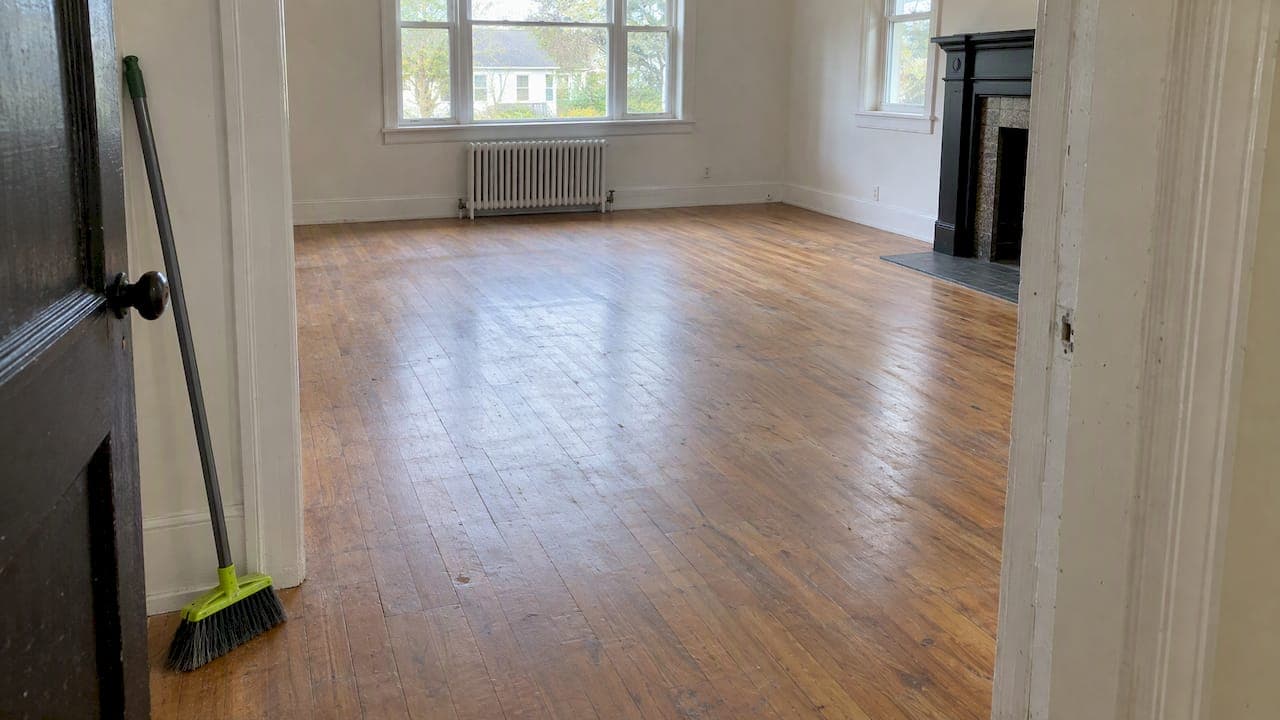
Broom swept condition (also called broom clean) means you hand over the property empty of your belongings and trash, with the floors swept and no debris left behind. It does not mean a professional deep clean. No statute defines it, so the exact meaning comes from your purchase agreement, your lease, and common practice in your market.
This guide explains what the term requires, what sellers most often forget, where buyers can ask for more, and what to do when the final walkthrough goes wrong.
TL;DR
- Broom swept means everything you own and all trash and debris are gone, and the floors are swept. Scrubbing, steam cleaning and repairs are not part of it.
- There is no national legal definition. Your contract controls, so read the delivery or condition-of-premises clause before you start packing.
- The costliest mistakes are leftovers: paint cans, old appliances, furniture, and whatever is hiding in the attic, basement, garage, or crawl space.
- If a buyer wants more than broom swept, such as professional cleaning, that has to be negotiated into the contract.
- If you cannot clear everything yourself in time, a junk removal crew can empty the property before the final walkthrough.
Table of Contents
- What broom swept condition actually means
- Is there a legal definition?
- What you have to remove
- What you do not have to do
- Broom swept vs. deep clean vs. move-in ready
- How to get a house broom swept before closing
- Who is asking, and what they need
- When the walkthrough goes wrong
- Our perspective: leftovers are the real problem
- Get the house emptied before the walkthrough
- FAQ
- Sources
What broom swept condition actually means
In plain terms, a broom swept home is one where a buyer can walk in and find nothing of yours left to deal with. Rooms are empty, closets and cabinets are clear, and the floors have had a pass with a broom or vacuum.
A law firm analysis of a court case on the question notes that residential contracts often require sellers to deliver the premises free of garbage, refuse, trash, other debris, and their possessions, and that broom clean does not require professional cleaning. In that case, the court treated a few pots, pans and silverware left behind as a minor violation. Hair, dust, crumbs, cobwebs and a dead fly did not justify reimbursing the buyer for cleaning.

That ruling is one case, and your contract may read differently. But it shows how courts tend to think: the line is between leftover stuff (a problem) and ordinary dust (usually not).
Broom swept, broom clean and broom-swept condition are used interchangeably in most contracts. If your agreement uses one of them, treat the others as the same standard unless the document defines it more strictly.
Is there a legal definition?
Not a universal one. The term appears in purchase agreements and leases, and what it demands depends on the wording around it. A Howard Hanna Allen Tate real estate blog post makes the same point: the phrase means different things to different people and has no set-in-stone requirements.
In Massachusetts, one of the states we serve, the state's course outline on residential purchase and sale agreements lists broom clean condition at closing among the customary clauses in the agreement. That tells you where to look: the possession and condition-of-premises section of your contract, not a statute. New Hampshire sellers should check the same section of their own agreement.
If the wording is vague, ask your agent or real estate attorney how the clause is read locally before you decide how much to do.
What you have to remove
The safest reading is simple: if you brought it in, take it out. That includes:
- Furniture and décor you are not selling with the house, including pieces stored in basements and attics.
- Appliances that are not listed as staying. The same court analysis names possessions such as furniture and appliances, and debris such as empty paint cans, as things sellers must clear.
- Trash and debris inside and outside: bags in the garage, scrap lumber behind the shed, yard waste piles, broken items in the crawl space.
- Hazardous leftovers such as old paint, solvents and chemicals. Many towns restrict how these are disposed of, so check with your local transfer station or public works department before the move.
- Personal items in built-ins: shelves, cabinets, closets, medicine cabinets, the space under the stairs.
Opendoor's pre-closing checklist recommends a final walkthrough and a check of areas people overlook, like crawl spaces, under-stair cabinets and mounted shelving. Those are exactly the places where forgotten items turn into a buyer complaint.
What stays with the house
Fixtures normally stay, and personal property normally goes, but the contract decides the gray areas. Light fixtures, curtain rods, mounted shelving, a mounted TV bracket and a wall-mounted shelf can all be disputed. Realtor.com advises that if you think a buyer might want floating shelves or leftover paint, you should ask, because leaving unwanted items could derail the sale.
A good habit: list every item you plan to leave in writing, and get the buyer's agreement before closing.
What you do not have to do
Broom swept is a low bar on purpose. According to the same law firm analysis, it generally does not give the buyer a right to a professionally deep-cleaned, move-in ready property. In practice that means you are not normally required to:
- Hire a cleaning crew
- Shampoo carpets or steam clean floors
- Scrub the inside of the oven or refrigerator
- Wash windows
- Make repairs, unless the contract or an inspection agreement calls for them
Realtor.com says professional cleaning is not required for home sellers, and that clutter removal and a sweep are reasonably expected. It also describes broom clean as more of a courtesy, since there is no security deposit to hold, as there is in a rental.
That said, many sellers choose to do a little more. Leaving the kitchen wiped down and the bathrooms tidy costs an hour and avoids friction at the walkthrough.
What about the oven?
This is the classic argument. A baked-on oven is dirt, not debris, so under a plain broom swept clause it is usually not a breach. But if a buyer's agent flags it at the walkthrough, a quick wipe is cheaper than a dispute. When your contract says nothing more than broom clean, you are within it either way.
Broom swept vs. deep clean vs. move-in ready
| Standard | What it usually covers | Who normally pays |
|---|---|---|
| Broom swept | All belongings and trash removed, floors swept or vacuumed | Seller, as part of the contract |
| Courtesy clean | Broom swept plus wiped counters, tidy bathrooms, cleaned appliance exteriors | Seller, by choice |
| Professional clean | Whole-house cleaning by a crew, often including windows, appliances and carpets | Whoever negotiates it into the contract |
The buyer's side sometimes asks for more. Realtor.com quotes real estate professional Bob Gordon saying buyers occasionally try to negotiate for more than broom swept, including professional cleaning, and that whether they succeed depends on market leverage. In a hot market sellers can say no. In a slow one, a cleaning credit may be an easy concession.
How to get a house broom swept before closing
A workable timeline beats a weekend panic. Wendy Wrzos, an interior redesign specialist quoted by Realtor.com, advises handling the work early in the selling process rather than at the last minute, to reduce stress and make sure every area is covered. If you are still working out the broader plan, this guide to preparing a house for sale walks through clearing and cleaning every area before the final walkthrough.
- Read your contract. Find the condition-of-premises clause and any list of items that convey.
- Sort what you own. Keep, sell, donate, or discard. Do this room by room, starting with the spaces you rarely open.
- Handle the big stuff early. Furniture, appliances, and the contents of the garage, basement and attic take the longest. Book help for these first.
- Move out. Take your belongings and leave the rooms empty.
- Sweep and look again. Sweep or vacuum every room, including closets. Open every cabinet, drawer and door.
- Check the outside. Garage, shed, porch, yard and curbside, plus the trash and recycling bins.
- Photograph the finished house. Dated photos of each room are your record that you delivered what the contract required.
If the house was a long-time family home, the job is bigger. Our guides on cleaning out your parents' house and on estate cleanouts for executors lay out realistic timelines. For homes with heavy accumulation, a guide on selling a hoarder house covers speed and health risks that come with that situation.
Who is asking, and what they need
The same phrase lands differently depending on who is reading it.
Sellers and heirs. Your job is delivering an empty property by closing. The risk is the last 10 percent: the full basement, the attic, the shed. Executors in particular should photograph contents before disposal, which is covered in our estate cleanout checklist.
Buyers. You are entitled to what the contract says, not more. Read the clause before you sign, and use the pre-closing walkthrough to check it.
Realtors. Clients often hear broom clean and picture a spotless home. Setting expectations at listing prevents closing-day fights. Our junk removal for Realtors page and Realtor cleanout guide show how agents get properties show-ready and closing-ready.
Landlords and tenants. The term also appears in leases, where it usually describes how a tenant returns a unit. If a tenant leaves belongings behind, see what to do when a tenant leaves junk behind and our landlord cleanout checklist.
When the walkthrough goes wrong
Disagreements happen most often at the final walkthrough, usually a day or so before closing. The common problems are leftover items and a house dirtier than the buyer expected.
One real-estate firm's guide to what buyers can do when sellers leave trash says the seller is contractually responsible for removing property, garbage and debris, but that in practice buyers often end up handling it and seeking reimbursement. It also points out that an escrow holdback is an option if the issue is noticed before closing, and that it may be gone once the deed records.
Here is a sensible order of operations.
If you are the buyer
- Do the walkthrough right before closing, not days earlier, and open every closet, cabinet and storage space.
- Photograph anything left behind and send it to your agent right away.
- Ask for removal before closing, or a written agreement for a holdback or credit. Your agent or attorney can tell you what the contract and local practice allow.
- Keep the photos and any emails. They matter if you have to seek reimbursement later.
If you are the seller
- Respond fast. A same-day clearing is far cheaper than a delayed closing.
- If something belongs in the gray area, such as a mounted shelf, say so in writing and offer to leave or remove it.
- If the buyer wants a professional clean beyond the contract, treat it as a negotiation. A modest credit may be cheaper than a standoff.
- Keep your own dated photos of the finished home.
Realtor.com's advice for the uncertain case is simple: if you are unsure whether the home needs professional cleaning, ask your agent. If the dispute is about money or the contract, ask your real estate attorney.
Our perspective: leftovers are the real problem
As a junk removal crew working in Massachusetts and New Hampshire, we rarely get calls about dust. We get calls about the stuff. A seller has closed on a new place, the old house is mostly empty, and what is left is a basement of paint cans, a garage of broken shelving, an attic of boxes nobody wants to open, and a couch that did not fit through the door.

That is where we see the broom swept standard most often missed. People imagine the job as sweeping. In reality, the job is hauling, and hauling is slow, physical and easy to underestimate.
Our advice is plain:
- Treat the basement, attic and garage as separate projects, and start them first.
- Decide on donation early. Usable furniture and household goods can often go to a charity instead of a landfill, and we donate and recycle whenever we can.
- Do not wait for the week of closing to book help. Same-day service exists, but a scheduled clearing a few days before the walkthrough gives you time to sweep and check.
- Leave a final pass for yourself: a broom, a flashlight, and ten minutes opening every door.
Broom swept is a small promise. Keeping it is mostly a matter of getting the heavy things out on time.
— Easy
Get the house emptied before the walkthrough
If your list of leftovers is bigger than a weekend can handle, our crew will do the lifting. EasyScrap serves Lawrence, Andover, Boston, Lowell and Haverhill, with free quotes and an insured crew. We take furniture, appliances, and the contents of garages, basements and attics, and we handle full estate cleanouts when a whole house needs to be cleared.
For general jobs, start with our junk removal service and request a free quote. Tell us your closing date and we will work backward from it.
FAQ
What does broom swept condition mean?
It means the seller or tenant leaves the property free of their belongings and trash, with the floors swept or vacuumed. It does not require deep cleaning, repairs, or professional services. The details come from the contract, so read the clause.
Do I have to clean the oven and bathrooms to leave a house broom swept?
Usually not. Courts and real estate professionals generally treat broom clean as a standard below professional cleaning, and ordinary dirt is not the same as debris. Still, a quick wipe of the kitchen and bathrooms often prevents friction at the final walkthrough.
Can a buyer demand a professional clean?
Only if the contract says so. A buyer can ask, and in some markets a seller will agree to a cleaning credit, but without a written term the standard stays broom swept. Your agent or attorney can advise on your specific agreement.
What if the seller leaves furniture or trash behind?
Contact your agent right away, document everything with photos, and try to settle it before closing, for example with removal or a holdback. After closing, recovery usually means seeking reimbursement, which is slower and less certain.
Is broom swept the same in a rental?
The words are the same, but the leverage is different. In a lease, the landlord may hold a security deposit and the lease may define the cleaning standard in more detail, so check the lease itself.
Sources
- Court Answers an Existential Question: How Clean is "Broom-Clean"?
- Broom Clean Condition: What Does It Mean If You're Moving Out?
- How to Clean a House After Selling But Before You Move
- What does broom clean mean? (Howard Hanna Allen Tate Blog)
- Pre-closing checklist: what to do before you hand over the keys (Opendoor)
- RE89R14: Purchase and Sale Agreement in Residential Transactions (Mass.gov)
- Seller Left Trash At Closing? What Buyers Can Do