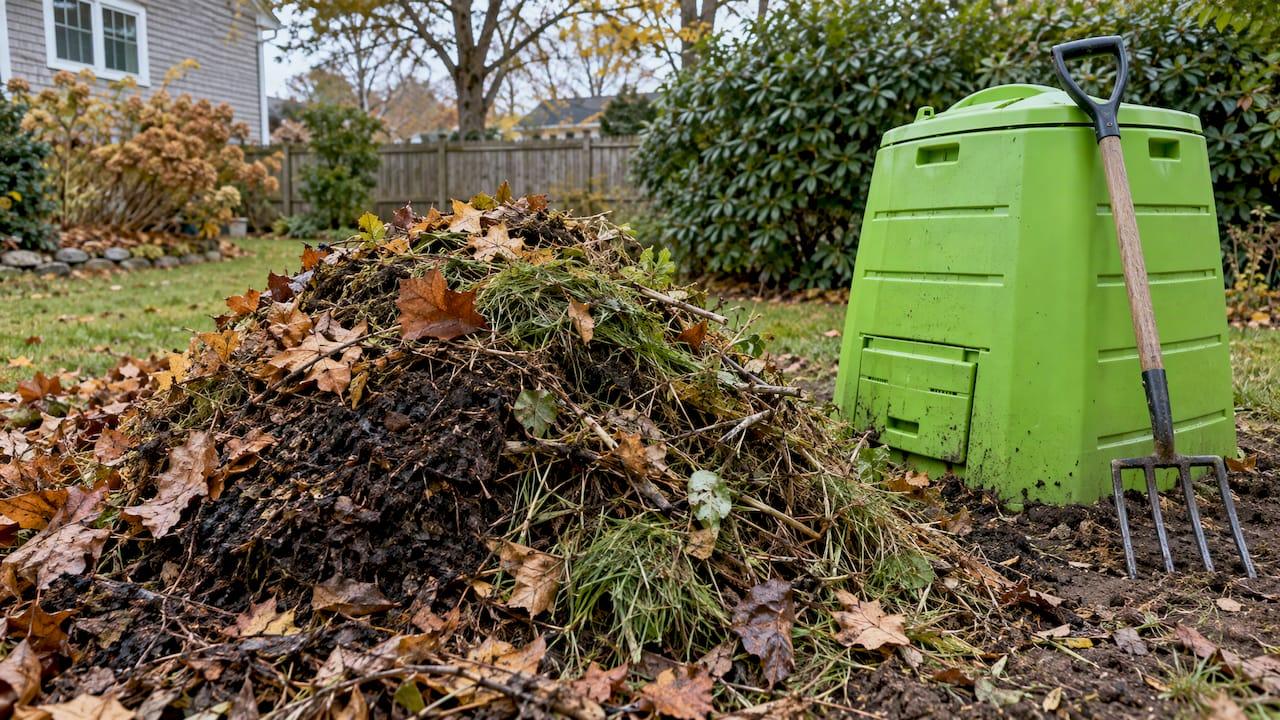
You can compost most yard waste at home: fallen leaves, grass clippings, spent garden plants and small twigs all break down into compost if you balance dry and fresh material, keep the pile damp and give it air. A tended pile can be ready in a few months. An ignored one takes much longer. This guide covers what to add, how to build the pile, how to keep it working, how to know it is done and what to do with the pile you cannot compost.
TL;DR
- Mix two to three parts dry "browns" (leaves, twigs, shredded paper) with one part fresh "greens" (grass clippings, plant trimmings, kitchen scraps), and keep the pile as damp as a wrung-out sponge.
- Leave out meat, dairy, grease, pet waste, diseased plants, weeds that have gone to seed and treated wood.
- Turn the pile for air. A well-tended pile is typically ready in about three to five months, while a neglected one can take a year.
- Smells and slow piles almost always trace back to moisture, air or the browns-to-greens ratio, and all three are easy to adjust.
- Branches, stumps, storm debris and large cleanup volumes do not belong in a backyard pile. That is a job for a hauler.
Table of Contents
- What yard waste composting actually is
- What you can compost from your yard
- Choose the spot and the bin
- Build the pile step by step
- Keep it working: moisture, air and turning
- How long does it take?
- Troubleshooting common problems
- Using your finished compost
- What does not belong in a backyard pile
- Our perspective: compost what you can, haul what you can't
- Need the rest of the yard cleared?
- FAQ
- Sources
What yard waste composting actually is
The US EPA describes composting as managed, aerobic decomposition of organic material by microorganisms, which produces a soil amendment called compost. The key words are "managed" and "aerobic." A heap of clippings left to sit turns slimy and smelly because it runs out of air. A managed pile gets the right mix, enough moisture and regular turning, so the microbes that need oxygen do the work.
For a homeowner, the payoff is simple. Leaves and clippings stop being a bagging chore or a disposal cost. They become something you spread back on your beds and lawn. Colorado State University Extension notes that composting works on most yard waste, including leaves, vegetable and flower plant parts, straw, and a limited amount of woody prunings and grass clippings.
What you can compost from your yard
Think of the pile as two ingredient groups. The EPA calls them browns and greens: carbon-rich browns, nitrogen-rich greens, plus water and air.
| Ingredient | Type | Notes |
|---|---|---|
| Dry fallen leaves | Brown | The backbone of a fall pile. Shred them if you can. |
| Twigs and plant stalks | Brown | Cut small so they break down. |
| Untreated wood chips | Brown | Use in modest amounts as bulky, airy material. |
| Shredded paper and cardboard | Brown | Keep it plain, not glossy. |
| Straw or hay | Brown | Good for fluffing a wet pile. |
| Grass clippings | Green | Mix in thin layers so they do not mat. |
| Garden plant trimmings | Green | Healthy plants only. |
| Fruit and vegetable scraps | Green | Bury under browns. |
| Coffee grounds and filters | Green | Paper filters are fine. |
| Crushed eggshells | Green | Break down slowly, so crush them. |
The EPA list matches state guidance. The Iowa Department of Natural Resources also lists dead flowers and leaves, grass clippings, straw and hay, and shredded non-glossy paper as acceptable.
What to keep out of the pile
The EPA advises against adding meat, bones, grease, dairy, pet waste, diseased or pest-infested plants, weeds with seeds, and treated or painted wood. Iowa State Extension adds charcoal ash, coal ash, pressure-treated wood, plywood and pressed wood products to the avoid list.
The reasons are practical. Meat, dairy and grease attract animals and smell. Pet waste can carry pathogens. Diseased plants and seeding weeds can survive in a pile that never gets hot enough, and then you spread the problem across your garden. Treated wood can leave chemicals in your finished compost.
When you are sorting a cleanup, a quick rule helps: if it grew in your yard, is healthy and is untreated, it can probably go in. If it was a fence post, a painted board or a diseased shrub, it goes out with the trash or a hauler.
Choose the spot and the bin
The EPA recommends an easily accessible spot with good drainage, not pushed right against a fence, and with a water source nearby. A hose that reaches the pile is worth more than a fancy bin, because moisture is the thing people forget.
You have several container options, and the EPA says bins can be made from wire, wood or cinder blocks, or you can use an enclosed barrel or tumbler.
- Open pile or wire cage: cheapest, easiest to turn, best for large volumes of leaves.
- Wood or block bin: tidier, holds heat well and keeps material from blowing around.
- Tumbler: easy to turn and good for small yards, though it holds less than a pile.
If you also compost kitchen scraps, keep a small lidded container by the sink and empty it into the pile every few days. A waste bin for scraps in the kitchen keeps the trips to the pile manageable.
Size matters for heat. Iowa State Extension notes a pile may fail to heat if it is too small, too dry, low in nitrogen or exposed to cold. In practice, aim for a pile or bin big enough to hold a few cubic feet of mixed material at once. Build it in one go in fall when the leaves come down, rather than adding a handful at a time.
Build the pile step by step
- Start with a coarse base. A few inches of twigs or straw lets air in from below and helps drainage.
- Layer browns and greens. The EPA says to add at least two to three times the volume of browns to greens. Shredded leaves and a thin layer of grass clippings is a typical combination.
- Cover food scraps. If you add kitchen scraps, the EPA says to bury them under four to eight inches of browns.
- Wet it as you build. Aim for the moisture of a wrung-out sponge: damp, but no water dripping when you squeeze a handful.
- Chop big pieces. Smaller pieces have more surface area, so they break down faster. A mower run over a pile of leaves works well.
- Keep adding in balance. Every time you add a bucket of greens, add two or three of browns.
If you do not have enough browns in summer, bag extra leaves in fall and store them dry. Many gardeners keep a pile of them next to the bin for the grass-cutting season.
Keep it working: moisture, air and turning
The pile does the job when four things are in place: carbon, nitrogen, water and oxygen. Moisture and oxygen are the ones you adjust week to week.

Moisture. Too dry and decomposition stalls. Too wet and the pile loses air and starts to smell. The EPA says if it is too dry, moisten it and turn it.
Turning. Turning brings oxygen in. Iowa State Extension says that for the fastest composting you can turn about once a week, but turning every two to four weeks is enough for most home gardeners. The pile will still compost without turning, just much more slowly. Illinois Extension advises waiting at least two weeks before the first turn so the center can heat up, then moving the center material outward and the edge material inward.
Heat. University of Maryland Extension explains that aerobic microorganisms generate heat as they work, and that this heat can help kill pathogens and weed seeds. That is one reason a well-balanced, adequately sized pile is worth the effort compared with a loose heap.
How long does it take?
The EPA says a well-maintained pile is ready in about three to five months, and an untended one may take a year. CalRecycle gives a similar range: about three months with close tending, and six months to a year if rarely tended.
| Approach | Typical time to finished compost |
|---|---|
| Shredded material, regular turning, kept damp | About 3 to 5 months (EPA); about 3 months with close tending (CalRecycle) |
| Occasional turning, mixed sizes | Several months, trending toward 6 |
| Left alone | 6 months to a year or more |
Elapsed time is only a guide. Go by the signs. CalRecycle lists them: the pile stops heating up after you turn it, cools to outside temperature, no longer looks like what you put in, and is dark and crumbly with an earthy smell.
The EPA also recommends curing the compost for at least four weeks once it no longer heats after mixing and shows no visible food scraps. Then sift it to remove the pieces that did not break down, and toss those back into the next pile.

In the Northeast, the cold matters. A pile started in late fall will slow down in a New England winter and pick up again in spring, so plan on a longer timeline and do not worry if it sits frozen for a while.
Troubleshooting common problems
Most problems come down to the same three levers: water, air and the browns-to-greens ratio. Iowa State Extension and Mississippi State Extension both map symptoms to causes.
| Symptom | Likely cause | Fix |
|---|---|---|
| Bad odor | Too wet, not enough air, or too many greens | Turn the pile and mix in dry browns |
| Slow breakdown | Too dry, too little nitrogen, not enough turning, or large pieces | Add water, add greens, turn, and shred coarse material |
| Damp and sweet-smelling but cold | Lack of nitrogen | Mix in fresh greens such as grass clippings |
| Center of pile is dry | Not enough water | Moisten as you turn |
| Pile will not heat | Too small, too dry, low in nitrogen, or cold weather | Build bigger, add water and greens |
| Charred interior | Extremely high temperature, pile too large | Reduce the size and add water |
Pests are usually a sign that food scraps are too close to the surface. Bury them under browns, and keep meat, dairy and grease out entirely.
Using your finished compost
Finished compost is a soil amendment. The US Composting Council publishes use guidance for lawns, flower and vegetable gardens, and trees and shrubs. For garden establishment, it recommends applying compost 1 to 2 inches deep and working it 6 to 8 inches into the soil.
Two cautions help you get good results:
- Do not use it as houseplant potting soil. The EPA's backyard composting guide says compost may still contain vegetable and grass seeds.
- Treat it as an amendment, not a fertilizer. Oregon State University Extension stresses that compost has low fertilizer value compared with chemical fertilizers, so heavy feeders such as vegetables may still need additional nutrition.
Compost is great as a top dressing on a lawn, mixed into planting beds in spring or spread around shrubs in fall.
What does not belong in a backyard pile
Home composting handles leaves, clippings and garden trimmings well. It does not handle everything that lands in a yard after a storm or a big cleanup. Thick branches, stumps, root balls, diseased plants, painted or treated lumber, old fencing and a season's worth of overgrown brush are better handled another way. Our guides cover tree branch disposal and yard waste disposal and when to hire a pro if you are sorting out what to do with the rest. If an old mower or outdoor furniture is cluttering the shed, see lawn mower disposal and outdoor furniture disposal.
Local rules also vary. Many Massachusetts and New Hampshire towns run their own seasonal leaf or brush pickup, so check your town's public works page for the current schedule.
Our perspective: compost what you can, haul what you can't
We see the same pattern every spring and fall. A homeowner starts a compost pile with good intentions, then a storm drops limbs, the garage fills with old gear, and the yard turns into a project that is bigger than a weekend.
Our view is that composting is the right home for leaves, clippings and garden trimmings, and a hauler is the right answer for everything that is too big, too woody, too mixed or too heavy for the pile. Doing both keeps your compost clean and your yard clear.
When we clear out a property, we aim to donate and recycle what we can instead of sending everything to the landfill. That is the same instinct behind composting: keep usable material in use. We are a young local crew serving Lawrence, Andover, Boston, Lowell and Haverhill, and we are insured, so you can hand us the heavy lifting.
If your compost bin is humming and you just need the branches, old fencing, broken planters or the whole garage cleared, that is the job we are here for.
Easy
Need the rest of the yard cleared?
If your pile can handle the leaves but you are left with brush, bulky debris or a cluttered garage, we can take it off your hands. EasyScrap offers yard waste removal, garage cleanouts and general junk removal for homes and businesses in Lawrence, Andover, Boston, Lowell and Haverhill, with free quotes and same-day service. See our yard waste removal and other services or go straight to garage cleanouts.
We donate and recycle usable items whenever possible, so what you no longer need can get a second life. For a broader haul, our junk removal page explains how to book.
FAQ
Can I compost grass clippings and leaves together?
Yes, and they balance each other well. Leaves are a carbon-rich brown and clippings are a nitrogen-rich green. Following the EPA's guidance, use two to three times as much leaf volume as clippings, and spread the clippings in thin layers so they do not mat down and turn smelly.
What yard waste should I never put in a compost pile?
Keep out diseased or pest-infested plants, weeds that have gone to seed, and treated, painted or pressure-treated wood. The EPA and Iowa State Extension also say to avoid meat, bones, grease, dairy and pet waste. Ashes from charcoal or coal should stay out too.
How often should I turn my yard waste compost?
For the fastest results, turn about once a week. For most home gardeners, every two to four weeks is enough, according to Iowa State Extension. Wait at least two weeks before the first turn so the center can heat up, as Illinois Extension advises.
How do I know when my compost is finished?
Finished compost is dark, crumbly and earthy-smelling, and no longer looks like the material you added. It also stops heating up after you turn it and cools to the outside temperature. Cure it for a few weeks and sift out any pieces that did not break down.
What do I do with branches and bulky yard debris?
Thick branches, stumps and large volumes of brush do not break down fast enough for a home pile. Check your town for seasonal brush pickup, or book a hauler. We handle yard waste removal in our Massachusetts service area and can quote the job for free.
Sources
- Composting At Home | US EPA
- Composting Yard Waste | CSU Extension
- Composting | Iowa Department of Natural Resources
- Composting for Home Gardeners | Iowa State Extension
- How It Works | Composting | Illinois Extension
- Composting (FS-2023-0687) | University of Maryland Extension
- Home Composting | CalRecycle
- Composting for the Mississippi Gardener | Mississippi State Extension
- Guidelines for the Use and Application of Compost | US Composting Council
- Backyard Composting: It's Only Natural | US EPA
- How to use compost in gardens and landscapes | OSU Extension