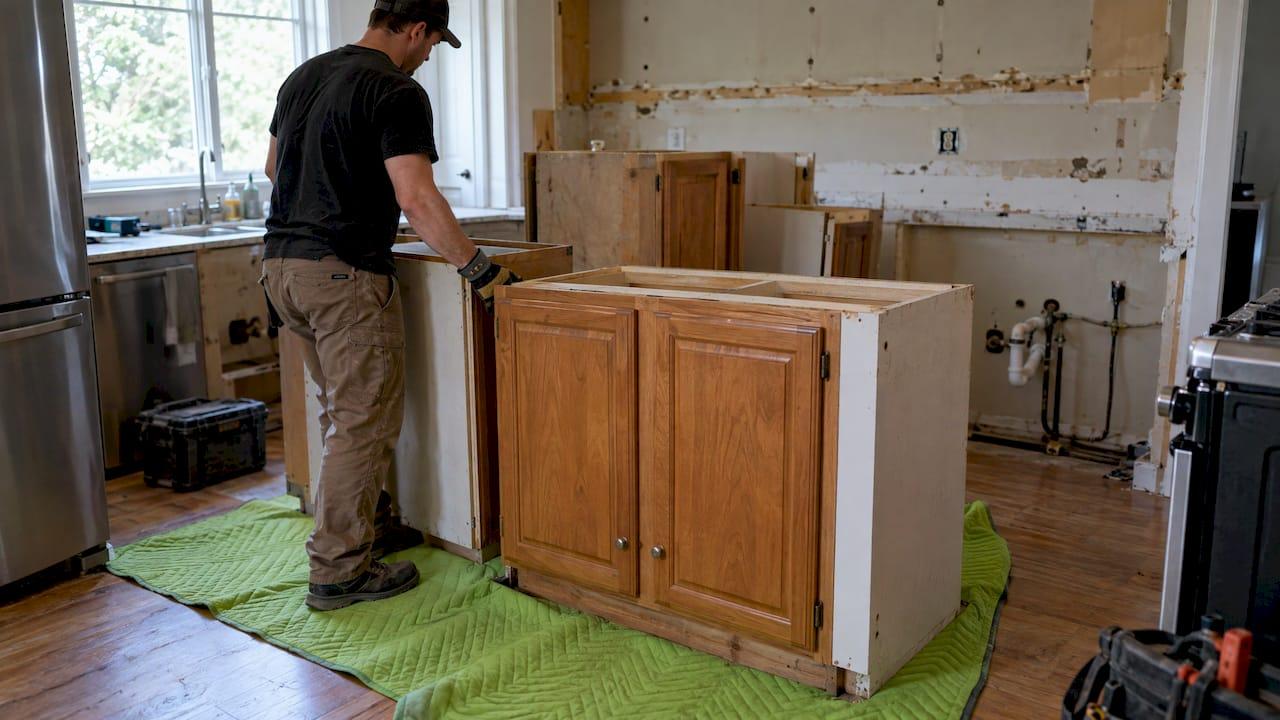
The best way to get rid of old kitchen cabinets depends on their condition. Cabinets in good shape can be donated. Worn-out cabinets usually have to be taken apart and brought to a transfer station as construction debris, or hauled off by a crew. Either way, plan the exit before you swing a pry bar, because cabinets are bulky, heavy and awkward to carry once they are in pieces.
This guide covers how to take cabinets out safely, what to do with them afterward, what a dump run usually costs, and how to handle the rest of the kitchen remodel debris.
TL;DR
- Usable cabinets with doors, drawers and hardware intact can often be donated to a building-materials reuse store. Call first, because each store sets its own rules.
- Worn or damaged cabinets are construction and demolition (C&D) debris. They do not belong in curbside trash or recycling carts.
- Transfer stations charge by weight, so a full kitchen's worth of cabinets and countertops adds up. Check your town's rules and fees before you load a truck.
- Empty the cabinets, shut off water and power, and support upper units while you remove the last screws.
- If you would rather not carry it all, we haul cabinets away from inside your home, garage or driveway and donate or recycle what we can.
Table of Contents
- Start with the condition of the cabinets
- How to take cabinets out safely
- Option 1: Donate cabinets in good condition
- Option 2: Reuse or repurpose before you discard
- Option 3: Recycle the parts that can be recycled
- Option 4: Bring them to a transfer station
- Option 5: Curbside bulk pickup
- Option 6: Hire a junk removal crew
- Beyond cabinets: sorting the rest of the kitchen remodel debris
- Which option fits your situation
- Our perspective
- Get cabinets and remodel debris hauled away
- FAQ
- Sources
Start with the condition of the cabinets
Before you decide where cabinets go, sort them into three groups. This one step settles most of the question.
Good condition. Boxes are square, doors and drawers are attached, hinges and pulls work, and there is no water damage or mold. These are candidates for donation.
Fair condition. The boxes are sound but finishes are chipped, doors are missing or the layout is odd. Some reuse outlets will still take them, and some people repurpose them as garage or workshop storage. A phone call settles it.
Poor condition. Swollen particleboard, water damage, broken frames, rust or sharp protruding nails. These are debris. Donation programs ask for clean, usable material, so don't expect a taker for these.

If you are unsure how to sort a mixed pile of household items, our three on-site tests for deciding what to donate or trash work for cabinets too.
How to take cabinets out safely
Safe removal protects you and your cabinets. If you want any of them to be donated, careful removal is not optional: a cabinet that has been pried apart is no longer a donation.
A manufacturer's installation guide, KitchenCraft's, lays out the removal sequence this way: empty the cabinets, shut off the kitchen's water and electricity, and remove the appliances. If you plan to reuse the sink and traps, disconnect them carefully. Then take out the cabinets and countertops, supporting the upper cabinets while you remove the last screws so they do not fall.
In practice:
- Empty everything. Dishes, shelf liners and the contents of the drawers. A loaded cabinet is far heavier than an empty one.
- Turn off water and power. Close the shutoff valves under the sink, and switch off the breaker for circuits that feed the kitchen. Have a licensed plumber or electrician handle disconnections you are not sure about.
- Pull appliances. Move the stove, dishwasher and refrigerator out of the way first. Old refrigerators have their own disposal rules, covered in our guide to heavy item removal and fridges.
- Remove doors, drawers and hardware. Lighter pieces, easier handling, and the doors and drawers can be kept together for donation.
- Take out the uppers first. Have a helper hold each one while you remove the screws from the studs. Work down to the base cabinets last.
- Detach the countertop. Countertops are often glued or screwed from below. Stone and laminate tops are heavy and brittle, so plan two or more people.
Wear gloves, eye protection and sturdy shoes. Old cabinets hide nails, staples and sharp edges. In homes built before 1978, paint on old cabinets may contain lead, so ask about testing before sanding or cutting. Check the EPA's lead-safe renovation guidance or talk to a certified renovator.
Option 1: Donate cabinets in good condition
Donation keeps good material out of the waste stream and, for some outlets, can mean a free pickup. Habitat for Humanity says its ReStores often accept kitchen cabinets, though what each store takes varies by location. Enter your ZIP code on that page to find the closest one, then call.
What donation programs generally want:
- Clean, usable, unbroken cabinets. Recycle Ann Arbor's guidance asks for gently used cabinets with hinges, pulls and installed doors and drawers.
- Parts kept together. Habitat for Humanity says hardware can go to a local salvage shop when the parts are kept together.
- A quick safety check. Habitat recommends checking for rust, sharp nails and broken boards before you donate building materials.
Three practical tips:
- Photograph the run of cabinets with measurements. Many outlets will want a look before agreeing to pick up.
- Label the doors and drawers with painter's tape so they stay with the right box.
- Ask about timing. Reuse stores have limited space, and a kitchen demo date does not always match their pickup schedule.
If timing is the problem, a hauling crew can bridge the gap. Our guide on getting donations accepted in one junk removal visit explains how we handle donation-ready items.
Option 2: Reuse or repurpose before you discard
Cabinets in decent shape have a second life without leaving your property. Base cabinets work well in a garage, a basement workshop or a laundry room. Upper cabinets can hang in a mudroom. Even with a worn finish, a coat of primer and paint can turn them into storage.
Public agencies recommend this order of thinking. Hennepin County, Minnesota, advises planning reuse before demolition and not destroying salvageable items. NC State's construction waste guidance puts reuse first, then recycling, then processing, and it points to public sales or nonprofits for reusable cabinets and shelves.
Option 3: Recycle the parts that can be recycled
Most whole cabinets are not accepted in curbside recycling. They are made of plywood, particleboard or MDF, finished with adhesives and coatings, and they come with metal hardware. Recycle Ann Arbor's guide says the cabinets themselves are not recyclable there, while metal hinges and pulls can go to scrap metal recycling.
So you can often pull off the hinges, pulls, slides and any metal brackets and put them in a scrap metal bin or take them to a scrap yard. What is left is wood-based debris.
In Massachusetts, wood is one of the materials banned from disposal under the state's C&D waste ban, which began for wood on July 1, 2006. The same list includes metal, brick, concrete, asphalt pavement and clean gypsum wallboard. In practice, that is why a transfer station in the Merrimack Valley may route a load of demolition wood differently from household trash. If you live in New Hampshire or Massachusetts, ask your town's transfer station or recycling coordinator how it handles cabinet wood.

Option 4: Bring them to a transfer station
When cabinets cannot be donated, the usual route is a transfer station or C&D facility. Rules and prices differ everywhere, so treat the examples below as a sense of scale and not a quote for your town.
| Location | What the facility says | Price or limit |
|---|---|---|
| New Haven, CT | Accepts kitchen and bath cabinets as construction or demolition material | Cited at $0.060 per pound, or $122.60 per ton |
| Iredell County, NC | Counts cabinets and fixtures from remodeling as C&D waste | $44 per ton plus a $22 per ton transportation fee |
| Detroit, MI | Curbside bulk allowance for renovation debris | Up to 2 cubic yards, doors removed, bundled, under 4 feet and under 50 pounds per piece |
A few patterns show up in these rules:
- Weight drives cost. Particleboard cabinets, plus a stone or laminate countertop, can add up fast. The cost is usually the weight of the load, plus minimums.
- Residency may matter. Iredell County, for one, restricts acceptance to waste generated within the county, and it requires loads to be covered or secured.
- Prep is required for curbside. Detroit asks for doors removed and materials bundled or packaged. Many towns require similar breakdown.
- Hazardous items are excluded. Detroit's guide excludes materials like paint, batteries, fuel, oil and chemicals from bulk pickup. Do not leave them inside cabinets you set out.
To estimate your own cost, count how many cabinet boxes you have, then ask your transfer station for its per-ton or per-load rate. Add the cost of a truck rental or fuel, plus the time. Our renovation debris disposal guide walks through the options, rules and costs in more depth.
Option 5: Curbside bulk pickup
Some towns pick up bulk items on a schedule or by appointment, and cabinets may qualify. Gainesville, Florida, for example, lists cabinets as eligible interior-remodeling debris for residential bulk collection, with size and weight limits. The rules vary a lot from town to town, and many municipalities exclude contractor-generated debris.
If your town offers bulk pickup, check three things on its website or by phone:
- Whether cabinets and construction debris are accepted at all.
- Size, weight and volume limits per piece and per pickup.
- Whether you need a sticker, a fee or a scheduled date.
A cabinet that is too big for the rules can be cut down, but cutting is messy, and you will need to wear a dust mask and eye protection.
Option 6: Hire a junk removal crew
A hauling crew makes sense when you have more than a few cabinets, when the pieces are heavy, or when your remodel schedule does not leave room for a dump run. It also helps if you have no truck, if the cabinets are in a basement or upstairs, or if you are managing a property from a distance.
We handle junk removal for homes and businesses in Lawrence, Andover, Boston, Lowell and Haverhill. For cabinets, the crew does the heavy lifting, carries the pieces from the kitchen, garage or driveway, and takes them away. Our approach is to donate and recycle whenever possible, so cabinets that are in usable shape have a chance to go to reuse instead of the landfill.
A hauler is also useful for what comes with the cabinets: old furniture from the dining room, a worn-out couch pushed aside during demo, a broken appliance or a bulky table. One visit can clear it all.
Beyond cabinets: sorting the rest of the kitchen remodel debris
Cabinets are rarely the only thing leaving a gutted kitchen. A typical remodel produces a mix of materials, and the way you sort them affects both cost and recycling.
- Metal. Hinges, pulls, old faucets, sink basins, brackets and appliance parts. Scrap metal is often accepted without charge. Iredell County, for instance, lists scrap metal and other source-separated recyclables as no-charge materials.
- Wood and cabinet boxes. Clean, untreated wood and cabinet carcasses go with C&D debris.
- Countertops. Heavy and often not recyclable. Ask the transfer station how it weighs and classifies them.
- Drywall and flooring. If you are tearing out walls or flooring too, keep them in separate piles. Hennepin County says source-separated C&D material has the best recycling potential, and it advises confirming that a mixed-waste processor actually diverts material and asking for receipts.
- Appliances. Old refrigerators and other appliances have special handling. See our appliance removal page, and our refrigerator removal service if you have one to pull out.
- Hazardous materials. Leftover paint, solvents, batteries and chemicals should never go in a debris pile or dumpster. Use your town's household hazardous waste program.
For a broader view of what counts as debris and where it goes, read our guide on where homeowners and contractors can take construction debris.
Which option fits your situation
| Your situation | Best fit |
|---|---|
| A few good cabinets, flexible timeline | Donate to a reuse store, or repurpose in the garage |
| Whole kitchen, cabinets in good shape | Careful removal, then donation or a hauler that donates |
| Damaged or moldy cabinets | Transfer station or hauler |
| No truck, tight schedule, heavy countertops | Hauling crew |
| Small amount of debris, town offers bulk pickup | Curbside bulk pickup, following the rules |
| Estate or rental turnover with a lot of items | Full-service cleanout |
Our perspective
Most people think about cabinets last. The demo day arrives, the cabinets come off the wall, and suddenly there is a pile of heavy boxes in the driveway and no plan.
Our view is that cabinets should have a destination before demo starts. If they are in decent shape, reuse beats disposal every time: it keeps material in circulation, and someone else gets a usable kitchen. That is why we donate and recycle whenever we can.
We also know most people do not have a free weekend, a truck and two strong helpers. As a young, local crew, we know the Merrimack Valley and the Boston area, and we built our service around fast scheduling, including same-day service when it is available, and around insured crews who carry the load out of the house for you.
Cabinets are rarely the only thing in the way. We clear the old couch, the busted appliance and the leftover debris in the same visit, so your kitchen project can move to the next stage.
Easy
Get cabinets and remodel debris hauled away
If you want the cabinets gone without the dump run, we can take care of it. We serve homeowners, landlords, property managers, real estate investors and Realtors. Tell us what is coming out of the kitchen, and we will give you a free quote. Our crew is insured, and we donate and recycle whenever possible.

You can start with our junk removal page, or see our full services list for construction debris cleanup and estate cleanouts. If the cabinets are coming out of a basement, our basement cleanout service covers that too, and our furniture removal service handles the pieces that surround them.
FAQ
How do I dispose of old kitchen cabinets?
First decide whether they are in good enough condition to donate. If they are, call a local reuse store or building-materials nonprofit. If they are not, remove metal hardware for scrap, then take the wood and boxes to a transfer station or have a hauling service remove them.
Can I put kitchen cabinets in the regular trash?
Usually not. Cabinets are bulky construction debris, and most curbside carts do not take them. Some towns offer bulk pickup with size and weight limits, so check your municipality's rules before setting anything at the curb.
Will anyone take my old cabinets for free?
Possibly. Reuse stores such as Habitat for Humanity ReStores often accept kitchen cabinets in good condition, but acceptance varies by location. Call ahead with photos and measurements, and keep doors, drawers and hardware together.
How much does it cost to dump cabinets at a transfer station?
It depends on where you live, and most facilities charge by weight. Published examples include $0.060 per pound in New Haven, Connecticut, and $44 per ton plus a $22 per ton transportation fee in Iredell County, North Carolina. Call your local facility for its current rate and minimum.
What should I do before removing the cabinets?
Empty them, shut off the water and electricity to the kitchen, and remove appliances. Support the upper cabinets as you take out the last screws so they do not fall. Have a licensed plumber or electrician handle any disconnection you are not sure about.
Sources
- KitchenCraft installation guide
- Habitat for Humanity ReStore: find and donate building materials
- Habitat for Humanity: 8 things to donate when renovating
- Recycle Ann Arbor: cabinets in good condition
- Hennepin County: home remodeling guide
- NC State: construction and demolition management
- MassDEP: construction and demolition materials waste ban FAQ
- New Haven Solid Waste & Recycling Authority: transfer station
- Detroit Department of Public Works: curbside collection
- City of Gainesville: bulk item collection