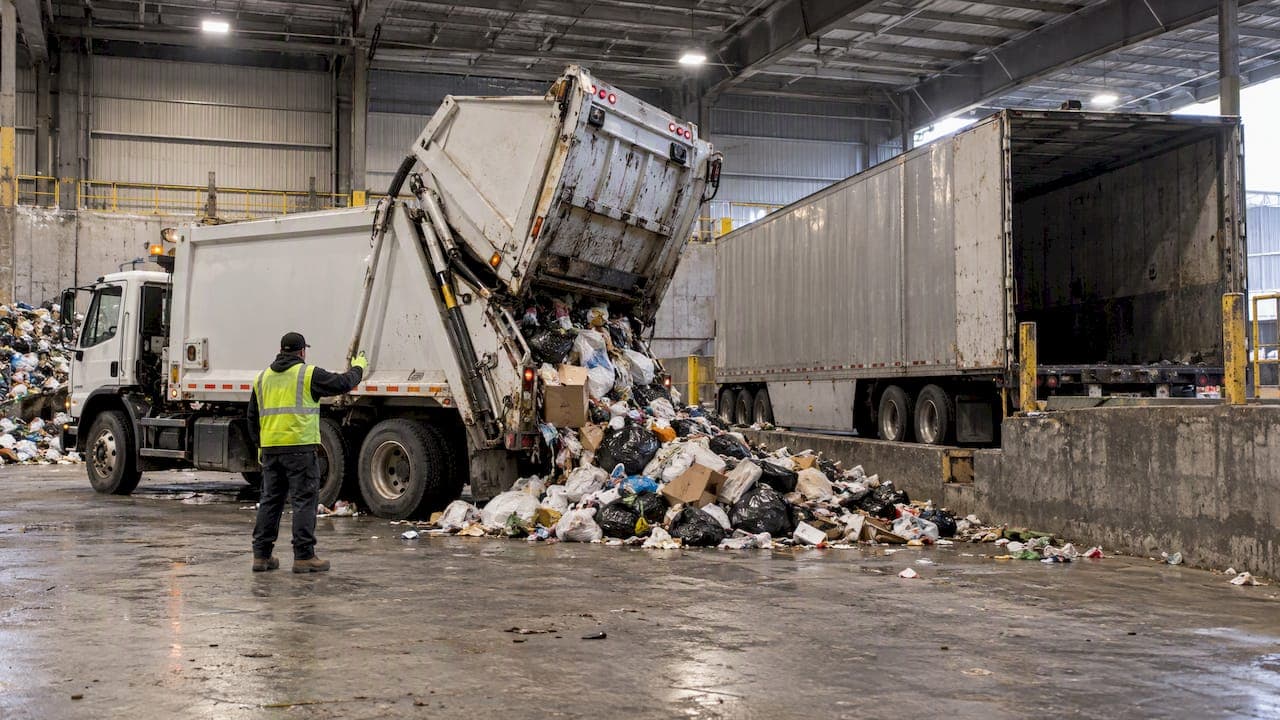
A landfill is where waste ends up. A transfer station is where it stops on the way there. Most people who say "the dump" mean a town transfer station or drop-off center. The big engineered landfill sits farther away, and your garbage truck is usually the only thing that goes there. Which one you need depends on what you are getting rid of, where you live, and what your town or the facility allows.
This guide explains how the two facilities differ, why the difference matters when you clear a garage, basement or estate, and how to avoid a rejected load. Examples lean toward Massachusetts and New Hampshire, where we work.
TL;DR
- A landfill is the final disposal site: an engineered area of land that receives household and other nonhazardous waste.
- A transfer station is an intermediate stop. Waste is received, consolidated and reloaded into larger vehicles, then moves on to a landfill, waste-to-energy plant or recycling facility.
- Neither is a free-for-all. Accepted materials, residency rules and fees are set by each facility or town, so check before you load the truck.
- In Massachusetts, state waste bans keep items like mattresses, appliances with metal, tires and clean wood out of the trash stream, so a mixed load can be refused.
- For a big or mixed cleanout, hiring a hauler that sorts, donates and recycles can save you several trips.
Table of Contents
- The short answer: final stop vs. middle stop
- Why transfer stations exist at all
- What about "the dump" and recycling centers?
- Which one can you actually use?
- Massachusetts waste bans: why a mixed load gets refused
- A quick decision guide
- Our perspective: the facility you choose matters less than the sorting you do
- When it makes sense to hire a hauler
- Where does the biggest U.S. landfill sit?
- FAQ
- Sources
The short answer: final stop vs. middle stop
The U.S. EPA describes a municipal solid waste landfill as a discrete area of land or an excavation that receives household waste. It may also take other nonhazardous waste, such as commercial solid waste. Waste goes in, gets covered, and stays.
A transfer station does something different. Under Massachusetts solid waste regulations, it is a facility where solid waste is stored and moved from one vehicle or container to another for treatment, processing or disposal somewhere else. It is not necessarily the final site. EPA's transfer station manual adds that waste generally leaves within hours, often compacted and reloaded into larger trailers, railcars, containers or barges.
Here is the comparison side by side.
| Landfill | Transfer station | |
|---|---|---|
| Role | Final disposal | Intermediate handling |
| What happens to waste | Placed, covered, left in the ground | Received, consolidated, reloaded, shipped on |
| Where it sits | Often far from town | Usually closer to the communities it serves |
| Who uses it | Mostly haulers and transfer trucks | Residents, small haulers, collection trucks |
| Typical next stop | None | Landfill, waste-to-energy, composting or recycling facility |
Why transfer stations exist at all
Transfer stations exist for one main reason: moving trash is expensive. According to EPA, the main purpose is to cut transportation costs and collection-vehicle downtime. They do not make waste disappear. A collection truck that holds a few tons can unload nearby and go back to its route, while one large transfer trailer makes the long trip to the landfill.
EPA's own worked example shows the logic. Using a $10-per-ton transfer cost, a 7-ton collection truck, a 21-ton transfer trailer and $3 per mile in trucking, the break-even point came out around 35 miles round trip. That is a modeling illustration, not a current price, and the real figure depends on the site. The takeaway is simple: the farther the landfill, the more a transfer station makes sense.

There is a trade-off. The same manual notes that consolidating loads can reduce fuel use, emissions and road wear along the long haul, but can raise traffic at the transfer station site itself.
EPA's solid-waste costing guidance puts the landfill side in perspective. It estimates that landfill construction alone can run at least $150,000 to $250,000 per acre, before operation and closure. It also notes that a community producing under 100 tons per day may find a modern landfill uneconomical. Those are planning figures for communities, not what you pay at the gate. They do explain why many towns ship waste out instead of burying it locally.
What about "the dump" and recycling centers?
People use "dump" for almost anything. In practice it can mean three different places.
- A town transfer station or drop-off center. This is what most residents visit. Some sites are resident-only and ask for a sticker or permit.
- A recycling center. It takes sorted materials such as metal, cardboard or clean wood. Some share a site with a transfer station, but EPA's manual notes a resident-only convenience center may be technically a separate facility.
- A landfill. Haulers use it. In many places, the public never sees it.
An "open dump" is a different thing entirely. State agencies treat it as illegal. Indiana's environmental agency, for example, explains that discarding waste anywhere other than a permitted facility or authorized recycling center is open dumping and can create fire, air and water hazards. That is one state's rule, and details vary, but the principle holds across the country: permitted facilities exist so waste does not end up on someone's back lot.
Which one can you actually use?
For most homeowners, the answer is not a choice between landfill and transfer station. It is whichever local facility will take your material, from your address, on the day you show up.
Before you load anything, check four things:
- Residency. Many town facilities serve only residents and may require a sticker or proof of address.
- Accepted materials. Facilities publish lists. Furniture, appliances, scrap metal, electronics and construction debris are often handled separately.
- Fees. Some items are charged by weight, item or load. We will not quote a figure here because they differ town by town and change.
- Hours and payment methods. Many sites are open only certain days.
In Massachusetts, MassDEP keeps a statewide list of landfills, transfer stations, compost sites and recycling facilities. The current master list is dated August 2026. Use it to find what operates near you, then check that facility's own page or call the town for its rules.
Special materials need their own check. For instance, if you are clearing out bamboo or other natural-material household items, this practical guide to disposing of bamboo products shows the kind of material-by-material thinking that saves you a wasted trip.
Massachusetts waste bans: why a mixed load gets refused
This is where homeowners, landlords and investors get caught. Massachusetts waste bans restrict disposal, transfer for disposal and contracting for disposal of certain hazardous items and recyclable materials at solid waste facilities (310 CMR 19.017). They apply to material headed for landfills, combustion facilities and transfer stations.
The banned list includes mattresses, white goods (large appliances), tires, metal, recyclable paper, cardboard, many plastics, clean wood, leaves and yard waste, and commercial organics.
Facilities must watch for these. MassDEP's webinar for municipal transfer station operators shows that operators monitor incoming loads and run required inspections. The responsibility sits with both the people generating the waste and the facility. A pickup bed full of mixed junk, with a mattress on top and a bag of scrap metal underneath, can be turned away or sent to a separate handling area.
What that means for a cleanout:
- Sort as you go: metal, wood, yard waste, cardboard, appliances and mattresses each in their own pile.
- Ask the facility how it wants each category presented.
- Keep hazardous items such as paint, batteries and chemicals out of the general pile, and ask the facility or your town's household hazardous waste program how to handle them.
New Hampshire has its own rules and facility network. We are not citing a New Hampshire rule here, so call your town's transfer station before you go.
A quick decision guide
| Your situation | Likely best route |
|---|---|
| A few bags of household trash | Curbside pickup or your town's transfer station |
| One old couch or dresser | Town drop-off, a donation center if usable, or a hauler |
| Fridge, washer or dryer | Check appliance rules first. Many facilities take them separately |
| Mattress | Check ban rules. Don't toss it in with the trash |
| Full garage, basement or attic | Sort and haul in several trips, or hire a crew |
| Estate or investor property | A hauler that can sort, donate and recycle in one visit |
| Construction debris | Look for a facility that handles it and check how it must be separated |
For specific items, our guides can help: heavy item and fridge removal, construction debris options, drywall disposal and concrete disposal.
Our perspective: the facility you choose matters less than the sorting you do
We haul across Lawrence, Andover, Boston, Lowell and Haverhill, and the same thing comes up on almost every job. The customer has been told to "just take it to the dump," and the pile in the garage is a mix of things that belong in three different places.
Our view is simple. A load that is sorted before it leaves the house goes faster, costs less hassle, and keeps more material out of the landfill. Usable furniture can be donated. Metal and appliances can go to recycling. Only what is truly left over needs to go to disposal.
A mixed cleanout is also where mistakes happen. A facility that checks loads can turn you away, and then you are standing in a parking lot with a full truck. That is why we look at the material mix and not only the volume. We donate and recycle whenever possible, and our crew is insured.
If you are a Realtor, investor or family handling a parent's home, time is usually the real cost. A day of loading, driving, waiting and getting refused is a day you did not have. If you are a homeowner with a weekend, a truck and a strong back, a transfer station run can be perfectly sensible. We would rather you pick the right route than the one we sell.
— Easy
When it makes sense to hire a hauler
A hauler is worth it when the job is bigger than one trip, when the items are heavy, when you don't have a truck, or when the property needs to be cleared by a date. It is also worth it when you can't tell which items are banned or which facility takes what.
EasyScrap handles junk removal for homes and businesses, including furniture removal, appliance removal, garage cleanouts, basement cleanouts and attic cleanouts. We also take on estate cleanouts, yard waste, construction debris and hoarding situations; see all our services. Quotes are free, and we offer same-day service.
If you want to see how we keep material out of landfills, read our guide to eco-friendly junk removal.
Where does the biggest U.S. landfill sit?
The answer depends on the measurement. Historically, Fresh Kills Landfill on Staten Island was the best-known giant. It covered about 2,200 acres, and at peak operation in 1986 it received around 29,000 short tons of residential waste per day. It closed in 2001 and is no longer a disposal option. Claims about the largest active landfill change with whether you count area, permitted capacity or lifetime tonnage, so check current figures before you quote one.
FAQ
Is a transfer station the same as a dump?
Not quite. A transfer station receives waste and reloads it into larger vehicles that take it on to a landfill, waste-to-energy plant or recycling facility. A landfill is the final burial site. People say "dump" for both, and for recycling drop-offs too.
Can I take my own junk to a landfill?
In many areas the public can't. Landfills often serve haulers and transfer trucks, while residents use a town transfer station or drop-off center. Call the facility first, because access, fees and accepted items vary.
Why was my load refused at the transfer station?
The most common causes are items the facility doesn't accept, items covered by state waste bans, or a missing resident sticker or proof of address. In Massachusetts, banned materials include mattresses, tires, metal and clean wood. Ask the facility which items to separate before your next trip.
Is a recycling center the same as a transfer station?
No, though they can share a site. A recycling center takes sorted materials for processing. A transfer station consolidates waste to ship on. A resident-only convenience center can sit beside either and is technically a separate facility.
Who decides which facility I should use?
Your town and the facility set the rules. In Massachusetts, start with MassDEP's facility list, then confirm accepted items and residency on the facility's own page or by phone.
Sources
- EPA: Waste Transfer Stations, A Manual for Decision-Making
- EPA: Municipal Solid Waste Landfills
- EPA: Tribal Solid Waste Program Costing Tool
- Massachusetts 310 CMR 19.000 Solid Waste Management Facility Regulations
- MassDEP: Your Business and the Waste Bans fact sheet
- MassDEP: Waste ban webinar for municipal transfer station operators, July 2022
- Mass.gov: Massachusetts landfills, transfer stations, compost sites and recycling facilities
- Indiana IDEM: Preventing Open Dumping
- Wikipedia: Fresh Kills Landfill