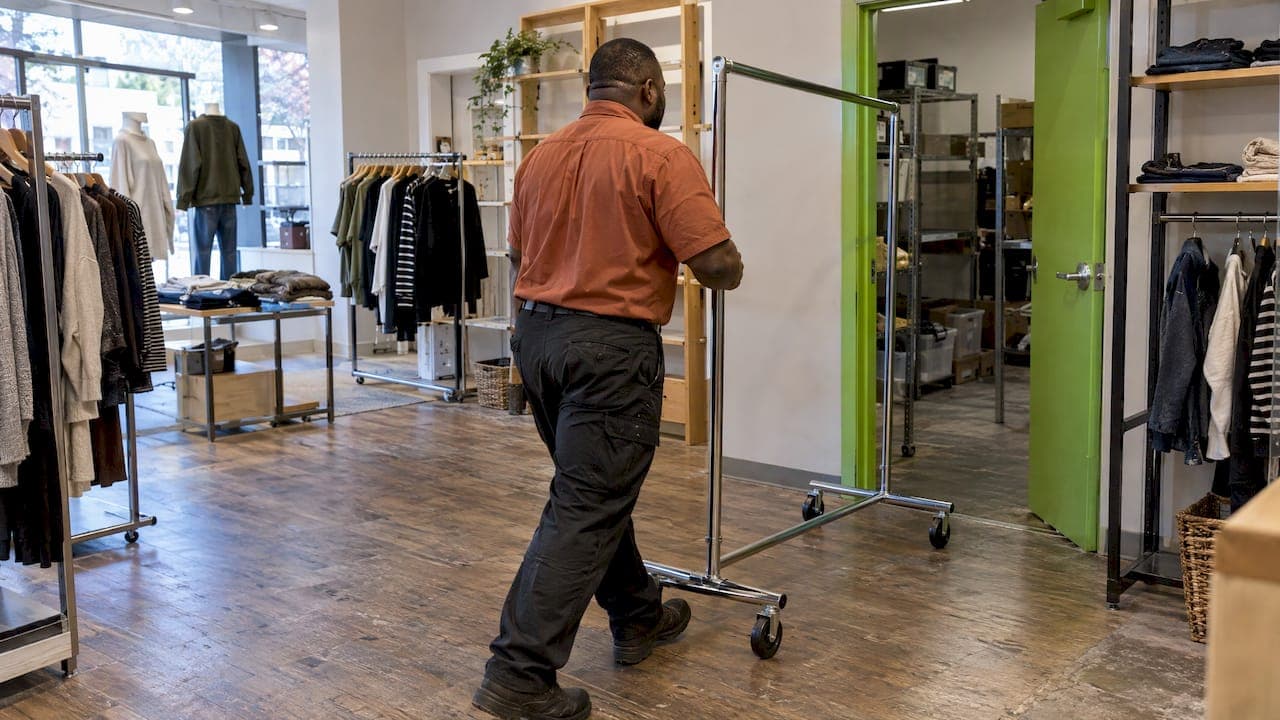
A retail store cleanout means clearing everything the next tenant or the landlord does not want: leftover inventory, shelving, fixtures, counters, back-room clutter and trash. The job goes fastest when you decide what is sold, donated, recycled or hauled before the crew arrives, and when you sort out hazardous stock and data-bearing equipment first. This guide walks through the order we recommend, from lease terms to final sweep.
TL;DR
- Read your lease first. Most leases require the space returned empty and "broom clean," and that standard sets the scope of the job.
- Sort into four piles before anyone hauls: sell, donate, recycle, dispose. Pull anything that could be hazardous waste (aerosols, batteries, paint, bulbs, chemicals) out of the general pile.
- Wipe or remove data from copiers, registers and computers before they leave the building.
- Book one haul for fixtures and junk after the sellable items are gone, so you pay to remove only what is left.
- A local, insured crew can clear most small and mid-size stores in a single visit and handle donation and recycling for you.
Table of Contents
- What a retail store cleanout actually covers
- Start with the lease, not the dumpster
- Sort before you haul: sell, donate, recycle, dispose
- Retail waste you cannot just throw away
- Protect your data before equipment leaves
- The retail store cleanout checklist
- Safety: when removal turns into demolition
- What happens to fixtures, furniture and appliances
- Our perspective
- Getting a quote for your store
- FAQ
- Sources
What a retail store cleanout actually covers
People use the phrase for several different situations: a store closing for good, a remodel, a lease turnover, a relocation to a smaller space, or a landlord clearing out after a tenant leaves. The work is similar in each case, but the deadline and the leftovers differ.
A typical retail cleanout includes:
- Unsold inventory and damaged goods
- Shelving, gondolas, wall displays, racks and mannequins
- Checkout counters, cabinets and back-room furniture
- Stockroom clutter, boxes, pallets and packaging
- Break room appliances such as refrigerators and microwaves
- Office equipment, signage and old electronics
- General trash and debris left in the space
What it usually does not include is construction work. Pulling out built-in walls, flooring or ceilings is demolition, and it follows different safety rules (more on that below). If your lease says to remove tenant improvements, plan that as a separate scope with the right contractor.
Start with the lease, not the dumpster
Before you schedule anything, find the surrender or return-of-premises clause in your lease. It tells you what condition the space must be in and by when. The most common standard is "broom clean," which in general means all personal property, debris and trash are removed and floors are swept, as this closing checklist describes. Your lease may say more, so treat the lease wording as final.
Check three things:
- Fixtures. Which shelving, lighting and counters belong to you, and which stay with the building? Removing a landlord's fixture can cost you your deposit.
- Deadline. Rent often runs until the day you hand back keys, so every extra day of clutter has a cost.
- Walk-through. Ask the landlord or property manager when they will inspect, and schedule the final haul at least a day before.
If you are closing the business entirely, the same checklist recommends talking with an attorney and an accountant before you announce a closure, and it lists the end-of-lease tasks that follow: cancelling utilities, licenses, permits and accounts once the space is handed back, then filing final tax returns and dissolving the entity. Those are your professionals' calls, not a junk crew's, so bring them in early.
Sort before you haul: sell, donate, recycle, dispose
The biggest cost mistake in a store cleanout is throwing everything into one pile. Anything that can be sold or donated should leave before the junk truck arrives, because you pay for what gets hauled.
Sell what still has value
Sellable inventory and good fixtures can often be marked down, sold to other shop owners or listed online. Shelving, display cases, racks and checkout counters in good shape tend to find buyers. Give this a firm cutoff, such as one week, so selling does not eat the time you need for the rest.
Donate usable items
Clothing, housewares, small furniture and unopened goods can go to local charities. Ask the charity what it accepts and whether it picks up, since many do not take large or damaged pieces. For furniture in the Boston area, our guide to furniture donation in Boston explains where to give and when to call for help. We donate and recycle whenever possible on our own jobs, so usable items in a cleanout do not have to end up in a landfill.
Recycle what can be recycled
Cardboard, metal shelving, wire racks and some electronics have recycling routes. Wood pallets and clean wood, plastics, used oil and used tires are treated by the EPA as separately collected streams rather than ordinary municipal trash, according to its municipal solid waste definition. In practice that means they often have their own recycling or disposal route, so ask your hauler how they handle them.
Dispose of the rest
Broken fixtures, damaged stock, worn-out furniture and mixed debris go to the haul-away pile. The EPA lists the kinds of everyday items that make up municipal solid waste: packaging, food scraps, furniture, clothing, appliances and batteries, in its municipal solid waste definition. Construction and demolition debris is generally treated as a different category, which is why a store buildout teardown is priced and handled differently from a stockroom clearout.
Retail waste you cannot just throw away
This is the part many store owners miss. Products that were perfectly legal to sell can become regulated waste when you discard them.
The EPA's retail strategy notes that once a decision to discard is made, the material becomes solid waste and the generator must determine whether it is hazardous, as laid out in its retail sector strategy under RCRA. The EPA has also listed examples of unsold retail items that may meet the hazardous waste definition if discarded, including aerosol cans, pool chemicals, mercury-containing lightbulbs, some pesticides, certain cleaning products, paint thinner, ammunition and fireworks, in a 2019 EPA letter on retail items.
California's toxics agency publishes similar guidance for retailers. It names spent batteries, expired over-the-counter medicines, bleach, detergents, fluorescent tubes, electronic devices, paint, ignitable liquids and aerosol cans as products that can become hazardous waste when discarded, in its retail industry guidance. That is California's program, so for a Massachusetts or New Hampshire store, use it as a prompt for what to look for and confirm the local rules with the state environmental agency or your town's hazardous waste program.
The practical rule: walk the stockroom with a clipboard before the haul and set aside anything with a warning label, anything pressurized, anything flammable, and anything with a battery or bulb. Do not let those items get mixed into a general junk load. Tell your hauler up front what is in the space so the crew can plan around it.

There is a useful flip side. The EPA's strategy recognizes that donation and liquidation can reduce waste and encourages recycling over disposal as hazardous waste, per the same retail sector strategy. Moving good stock out through sale or donation is often the simplest compliance step too.
Protect your data before equipment leaves
A store is full of devices that remember things. Registers, back-office computers, tablets, security recorders and copiers can all hold customer or employee information. The FTC warns that business copiers can store copied, printed, scanned, faxed or emailed information on hard drives, and that data security should be addressed when you return or dispose of one, in its copier data security guide.
Before anything goes on the truck:
- Back up what you need, then wipe or remove the storage on computers, registers and recorders.
- Ask the copier's lessor or manufacturer how to clear its drive before it is returned or discarded.
- Shred paper records you are not legally required to keep, and ask your accountant how long to keep the rest.
- Collect keys, fobs and access cards and note who has them.
The retail store cleanout checklist
Use this order. It keeps the job from stalling on surprises.
- Read the lease and note the return condition, deadline and fixture ownership.
- Talk to your attorney and accountant if the business is closing.
- Inventory the space room by room: sales floor, stockroom, office, break room, restrooms, storefront and any storage area.
- Sell or return what has value by a hard cutoff date.
- Pull out hazardous items and handle them through the proper local channel.
- Wipe data from copiers, computers and registers.
- Donate usable goods and small furniture, and schedule charity pickups early.
- Recycle cardboard, metal and electronics where routes exist.
- Book the junk haul for fixtures, furniture, appliances and everything left.
- Do the broom-clean pass once the space is empty: sweep, remove trash, check closets, ceilings tiles and loading areas.
- Walk through with the landlord, take dated photos, and return keys.
- Close out accounts: utilities, permits, licenses and subscriptions after handover.
For stockrooms or off-site units tied to the store, the same sorting logic applies. Our guide to storage unit cleanout explains how sorting first prevents pickup surprises.
Safety: when removal turns into demolition
Most cleanouts are lifting and loading, but the work still has hazards. OSHA notes that warehousing and refuse-handling workers face struck-by, caught-in, caught-between and falling hazards, and that being struck by material-handling equipment or vehicles is a named risk, in its regional emphasis program. Loading docks, pallet jacks and tight stockrooms are exactly where this happens.
If your plan involves tearing out walls, floors or ceilings, OSHA's demolition guidance says the work needs appropriate PPE, guarded wall openings, covered and secured floor openings, and a top-down approach to removing exterior walls and floors. It also warns that demolition carries added hazards from unknown factors such as hidden materials and structural weaknesses, so it requires advance planning, per the OSHA demolition and cleanup fact sheet. If a tenant-improvement removal is on your lease, hire a licensed contractor for that part and keep the junk crew focused on contents and fixtures that come out without structural work.
For your own staff, a simple rule helps: nobody lifts heavy shelving, safes or refrigerators alone, and nobody works the dock with a vehicle backing in.

What happens to fixtures, furniture and appliances
Fixtures are the bulk of the volume. Gondola shelving, slat walls, glass cases and counters are heavy and awkward, and they often need to be unbolted from the floor first. A crew with the right tools and enough hands does this faster and with less damage to the floor and walls, which matters when your deposit is on the line.
Other items worth planning for:
- Break room and stockroom appliances. Refrigerators, freezers and water coolers need proper handling because of their refrigerant. See our appliance removal page for what we take.
- Office furniture. Desks, filing cabinets and chairs add up quickly. Our piece on office furniture disposal options covers the routes available to facility managers.
- Store furniture. Benches, display tables, couches in fitting areas and storage units are covered by our furniture removal service.
- Trash and packaging. Mixed debris and overflowing bins can be handled with trash pickup service.
If you manage multiple spaces or you are a landlord taking back a unit, two guides may help: the landlord cleanout checklist for hitting a one-week turnover, and what to do when a tenant leaves junk behind.
Our perspective
We clear out homes and properties across Lawrence, Andover, Boston, Lowell and Haverhill, and retail spaces share the same pressure we see everywhere: a deadline, a landlord, and too much stuff.
Our advice is to decide early who owns the haul. When a store owner is also counting inventory, answering the landlord and winding down accounts, the physical cleanout is the task that slips. Handing it to a crew that is insured, shows up on a flexible schedule and offers same-day service takes the heaviest item off the list.
We also think the best cleanout is the one where as little as possible reaches a landfill. Our crew donates usable items and recycles whenever possible, and we work with local charities, so sorted goods have somewhere to go. Tell us what is in the space, including anything that looks hazardous, and we will plan the job around it.
Easy
Getting a quote for your store
We provide free quotes and an insured crew for junk removal, furniture removal, appliance removal and cleanouts for homes and businesses. For a store, send us a description or photos of the sales floor, stockroom and back office, tell us your lease deadline, and we will tell you what the job looks like and how soon we can schedule it. We offer same-day service where our schedule allows.
Start with our junk removal service page, or see everything we handle, from construction debris cleanup to estate cleanouts, on our services page. If you manage properties and need space turned over fast, our guide on junk removal for property managers shows how we keep turnarounds short.
FAQ
What is considered retail waste?
Retail waste is material discarded by stores and similar businesses. Much of it is ordinary municipal solid waste such as packaging, food scraps, furniture, clothing, appliances and batteries, according to the EPA. Some unsold products, like aerosols or paint thinner, can be hazardous waste once discarded and need separate handling.
How long does a retail store cleanout take?
It depends on the size of the space, how many fixtures are bolted down, and how much sorting is done beforehand. Many small and mid-size stores can be cleared in one visit when items are sorted and access is clear. Send us photos and your deadline and we will give you a realistic timeline.
Who is responsible for leftover items when a tenant moves out?
The lease usually controls this, and it commonly requires the tenant to return the space broom clean with all property and trash removed. If you are a landlord dealing with abandoned items, check your lease and local rules before disposing of anything, and see our guide on junk a tenant leaves behind.
Can unsold inventory be donated instead of thrown out?
Often yes. Usable clothing, housewares and small furniture can go to local charities, which the EPA's retail strategy recognizes can reduce waste, as described in its retail sector strategy. Check what each charity accepts before you schedule, and keep hazardous products out of donation loads.
What should I do about copiers and computers?
Clear the data before they leave. The FTC notes that business copiers can store scanned, printed and emailed information on hard drives, so ask the lessor or manufacturer how to wipe the drive, as explained in its copier data security guide.
Sources
- EPA: Municipal solid waste definition
- EPA: Strategy for addressing the retail sector under RCRA
- EPA: 2019 letter on unsold retail items
- California DTSC: Retail industry hazardous waste guidance
- FTC: Copier data security guide for businesses
- OSHA: Demolition and cleanup fact sheet
- OSHA: Regional emphasis program for warehousing and refuse handlers
- Store closing checklist and broom-clean standard