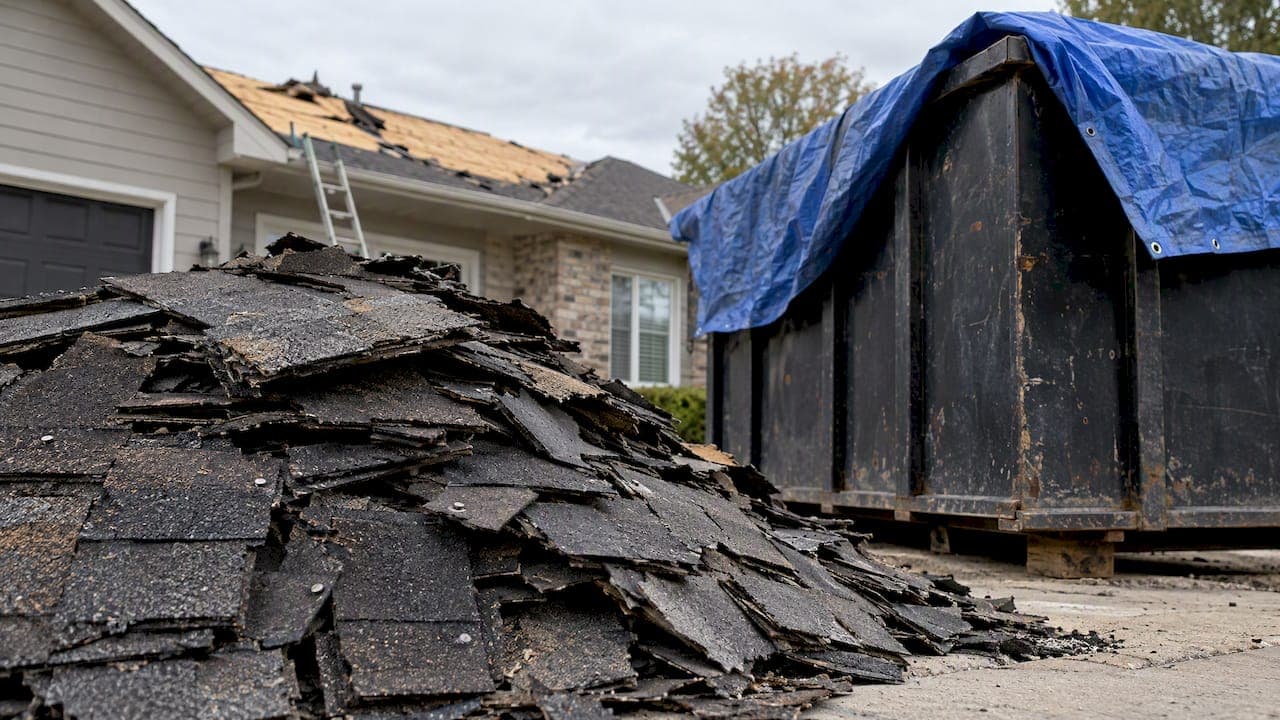
You have four realistic ways to get rid of old roof shingles: have your roofer handle them, rent a dumpster, take them to a transfer station or C&D facility yourself, or hire a junk removal crew to haul them. Recycling is possible in all four, but only if the shingles stay clean and separate from other debris. Which one fits depends on how much roofing you have, whether it is a tear-off or a few leftover bundles, and what your local facility accepts.
We haul debris for homeowners, landlords and Realtors in Massachusetts and New Hampshire, so this guide is written from that side of the job.
TL;DR
- Asphalt shingles can be recycled, mostly into pavement, but only through facilities that accept them. Call before you load anything.
- Keep shingles apart from wood, metal, trash and other roofing materials. Mixed loads are harder to recycle and may cost more.
- Massachusetts's construction debris waste ban does not list asphalt shingles, but individual facilities still set their own rules and fees.
- Older shingles, flashing, mastic and rolled roofing can raise asbestos questions. Ask the receiving facility what it requires.
- For a small job, a hauler is often the simplest route. For a full tear-off, ask your roofer what is included in the quote.
Table of Contents
- The main ways to dispose of old shingles
- Can asphalt shingles be recycled?
- Preparing shingles so they can be recycled
- Massachusetts: what the rules say
- New Hampshire: check your town first
- Can you take shingles to the landfill?
- What it costs
- Our perspective
- When hiring a hauler makes sense
- Need shingles or other debris hauled away?
- FAQ
- Sources
The main ways to dispose of old shingles
New Hampshire's environmental agency describes the basic routes for construction and demolition debris: separate it from household trash, then deliver it to a transfer station, use dumpster service, or let a demolition contractor take it. It also notes that some transfer stations sort asphalt shingles for recycling. That list maps neatly onto the choices below.
| Option | Best for | What to watch |
|---|---|---|
| Roofer takes them away | Full tear-offs | Confirm disposal is in the written quote, and ask where the shingles go |
| Rented dumpster | Large or multi-day projects | Keep shingles out of the mixed pile if you want them recycled |
| Drive them to a transfer station or C&D facility | Small loads, DIY jobs | Fees depend on the facility, and weight and truck access matter |
| Junk removal crew | Leftover bundles, partial tear-offs, garage or shed stockpiles | Tell the crew what the material is so it is sorted correctly |
| Reuse or donate | Unopened, undamaged bundles | Shed roofs, patch repairs, or a neighbor who needs a few bundles |
Let the roofer handle it
For a full roof replacement this is usually the default. The trade association for roofing manufacturers advises owners to talk to the roofing contractor about shingle recycling practices when the old roof comes off. Ask three plain questions: Is disposal included in the price? Will the shingles go to a recycler or a landfill? Will the crew keep them separate from other debris on the roof and in the truck or dumpster?
A roofer who does not know the answers is not necessarily doing anything wrong, but you should know before the job starts.
Rent a dumpster
A roll-off is practical when you have a whole house of tear-off. The weakness is mixing. Shingles, wood sheathing, nails, vent boots, plastic wrap and household trash tend to end up in the same box. Once that happens, the load goes to a general C&D processor, where materials are separated by type through hand and mechanical sorting and sent to whatever end use has a market. That can work, but a load of clean, separated shingles has a much better chance of being recycled as shingles.
Sorting also matters for what the dumpster company will accept. Ask whether they allow roofing in the box, what the weight limit is, and whether overweight charges apply. Shingles are heavy, and a small container fills by weight long before it fills by volume.
Drive them to a transfer station or C&D facility
This is the cheapest route for a small load if you have a truck and a free morning. New Hampshire's agency says fees vary by facility and may depend on material type, volume or weight, so check locally before you deliver. Call and ask:
- Do you accept asphalt shingles, and are they in a separate pile or bin?
- How do you charge: by the load, by weight, or by vehicle size?
- Do I need proof of residency, a sticker or a permit?
- Do the nails need to be removed? (Generally not for recycling, but confirm local requirements.)
- Do you ask for asbestos documentation on older roofs?
Tarps matter. Loose shingles blowing off a pickup are a hazard to the cars behind you.
Hire a junk removal crew
If you have a pile of leftover bundles beside the garage, a torn-off patch from a small repair, or a shed roof you replaced over a weekend, hauling is often easier than a dumpster. We handle this kind of work through our junk removal service and our construction debris cleanup. For more on what counts as construction debris and where it can go, see our guide to where U.S. homeowners and contractors can take construction debris.
Can asphalt shingles be recycled?
Yes. The industry's May 2026 technical bulletin says recycled shingles are typically ground for use in pavement. Other uses include roofing products, road maintenance, road base, pavers and erosion control. The bulletin also notes that many recyclers use magnets on their grinders to pull out nails, which is why homeowners generally do not need to pick them out.
The process is simple at its core. Tear-off is collected, sorted and ground. Wisconsin's natural resources agency says asphalt shingles must be ground before hot-mix asphalt plants can use them, and it encourages separating shingles at the job site. North Carolina's environmental agency describes several paths: shingles can arrive at asphalt producers already ground, pass through a permitted facility, or come directly from roofing contractors for processing at the plant.

One roofing manufacturer also runs its own program that collects tear-off and converts it into asphalt powder, briquettes and rock granules for use in roads, pavement and new shingles. Availability depends on where you live and who is doing the roof, so ask your contractor rather than assuming.
The word "recyclable" gets used loosely, and it helps to separate it from "biodegradable" when you read any disposal claim. This short explainer on biodegradable versus recyclable materials covers the difference. Shingles are not biodegradable. They are recyclable only when a facility with a market for them actually takes them.
Preparing shingles so they can be recycled
The trade association's guidance is to call the receiving recycler about its rules and keep shingles separate from other construction debris such as wood or metal. A few habits make a real difference:
- Sort on the ground. Drop shingles into their own pile or container as they come off the roof, not into the general debris heap.
- Keep out the extras. Wisconsin's agency lists wood, metal, cardboard, plastic packaging and nails among the contaminants of concern, along with flashing, fabrics, rolled roofing and mastic. Other roofing wastes can degrade pavement made with ground shingles.
- Keep them dry and covered if they will sit for days. This is common sense rather than a rule, and your facility may have its own requirements.
- Do not pull every nail. Confirm with the facility, but magnets usually handle them.
The asbestos question
This is the one part of shingle disposal that deserves real caution. Wisconsin's agency says shingles made before 1973 are an asbestos concern for recycling, and that grinding asbestos-containing material violates Clean Air Act restrictions. North Carolina requires shingles to be tested for asbestos before grinding by an appropriately accredited inspector or roofing supervisor. Those are other states' rules, but they show why a receiving facility may ask about your roof's age.
If your house is older, or the roof has layers of unknown age, tell the facility or hauler up front. If you suspect asbestos, do not break or grind anything yourself. Ask your state environmental agency or a licensed asbestos inspector what testing and handling is required before the work starts.
Massachusetts: what the rules say
Massachusetts bans certain materials from disposal at solid waste facilities under 310 CMR 19.017. MassDEP's FAQ lists the banned construction materials as asphalt pavement, brick, concrete, metal, wood and clean gypsum wallboard, and asphalt shingles are not on that list. The FAQ is dated June 2020, so check MassDEP for the current version.
That has two practical effects. First, a mixed load of shingles with wood or metal in it can still run into the ban, because those materials are listed. Wood sheathing and metal flashing from a roof job are the usual culprits. Second, because shingles themselves are not banned, whether they go to recycling or landfill is largely a matter of what your facility, hauler or roofer chooses to do and what it costs.
The market for recycled shingles exists in the state. ARMA's survey data says reclaimed asphalt shingles were used in 20 states in 2024 and that Massachusetts was among those reporting use every year from 2014 through 2024. If you want the shingles recycled, ask for it by name.
A related note for the same project: drywall and paint often come out during roof-adjacent repairs, such as ceiling damage from a leak. We cover those separately in our guides to drywall disposal and legal paint disposal in Massachusetts.
New Hampshire: check your town first
In New Hampshire, much of the practical answer sits with your town's transfer station. The state's guidance says construction debris should be separated from household trash and that fees and acceptance differ by facility. Some stations take shingles in a dedicated area, some charge by weight, and some send roofing to a larger C&D processor. A two-minute phone call to the station tells you more than any general guide can.

Can you take shingles to the landfill?
Often you can, but you should not assume it. Whether a particular landfill, transfer station or curbside program takes shingles is set locally, and many facilities treat roofing as construction debris with its own fee. Municipal trash programs commonly exclude construction debris from regular pickup, so do not set a tear-off at the curb without asking your town first.
Where shingles are allowed in the trash stream, recycling is still the better outcome when a recycler is within reach, because it keeps the material out of the disposal stream and into pavement or other products. Cost is the deciding factor for most people, and it varies by facility, so compare a recycler's price with the landfill price before you choose.
What it costs
We do not publish fixed prices for roofing debris, because the load decides the cost: weight, access, how much sorting is needed and where it has to go. Facility fees are set by each facility, and hauling is quoted per job. For a broader view of budgeting, our construction debris removal cost guide walks through the factors. Free quotes are how we handle it: send us the details and photos, and we tell you the price before the crew arrives.
Our perspective
Most shingle problems we see are not about the shingles. They are about timing and mixing. A roofer finishes, the dumpster is full of everything, and a homeowner is left with a few leftover bundles, a torn tarp and a stack of old flashing in the driveway.
Our view is simple. Decide who handles the debris before the work starts, and get it in writing. Keep shingles separate from the beginning. Be honest about the age of the roof, because that is the one detail that can change how the material is handled. When something is still usable, such as unopened bundles, we try to donate or reuse it before we recycle or dispose of it. We work with local charities for that reason, and we recycle wherever a facility will take the material.
We are also honest about limits. If your project is a full roof replacement, your roofer should be handling the tear-off. We are the right call for what is left over, for cleanouts of garages, sheds and basements where old roofing material has been sitting, and for properties being prepared for sale.
— Easy
When hiring a hauler makes sense
There are a few situations where we are usually the easiest option:
- You have leftover bundles or torn-off sections and no truck.
- A landlord or investor needs a property cleared fast, including roofing scraps, old furniture and yard waste.
- An estate or garage cleanout turned up old roofing material with everything else.
- A renovation produced mixed debris and you want one crew to take it all. Our guide to renovation cleanup options compares the approaches.
Contractors with regular volume have different needs, and we cover those in our guide to junk removal for contractors.
Need shingles or other debris hauled away?
EasyScrap serves Lawrence, Andover, Boston, Lowell and Haverhill, with insured crews, flexible scheduling and same-day service for many jobs. Tell us what you have, and we will sort it, donate or recycle what we can, and haul the rest. Request a free quote on our junk removal page.
For larger jobs involving several kinds of material, see our full list of services.
FAQ
How do I dispose of roof shingles?
Start by deciding who is responsible: your roofer, a dumpster company, a hauler or you. Keep the shingles separate from other debris, then call the receiving facility to confirm it accepts them and how it charges. Recycling is the preferred route where it is available.
Is asphalt shingle recycling available in Massachusetts?
Yes, reclaimed asphalt shingles have been used in Massachusetts pavement every year in the industry's survey from 2014 through 2024. Availability for a single homeowner depends on the facility or contractor you use. Ask your roofer or hauler where the shingles are going.
Do I need to remove nails from shingles before recycling?
Usually not. The industry's technical bulletin says nails generally need not be pulled and notes that many recyclers use magnets to remove them. Confirm with the specific facility, since requirements differ.
Can I take shingles to the landfill?
Sometimes. Massachusetts's construction debris ban does not list asphalt shingles, but each landfill or transfer station sets its own acceptance rules and fees. Call first, and keep wood and metal out of the load.
What if my roof is very old?
Tell the facility or hauler before anything is moved. Older shingles, flashing and mastic can raise asbestos concerns, and some facilities require documentation or testing. Ask your state environmental agency or a licensed asbestos inspector if you suspect it.
Sources
- New Hampshire DES: Construction and Demolition Debris
- ARMA technical bulletin on asphalt shingle recycling
- ARMA: Asphalt Shingle Recycling
- Wisconsin DNR: Recycling Residential Asphalt Shingles
- NC DEQ: Asphalt Shingles
- GAF: Asphalt Shingles Recycling
- RecyclingWorks Massachusetts: Construction Materials
- MassDEP: C&D Materials Waste Ban FAQ