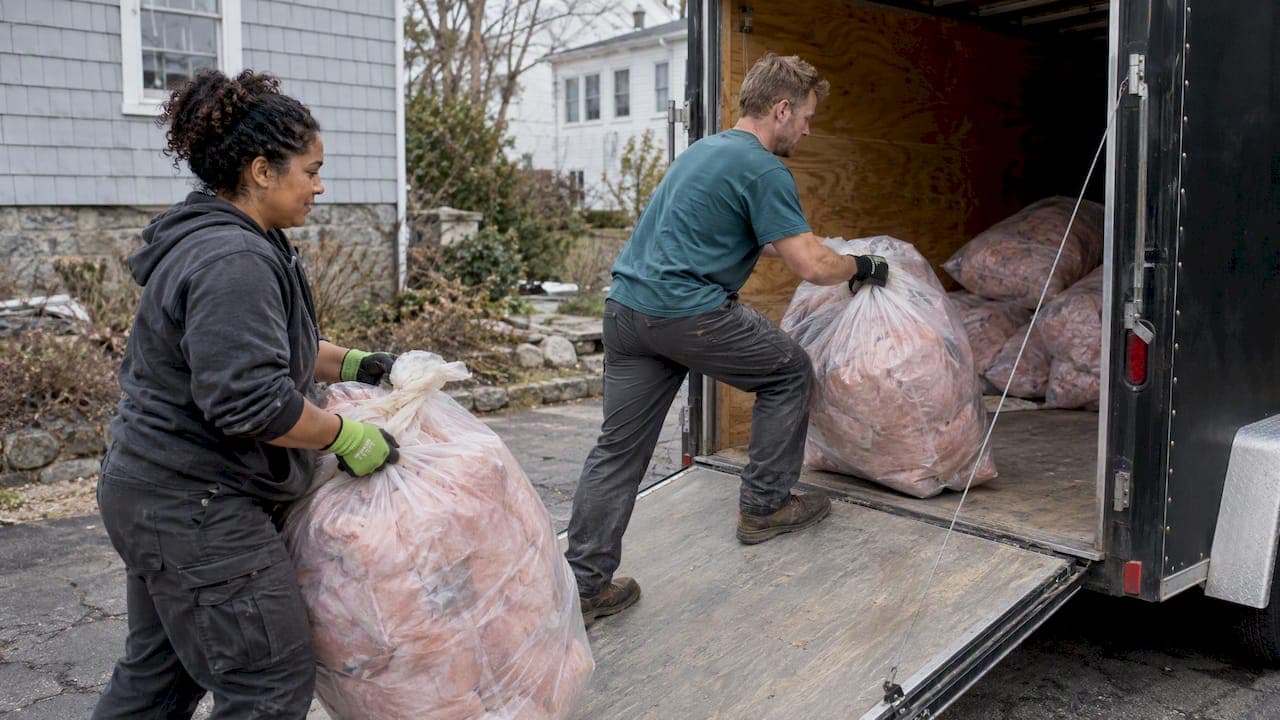
You have three realistic ways to get rid of old insulation: bag small amounts and put them in your trash if your town allows it, haul larger amounts to a landfill or transfer station that accepts construction and demolition (C&D) debris, or hire a hauler to do the lifting and driving. Which one fits depends on how much you have, what kind it is, and what your town or transfer station says. The one thing to settle before any of them is whether the material could contain asbestos.
TL;DR
- Small amounts of fiberglass or cellulose can usually go out with household trash, double-bagged in heavy plastic. Hennepin County's disposal guide says the same, but your local rules decide.
- Large amounts belong at a landfill or transfer station that takes C&D debris. In New Hampshire, the state environmental agency lists non-asbestos insulation as C&D.
- Old vermiculite (loose, pebble-like, gray-gold) may contain asbestos. Do not disturb it. Only licensed companies should sample and remove it.
- Wear gloves, long sleeves, eye protection and a respirator while handling fiberglass, and bag it as you go.
- If the load is big, awkward or tucked in an attic, a hauler can remove and dispose of it for you.
Table of Contents
- First, work out what kind of insulation you have
- Option 1: Bag it and put it in the trash
- Option 2: Haul it to a transfer station or C&D landfill
- Option 3: Rent a dumpster for a bigger project
- Option 4: Hire a junk removal crew
- Safe handling: what to wear and how to clean up
- What to do if you suspect asbestos or contamination
- Can insulation be recycled or reused?
- Which option fits your job?
- Perspective: why we handle insulation as part of cleanouts
- Get the insulation, and everything around it, hauled away
- FAQ
- Sources
First, work out what kind of insulation you have
The material decides the rules, so identify it before you pull anything out.
Fiberglass batts and rolls. Pink, yellow or white, itchy, usually paper- or foil-faced. This is the most common material in New England attics, walls and basements.

Loose-fill fiberglass or cellulose. Fluffy, blown into attic floors. Cellulose is gray and made from recycled paper. Fiberglass loose-fill is lighter and more like cotton candy.
Spray foam and rigid foam board. Pressed into walls or glued to basement foundations. These are bulkier and behave differently from fluffy insulation, so ask your transfer station how it wants them.
Vermiculite. Pebble-like granules, often gray-brown or gold, poured between attic joists in older homes. Hennepin County warns that old vermiculite may contain asbestos, and that suspected asbestos insulation should only be sampled and removed by licensed companies.

If you see vermiculite, stop. Leave it where it is, keep the attic closed off, and call a licensed asbestos professional for testing. Do not bag it yourself and do not hand it to a general junk hauler.
Option 1: Bag it and put it in the trash
For a small job, such as a section of a wall you opened or a few batts from a closet, household trash is often the simplest route. Cellulose and fiberglass insulation may go in the garbage, according to Hennepin County's guide. That is one county's guidance, though. Many towns in Massachusetts and New Hampshire cap bag size, require pay-per-bag stickers, or treat renovation debris separately from household trash.
Before you put anything at the curb, call your town's public works or solid waste office and ask three questions:
- Is insulation accepted in curbside trash, and in what quantity?
- Do I need official trash bags or stickers?
- Is there a bulky waste or renovation debris rule I should know about?
How to bag it so it stays put:
- Use thick contractor bags rather than kitchen bags. Fiberglass shreds thin plastic.
- Fill each bag about half to two-thirds full so you can seal it without squeezing fibers out.
- Seal the bag, then put it inside a second bag. San Jose's recycling guide recommends this double-bagging for loose-fill fiberglass.
- Get the bags out of the work area quickly. CertainTeed's disposal guidance advises collecting unusable insulation in large, durable bags, sealing them securely and removing them promptly.
Do not compact the bags by stomping on them. That is how fibers escape.
Option 2: Haul it to a transfer station or C&D landfill
Once you have more than a few bags, trash pickup stops being practical. Hennepin County, among other agencies, says large quantities should go to a landfill or transfer station that accepts construction and demolition debris. Our guide to how a landfill differs from a transfer station explains what happens at each stop.
In New Hampshire, the Department of Environmental Services says C&D should be separated from household trash before disposal at a transfer station, through a dumpster service or via a hired contractor. It lists non-asbestos insulation as C&D. It also notes that many transfer stations accept mixed C&D, that fees vary by facility and can depend on material type, volume or weight, and that open burning of trash and C&D is illegal in the state.
What to expect at the gate:
- Residency or permit rules. Many municipal transfer stations serve only residents, sometimes with a sticker or permit.
- Fees by volume or weight. Ask what a pickup truck load costs before you load up.
- Separate bins. Some sites have a C&D bin distinct from the household trash compactor.
- Bagging requirements. Some want bagged insulation, others want it loose in the bin. Ask first.
Other states set their own limits. In Missouri, for example, state guidance says regulated nonhazardous C&D waste, including insulation, generally cannot be burned or buried except in a permitted landfill, and that municipalities and counties may add stricter requirements. The takeaway applies anywhere: your local rules can be tighter than the state's.
For transport, keep bags covered with a tarp or in an enclosed trailer so they do not shed on the road. Fiberglass bags are light but bulky, and an open pickup bed at highway speed will lose them.
Option 3: Rent a dumpster for a bigger project
If insulation is one piece of a bigger gut job, with drywall, flooring and framing coming out too, a dumpster lets you toss material as you work instead of staging bags in the yard. It suits a long project, but you will pay for the rental period and the weight, and you still have to load every bag yourself. Before you order one, check whether your street or HOA permits it, and ask what the container may not hold.
Our article on what counts as construction debris and where it can go walks through how to sort a mixed renovation load, and the one on drywall disposal covers the material that usually comes out right next to insulation.
Option 4: Hire a junk removal crew
This is the route when the insulation is in a tight attic, a crawl space, or a basement ceiling, or when you simply do not want fiberglass on your skin. A crew loads the bags, hauls them off, and handles drop-off at an appropriate facility, so you skip the gate fees, the truck rental and the lifting.
Hiring out makes the most sense in these situations:
- You are cleaning out an attic or basement and the insulation is mixed with boxes, old furniture or other debris.
- You are a landlord or investor turning over a property on a deadline.
- You are an older homeowner, or helping a parent, and climbing an attic ladder with heavy bags is not safe.
- You pulled out insulation after a leak or pest problem and do not want to handle it again.
Tell the crew what the material is before the visit. Photos help. If you suspect vermiculite or any asbestos-containing material, get it tested first, because that material needs a licensed professional and not a standard hauling job.
Safe handling: what to wear and how to clean up
Fiberglass will not hurt you with one careful afternoon of handling, but it will irritate skin, eyes and airways if you are sloppy. The Illinois Department of Public Health recommends long-sleeved, loose-fitting clothing, cut-resistant gloves, an N95 respirator and safety goggles. CertainTeed's guidance adds a head covering and ventilating the area.
A workable routine:
- Dress before you go into the space: loose long sleeves and pants, a hat, gloves, goggles, N95.
- Open windows or run a fan to move air out, not into the rest of the house.
- Lift batts rather than dragging them, and bag them immediately.
- Clean up with a HEPA-filtered vacuum. A regular shop vacuum can blow fine fibers back into the air. Both the Illinois fact sheet and CertainTeed point to HEPA vacuums for cleanup.
- Wash exposed skin with soap and warm water, and launder work clothes separately, as the Illinois health department advises.
If you develop persistent breathing trouble, a rash that does not clear, or eye irritation that lingers, see your doctor.
What to do if you suspect asbestos or contamination
Most modern fiberglass and cellulose does not contain asbestos. Vermiculite from older homes is the main concern. If your attic has loose gray-gold granules, or you cannot tell what you have, do this:
- Do not sweep, vacuum, or bag it.
- Keep people and pets out of the space and avoid running the attic fan or HVAC through it.
- Have a licensed asbestos professional test it. Hennepin County says only licensed companies should sample and remove suspected asbestos insulation.
- Follow their disposal instructions. Hazardous waste goes to a licensed or permitted facility, often through a licensed transporter, as Wisconsin's demolition guidance describes.
In New Hampshire, DES notes that a transfer station or disposal facility may require specific testing if your C&D could contain hazardous materials. Mold-soaked or contaminated insulation after a flood or fire is another case to raise with your town or facility before you haul it.
Can insulation be recycled or reused?
Recycling fiberglass is still patchy. CertainTeed advises asking your local solid waste authority or disposal site whether it takes fiberglass for recycling, since some regions do. The same page says the National Insulation Association is researching ways to turn fiberglass into acoustic and thermal materials, which could widen access over time.
So for most households the realistic answer is proper disposal at a C&D facility, not a recycling bin. Where recycling does matter is the replacement. If you are replacing what you pulled out, you can look at fiberglass insulation upgrades for better comfort and efficiency, and San Jose's guide points out that natural fibers such as cotton and wool and cellulose are options too.
Usable material is a different story. Unopened or clean, dry batts left over from a project may be worth offering to neighbors or a reuse center. Wet, moldy or compressed insulation is not worth saving.
Which option fits your job?
| Situation | Best fit | Watch for |
|---|---|---|
| A few batts from one wall | Double-bag, put in trash if your town allows | Bag limits, stickers |
| A garage or shed of leftover rolls | Transfer station C&D bin | Resident permit, fees |
| Whole attic, tight access | Junk removal crew | Test unknown granules first |
| Full renovation with drywall and framing | Dumpster or hauler | Permit for placement, weight |
| Vermiculite or suspected asbestos | Licensed asbestos professional | Do not disturb |
Perspective: why we handle insulation as part of cleanouts
Most people who call us about insulation are not really calling about insulation. They are standing in an attic or basement full of years of stuff, and the insulation is the part nobody wants to touch.
We are a local crew serving Lawrence, Andover, Boston, Lowell and Haverhill, and we are insured. That matters when the job involves ladders, tight spaces and bulky bags. Our approach is to take the whole space in one visit: the insulation, the boxes, the old furniture, the broken appliances. Our attic cleanouts and basement cleanouts are built around exactly that.
We also try to donate and recycle whenever possible, so usable items do not end up in a landfill. For insulation itself, we think the honest answer is to send it where local rules say it belongs, and to tell you early if something looks like it needs testing first.
Easy
Get the insulation, and everything around it, hauled away
If you would rather not crawl through an attic with contractor bags, we can do it. EasyScrap removes junk and cleanout debris for homes and businesses in Lawrence, Andover, Boston, Lowell and Haverhill. Same-day service is available, quotes are free, and our crew is insured.
Start with our junk removal service for a general haul, or see everything we handle, including construction debris and estate cleanouts. If you are tearing out a room, our guide to a pre-renovation cleanout shows how to plan the order of work.
FAQ
Can I put old fiberglass insulation in my regular trash?
Often yes for small amounts, if it is double-bagged in heavy plastic and your town allows it. Some agencies, such as Hennepin County, say fiberglass and cellulose may go in the garbage. Larger quantities generally need a C&D-accepting facility, so call your town's solid waste office first.
Where do I take a large amount of insulation?
Take it to a landfill or transfer station that accepts construction and demolition debris. In New Hampshire, non-asbestos insulation counts as C&D, and many transfer stations take it for a fee. Ask about permits, residency rules and how they want it packaged before you load.
How do I dispose of fiberglass insulation safely?
Wear gloves, long sleeves, goggles and an N95 respirator, and ventilate the space. Bag the material in sturdy contractor bags as you remove it, seal them, and clean up with a HEPA vacuum. Wash exposed skin and launder your work clothes separately.
How do I know if my insulation contains asbestos?
You cannot tell by looking, but loose gray-gold, pebble-like vermiculite in an older attic is the main warning sign. Do not disturb it. Have a licensed asbestos professional test it and remove it if needed.
Is insulation recyclable?
Sometimes. Some regions accept fiberglass at recycling facilities, but it is not widely available. Ask your local solid waste authority or transfer station. If there is no recycling program, proper C&D disposal is the standard route.
Sources
- Insulation, Hennepin County Green Disposal Guide
- Construction and Demolition Debris (C&D), New Hampshire DES
- Managing Construction and Demolition Waste, Missouri DNR
- Planning Your Demolition or Renovation Project, Wisconsin DNR
- Fiberglass fact sheet, Illinois Department of Public Health
- How to Properly Dispose of Fiberglass Insulation, CertainTeed
- Insulation (Loose-Fill Fiberglass), San Jose Recycles